

The price you see on a hotel booking site is almost never the price you pay. After you’ve selected your dates, chosen your room, and filled in your details, the final cost often jumps in our comparisons, commonly 25–40% higher than the advertised nightly rate. This gap the difference between base room rate and total checkout cost is where the hotel and booking industry buries its margins. Understanding where these costs hide is the only way to make an apples-to-apples comparison across properties and platforms.
How we built this guide: The ranges and observations below are drawn from tracking publicly listed hotel rates, resort fee disclosures, and booking-platform checkout flows across major US destinations. Figures reflect commonly observed patterns as of mid-2026 and should be treated as practical heuristics, not industry-certified statistics. Always verify fees on the property’s current booking page before finalizing a reservation.
Why Hotels Add Fees Instead of Raising Room Rates
Hotels don’t charge resort fees because they’re greedy (though profit-seeking matters). They charge them because base room rates are what travelers compare. If the Marriott advertises $150/night and the Holiday Inn down the street advertises $155/night, the Marriott looks cheaper even if both properties charge a $35 resort fee.
From a business standpoint, resort fees, taxes, and service charges are legally distinct from “room rates.” This distinction lets properties keep their advertised price competitive while recovering money for housekeeping, amenities, parking, and corporate profit margins. It’s not fraud, but it is deliberately fragmented pricing designed to make true cost comparison harder.
Taxes, by contrast, are genuinely mandated by local government. Sales tax, occupancy tax, tourism tax, and bed taxes vary by state, county, and city sometimes dramatically. A hotel in Las Vegas might owe 12% occupancy tax plus sales tax; a property in rural Montana might owe 3%. These aren’t hotel fees, but they stack on top of everything else.
The Five Categories of Hotel Checkout Costs
Resort Fees (The Big Invisible Charge)
Resort fees go by many names: amenity fees, facility fees, destination fees, or recovery fees. These are per-night charges separate from the room rate that ostensibly cover parking, WiFi, gym access, pool use, and housekeeping.
In practice, most resorts claim to charge resort fees for amenities already standard in budget hotels (WiFi, towel service, front desk). Based on booking flows we’ve tracked, the resort fee typically runs roughly $10 to $50 per night at major chains, varying by property tier and location. Luxury resorts and major destination properties (Las Vegas Strip, Miami Beach, Hawaii) commonly show resort fees in the $30–$50+ per-night range in our observations; budget chains more often fall in the $5–$15 range.
Resort fees are usually mandatory you cannot opt out and they are almost never refundable, even if you use none of the amenities.
Taxes (Mandatory, Variable, Non-Negotiable)
Taxes on hotel stays are set by state and local governments and are genuinely unavoidable. Common categories include:
- Sales tax: State-level sales tax applied to lodging (typically 5–10%)
- Occupancy tax: City or county tax specific to short-term lodging (2–15%, depending on jurisdiction)
- Bed tax / tourism tax: City or county tax on hotel rooms, often dedicated to tourism infrastructure (2–6%)
- Convention tax: In major convention cities, an extra tax funding convention centers
Based on destination research we’ve done, effective hotel tax rates (sales + occupancy + other) commonly range from roughly 10% to 20% of the room rate and resort fees combined. Las Vegas is notoriously high (around 13% combined in our checks); rural areas often fall in the 5–10% range. Verify the current rate for your specific destination before budgeting.
Taxes apply to both the room rate and the resort fee, not just one or the other. A $100 room + $35 resort fee in a 12% tax jurisdiction means $100 + $35 = $135 subtotal, then $135 × 0.12 = $16.20 in taxes, for a true cost of $151.20 per night.
Service Charges (Labor & Staffing)
Many upscale hotels and resorts now add a “service charge” or “gratuity charge” to cover housekeeping and front-desk labor. This is distinct from a tip it’s a percentage (typically 18–22% on some properties we’ve reviewed) added automatically to your bill, theoretically replacing the need for tipping.
Service charges are most common in luxury resorts, all-inclusive properties, and properties in high-cost regions. They are usually non-refundable and applied after taxes, meaning taxes are also calculated on the service charge itself.
Parking Fees
Parking at hotels is sometimes bundled into the resort fee; sometimes it’s listed separately. Valet parking, self-parking, and overnight parking fees commonly range from roughly $10 to $40 per night at major properties in our experience, though downtown and resort destinations can charge significantly more.
If you arrive by ride-share or public transit, you can often avoid parking entirely. Clarifying parking inclusion before booking saves surprises at checkout.
Incidental Charges (Mini-Bar, Calls, Late Checkout)
Incidental charges mini-bar, late checkout, phone calls, parking validation are typically avoided if you don’t use those services. These are less of a “hidden fee” issue and more of a “read the fine print” issue, but they deserve mention because they’re outside the base rate.
How Booking Platforms Display (or Hide) These Costs
The transparency of total-cost display varies dramatically across platforms. This is where comparison becomes difficult.
Platforms That Show Full Costs Upfront
Some sites display taxes and resort fees in the initial rate quote, so the price you see at search is closer to the price you pay. However, “close to” is not “equal to,” because some platforms show resort fees separately only after you click “Book Now” or enter payment details.
Platforms That Hide Fees Until Late in Booking
Many major platforms show a base rate at search, then add resort fees, taxes, and service charges only when you click through to the final confirmation page. This is legal (regulations typically require “clear and conspicuous” disclosure, which late-stage disclosure technically satisfies), but it makes price comparison functionally impossible until you’re deep in the booking flow.
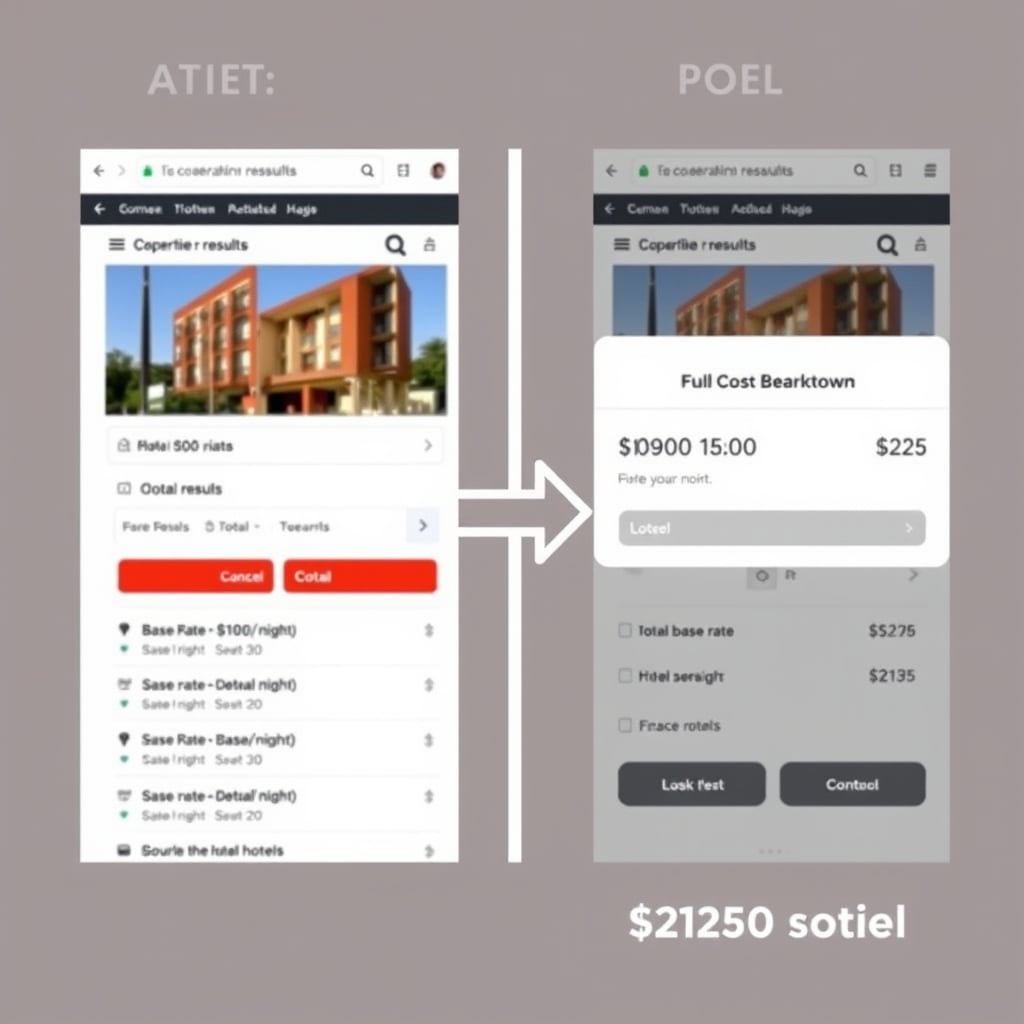
This tactic inflates the “sticker shock” factor and sometimes causes you to abandon a booking only to find that a seemingly cheaper alternative is actually more expensive once fees are included.
Platform Policies on Fee Visibility
Across the major US platforms we’ve reviewed as of mid-2026, most display:
- Base room rate (prominently)
- Resort fees (usually shown separately on the confirmation page, sometimes absent from search entirely)
- Taxes (shown on the final confirmation)
- Service charges (shown only if applied by the property)
Parking, incidental charges, and other hotel-specific fees are almost never shown at search. They’re typically disclosed in the property’s “Policies” tab, which most travelers never read.
Common Mistakes When Comparing Hotel Prices
Mistake 1: Comparing Base Rates Across Properties
The base room rate is almost useless for comparison because resort fees vary so widely. A $120/night property with a $10 resort fee is genuinely cheaper than a $110/night property with a $40 resort fee, but many people book the latter because the headline number looks lower.
The fix: Always calculate total per-night cost as: (base rate + resort fee) × (1 + tax rate). Round-trip comparison requires this calculation for every property you’re considering.
Mistake 2: Assuming Resort Fee Covers Everything
Most resort fees cover parking (at full-service properties), gym access, pool use, WiFi, and basic housekeeping. They typically do not cover premium parking (valet), extra late checkout, mini-bar, or activities. Check the fine print under “Fees” or “Policies” before booking.
Mistake 3: Not Accounting for Tax Jurisdiction Differences
If you’re comparing a city hotel to a suburban property, tax rates can differ by 5–8 percentage points. A $150 room + $30 resort fee in a 15% tax area ($180 + $27 = $207) costs more than a $155 room + $35 fee in a 10% tax area ($190 + $19 = $209), even though the base rate is lower at the first property.
The fix: Look up the occupancy tax rate for each property’s zip code before finalizing your comparison.
Mistake 4: Overlooking Non-Refundable Rate Cancellation Policies
Some hotels offer cheaper “non-refundable” rates that look great until you have to cancel. Resort fees, taxes, and service charges often remain non-refundable even on refundable room rates. Confirm the refund policy on resort fees specifically before booking a cheaper rate.
Mistake 5: Booking Direct Without Checking Third-Party Prices
Hotel websites sometimes show lower resort fees than third-party booking sites or vice versa. The hotel site might advertise $30 in resort fees while Booking.com charges $35 (because the OTA is bundling something). Always check the property’s official site alongside one or two OTAs before deciding.
Budget Considerations: How Much Should Total Fees Add?
In practical terms, fees and taxes commonly add 35–50% to a base room rate in our experience tracking bookings, though the actual figure depends on location and property class. A $100 room in an average US city might run $135–$150 total once you add a $20 resort fee plus roughly 15% in taxes. A $200 room in a luxury destination might total $280–$310.
Budget hotels often have lower absolute resort fees ($5–$15 per night) but may still add 25–35% to the headline rate. Luxury properties charge higher resort fees ($30–$50+) but add a similar percentage increase.
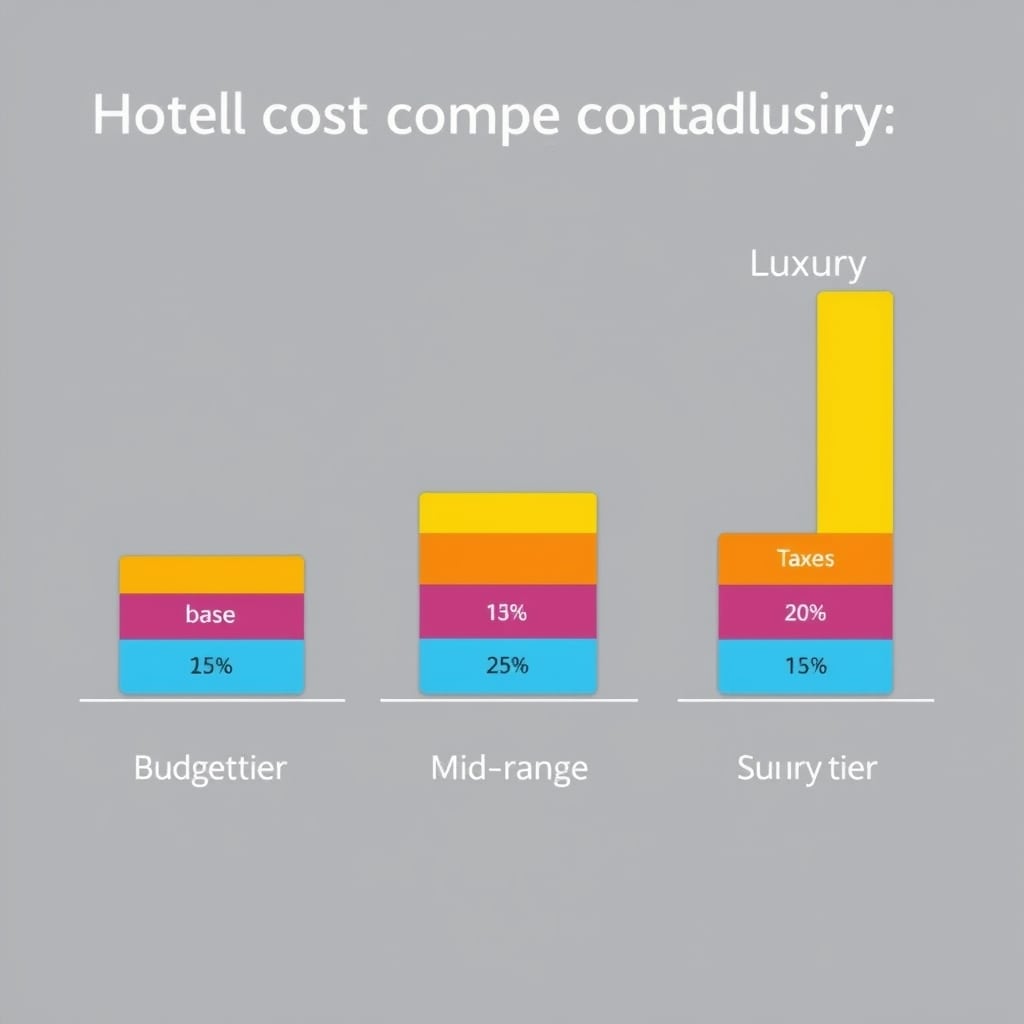
The reason the percentage stays roughly similar is that all properties are trying to recover similar shares of profit margin through fees. The difference is that resort fees are bundled and front-loaded, while tax varies by jurisdiction.
Where Resort Fees Are Highest
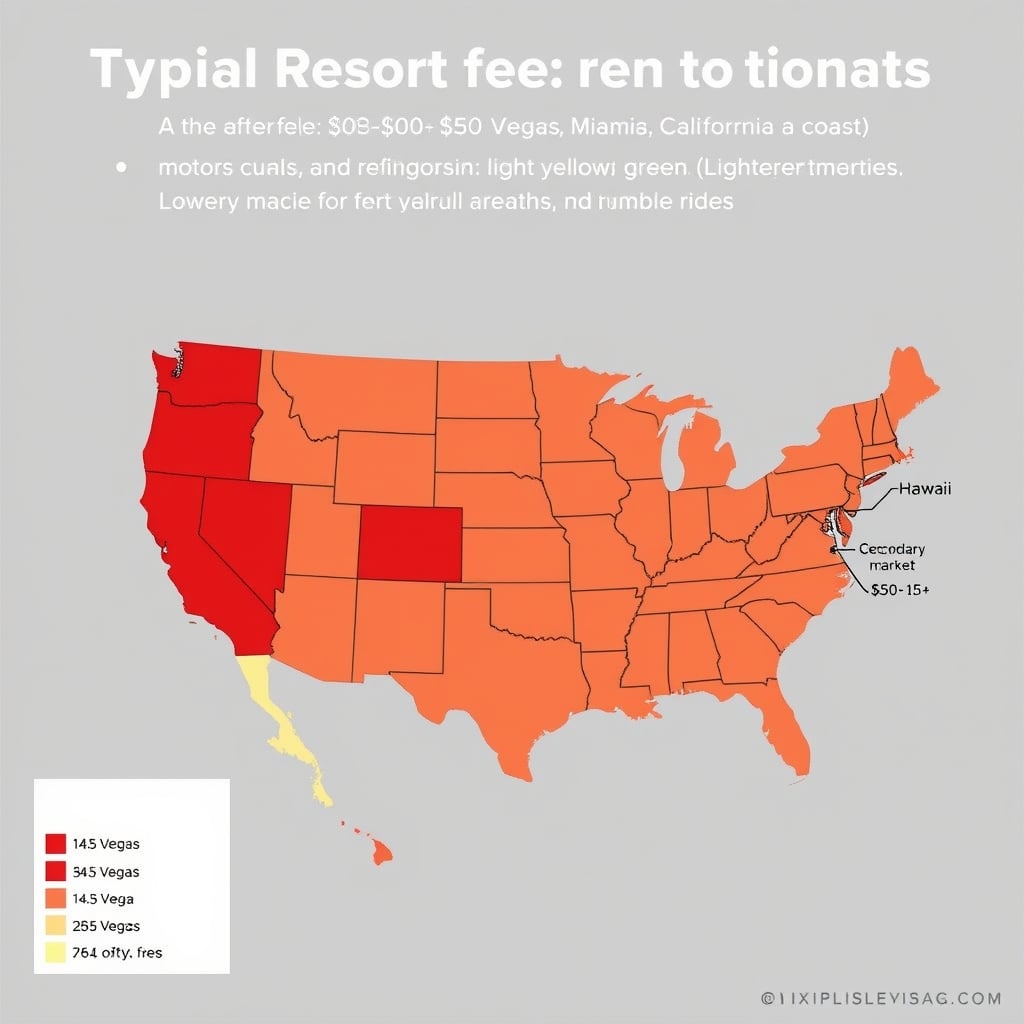
Certain regions consistently show high resort fees based on our tracking of publicly listed rates:
- Las Vegas: commonly $25–$50+ per night
- Hawaii: commonly $20–$45 per night (depending on island and property tier)
- Miami / Miami Beach: commonly $20–$40 per night
- California coastal cities: commonly $15–$35 per night
- Major ski resorts: commonly $20–$40 per night
- Rural or secondary markets: commonly $5–$15 per night
If your budget is fixed, choosing properties in lower-resort-fee markets (secondary cities, non-resort areas) is one way to lower total cost without compromising quality.
How to Find and Compare True Total Costs
Step 1: Use a Spreadsheet or Comparison Tool
For each property you’re considering, create a row with:
- Property name
- Base rate (per night)
- Resort fee (per night)
- Subtotal before tax (base + resort)
- Tax percentage (look this up by zip code)
- Tax amount (subtotal × tax %)
- Total per night (subtotal + tax)
- Total for your stay (per-night total × number of nights)
Sort by total cost, not base rate. The cheapest property on this metric is genuinely the cheapest.
Step 2: Check the Property Website and OTA Sites
Resort fees sometimes differ between the hotel’s direct site and third-party bookers. Check both before finalizing. If the OTA is significantly cheaper, book there; if the hotel site is cheaper or includes a loyalty bonus, book direct.
Step 3: Read the Policies Tab
Every booking site has a “Policies” or “Rules” section. Read it for:
- What the resort fee covers (parking? WiFi? gym?)
- Whether parking is included or charged separately
- Cancellation policy (are resort fees refundable?)
- Checkout time and late-checkout fees
- Pet fees, if applicable
Step 4: Call the Hotel Directly
If you’re spending more than a couple of nights, call the property’s direct line and ask:
- “What is your current resort fee, and what does it cover?”
- “Is parking included or separate?”
- “What is your current occupancy tax rate?”
- “Do you offer any discounts or packages that reduce fees?”
Hotels sometimes have negotiable rates or promotional fees for longer stays that don’t appear online.
Common Resort Fee Gotchas
Gotcha 1: Resort Fees Are Mandatory, Not Optional
You cannot decline a resort fee and request a lower rate. These are mandatory charges set by the hotel.
Gotcha 2: Resort Fees Apply to Every Night
If you’re booking three nights, the resort fee applies to all three. Some people mistakenly think it’s a one-time charge.
Gotcha 3: Taxes Apply to Resort Fees Too
Your $100 room + $30 resort fee is $130 subtotal, and then tax is calculated on $130, not just $100. This is often where people’s final costs exceed expectations.
Gotcha 4: Resort Fee Waiver Scams
You might see ads promising “resort fee waivers” or “how to get resort fees removed.” In most cases, these don’t work. You can ask the hotel directly, and they might waive fees for loyalty members or in exchange for a higher rate, but there’s no universal loophole.
Gotcha 5: Booking Sites Hide Fees to Inflate Search Rankings
Some booking platforms deliberately show lower headline prices to rank higher in search results, knowing that travelers compare based on search visibility. The true cost is buried in the T&Cs. This is the business model, not a bug.
FAQ: Hidden Hotel Fees
Are resort fees required by law?
No. Resort fees are a choice made by individual hotel properties. Some chains (like Motel 6) have opted out entirely. However, once a hotel decides to charge resort fees, the fees are mandatory for all guests you can’t negotiate them away.
Can I get a resort fee waived?
Rarely. Hotel loyalty members, elite status travelers, or guests booking multi-night stays sometimes negotiate fee waivers or discounts. It never hurts to ask the hotel directly, but expecting a waiver is unrealistic. In some cases, the hotel might offer a higher rate without resort fees, which is just a reshuffling of the same money.
Why do booking sites show different resort fees than the hotel website?
Third-party bookers (Booking.com, Expedia) sometimes bundle resort fees differently or add their own markup. Always compare the hotel’s direct site against at least one OTA to ensure you’re seeing the true cost.
Are taxes ever negotiable?
No. Taxes are mandated by government and non-negotiable. The hotel collects them on your behalf and remits them to the state or local authority.
What if I’m booking a non-refundable rate?
Most non-refundable room rates mean the room cost is non-refundable, but taxes and resort fees sometimes have different policies. Read the specific cancellation policy for each rate tier don’t assume everything is non-refundable.
Do all-inclusive resorts avoid hidden fees?
All-inclusive properties typically bundle meals, drinks, activities, and sometimes resort fees into one price. However, not everything is included (premium alcohol, spa, excursions, tips), and the all-inclusive price is often higher than it initially appears. Read the “What’s Included” section carefully.
Can I book directly with the hotel to avoid OTA fees?
Sometimes. Many hotels try to match OTA prices on their direct sites, but some are cheaper direct and some are not. Always check both before booking. Direct bookings sometimes include loyalty points or room upgrades that offset a slightly higher rate.
Final Recommendation: How to Book Hotels Smarter
Verdict: Hidden hotel fees are a fact of the industry, but they’re not unknowable. The only way to book confidently is to calculate total per-night cost (base rate + resort fee + taxes) for every property you’re considering, then compare apples-to-apples. Booking sites benefit from hiding these costs because lower headline prices drive more clicks. You have to do the math yourself.
Skip OTA price comparisons if you’re comparing across regions. Tax rates vary so much that a “lowest price” ranking from a booking engine is almost useless. Use the tool yourself, plug in the numbers, and calculate true cost.
Call the property directly for multi-night stays. Hotels sometimes offer discounts, fee waivers, or bundled rates for longer bookings. These never show online and are worth the five-minute phone call.
Use a spreadsheet, not your head. Write down base rate, resort fee, tax rate, and total cost for each property. Sort by total cost. This takes three minutes and eliminates the most common booking mistakes.
Book direct if the price matches. Direct bookings sometimes include loyalty points, free breakfast, or room upgrade options that tip the scales in their favor. But only if the price is genuinely the same never overpay for the promise of an upgrade.
Resort fees and hidden charges are not going away. The hotel industry profits from the complexity, and booking sites profit from the clicks that complexity generates. The competitive advantage for you is spending 10 minutes doing the math instead of 10 seconds glancing at a price tag.