


Hotel loyalty programs exist to lock you into one chain or booking platform by rewarding repeat stays with points, upgrades, and status perks but not all programs deliver the same value. For most frequent travelers, the best move is to pick one primary chain program where you can consolidate stays and reach elite status, then compare how that status translates to real benefits: free breakfast, room upgrades, late checkout, and point bonuses that compound over time.
What Actually Matters When Choosing a Loyalty Program
1. How Points Actually Convert to Cash Value
The headline “earn 10 points per dollar” means almost nothing without knowing what those points are worth. A point’s real value depends entirely on how you redeem it and hotels deliberately structure redemptions to make some paths much better than others.
Most major hotel chains publish a redemption chart that shows how many points equal one free night. Based on publicly available redemption charts as of August 2026, standard rooms typically require somewhere in the range of 10,000 to 50,000 points, depending on the chain and the property’s category. But here’s where most people stumble: the “points value” changes based on whether you’re redeeming at a budget property in a secondary market or a premium resort in peak season.
A more useful metric is cents per point the actual dollar value you’re getting when you convert points to a free night. If a hotel costs $150 per night and the redemption requires 15,000 points, your points are worth 1 cent each. If the same hotel costs $150 but requires 10,000 points, each point is worth 1.5 cents. The difference compounds over a year of travel. Based on commonly reported community benchmarks, most programs land in the 0.5–2 cents per point range depending on where and when you redeem treat that as a starting estimate, not a guarantee.
What to ignore: The headline “earn 10x points” during a promotion. Those bonuses are real, but they’re only valuable if you redeem at a property where your points translate to high cents-per-point value. A 5x bonus on a bad redemption is still a bad redemption.
2. Elite Status Thresholds and What You Actually Get
Elite status is the true profit center of hotel loyalty programs. Once you hit a tier Silver, Gold, Platinum, whatever the chain calls it you unlock perks that aren’t available to regular members, even if they have the same points balance.

Elite status is typically earned by meeting a night count (stay 20 nights in a calendar year, for example) or spending a dollar threshold ($3,000 in room charges). Some programs offer “elite night credits” as status boosts, and a few let you buy status outright that’s worth flagging because it changes the math entirely.
The real question is: what are elite perks actually worth? Free breakfast sounds good until you realize it’s only at certain properties and only for the cardholder, not traveling companions. A guaranteed room upgrade is valuable only if the property has better rooms to upgrade into. Late checkout by two hours is genuinely useful for business travelers who catch afternoon flights. Airline lounge access or a free airline incidental fee credit can be worth $100+ per stay if you’re actually using them.
Based on what frequent travelers consistently flag in loyalty forums and travel communities, the elite perks that most reliably drive long-term loyalty are: complimentary room upgrades (when available), free breakfast, late checkout, and point bonuses on elite stays. Elite qualifying night bonuses extra nights credited toward status let some travelers reach the next tier faster if they’re staying strategically.
What to ignore: Marketing language around “exclusive” perks. A “late checkout privilege” that only extends checkout to 2pm when your flight leaves at 5pm is theater. Test elite benefits against your actual travel schedule if you’re a 9-to-5 business traveler, 4pm checkout might matter; if you’re traveling on weekends, it doesn’t.
3. Spending Patterns and Status Velocity
Some programs reward nights stayed; others reward dollars spent. This matters enormously depending on how you travel.
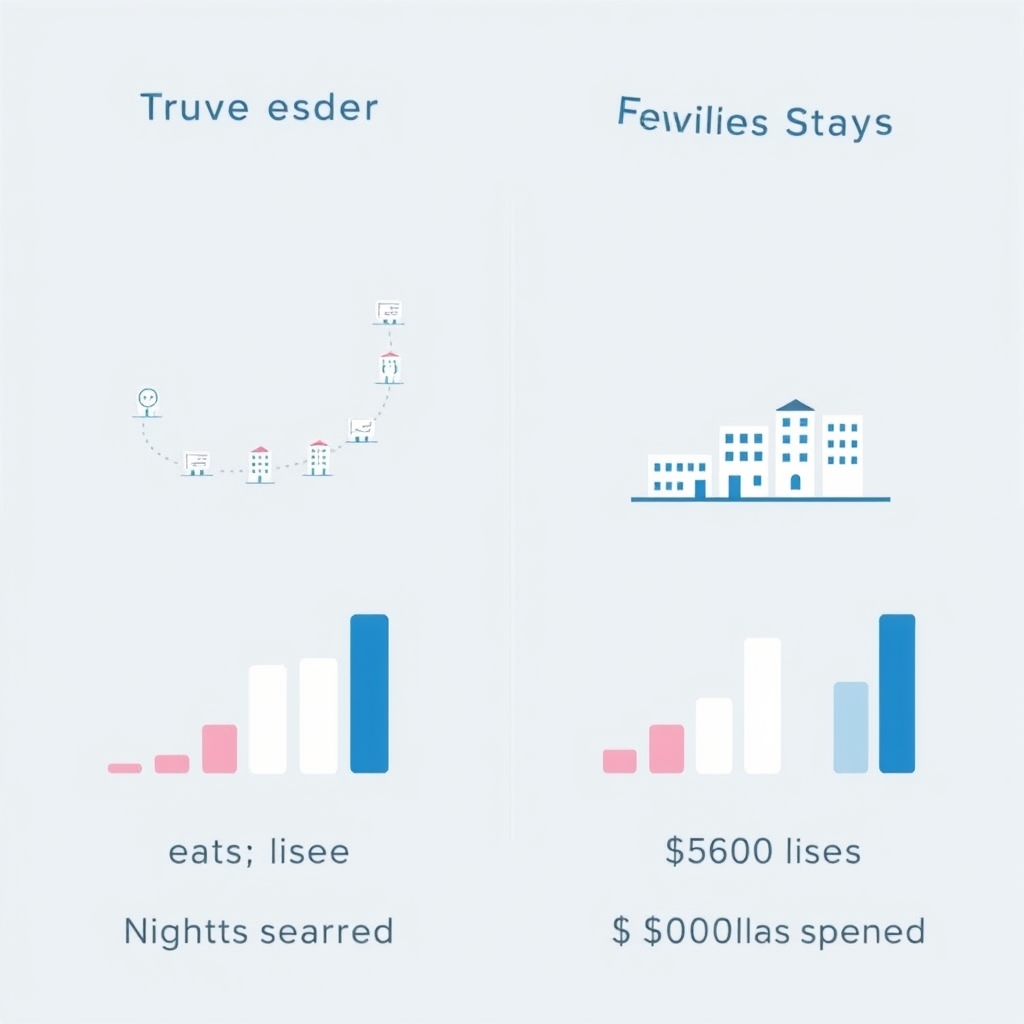
If you take four two-night trips to budget properties ($100/night), you’ll rack up 8 elite nights and $800 in spend. If you take two five-night trips to premium resorts ($250/night), you’ll have the same 10 nights but $2,500 in spend. A program that counts nights will favor the first traveler; one that counts dollars will favor the second.
Yet another variable: some programs award points based on the room rate (higher rate = more points), while others give a flat points-per-night bonus. The rate-based model rewards you for staying in premium properties; the flat model rewards you for staying frequently, regardless of price.
What to ignore: Elite status “fast track” promotions that require you to pay a fee to accelerate progress. Unless you’re trying to hit status for a specific trip, you can usually hit elite naturally through normal travel. The exception: if a program offers elite night credits during promotions, and you know you’ll recoup the value through elite benefits during that period, it might pencil out.
4. Redemption Flexibility and Award Availability
Points are only valuable if you can actually use them to book a room. Some programs allow you to search and book any property at any time; others restrict award availability, meaning the nights you actually want to travel aren’t bookable at points you’ll have to pay cash.
Programs with strict award blocking are effectively pricing you out of redemptions during peak travel windows. If the program shows zero availability for points redemption during summer weeks or major holidays, your points only work during off-peak travel, which limits your flexibility.
Some programs now offer “flexible redemption” or “points + cash” options, where you can pay part of the rate in points and part in cash useful when you don’t have enough points but want to stretch your balance. A few programs let you transfer points to airline partners, which can sometimes unlock better value than hotel redemptions if you’re strategic about it.
What to ignore: “Elite nights are always available” if the fine print says they’re only available Sunday to Thursday. That’s a real limitation hiding in marketing language.
5. Loyalty Program Stacking Across Ecosystems
Many travelers stay at multiple chains based on location and availability, which means one-program loyalty is often impossible. Some hotel companies own multiple brands Marriott owns Ritz-Carlton, St. Regis, Marriott, Courtyard, and others. Some programs let you earn toward status across all of those brands; others keep them separate.
Booking platforms like Expedia and Hotels.com also run loyalty programs that compete with hotel chain programs. Some people chase platform loyalty for cashback; others focus on chain loyalty for elite perks. The trade-off is real: a platform program might give you 10% cashback on every booking, but you won’t reach hotel elite status, so you lose breakfast and upgrades.
What to ignore: The assumption that you have to choose one program forever. Your loyalty strategy can shift based on travel patterns. If you’re taking four trips a year to different cities, chasing one chain’s elite status makes sense. If you’re taking 12 one-off bookings across different properties, a cashback booking platform might be better.
Price Tiers: What You’re Paying for
Hotel loyalty programs themselves are free to join, but the value you extract depends on your travel volume and how strategically you use the program.
Budget Traveler Tier ($0–$1,500/year in hotel spend)
You’re not hitting elite status, so you’re earning base points only. Redemption value is modest enough for one or two free nights per year if you’re accumulating responsibly. Membership cost: free. Real value is roughly 1–2% of what you spend, based on typical earn rates and redemption benchmarks in the 1-cent-per-point range. Best strategy: Join a program, earn passively, and redeem only on off-peak stays where award availability is high and the points-to-cash ratio favors you.
Mid-Range Frequent Traveler Tier ($1,500–$5,000/year)
This is where elite status becomes reachable and the program pays off. You’re likely hitting Silver or Gold status, unlocking free breakfast and the occasional room upgrade. If you stay 25–40 nights per year, elite status momentum compounds your elite night bonuses (often 10% of earned nights on higher tiers) accelerate you toward the next tier. Membership cost: free; many programs offer premium co-branded credit cards in the $95–$150/year range (verify current pricing with the issuer) that grant elite status immediately and add point multipliers. Real value: A premium card that grants status and layered point multipliers can meaningfully offset its annual fee in perks, though the actual dollar figure depends on how consistently you use the benefits.
High-Volume / Premium Traveler Tier ($5,000+/year)
You’re hitting Platinum or higher, accessing lounge access, guaranteed upgrades, complimentary suite upgrades at certain properties, and the highest point multipliers. At this tier, co-branded credit cards often waive annual fees or include travel credits that effectively pay for themselves. Some programs offer status match programs you can transfer elite status from a competing program or elite night credits purchased through promotions. Real value: Elite benefits alone can offset your card’s annual fee if you’re using upgrades, lounge access, and late checkout on most stays. Point accumulation at high multipliers means you’re effectively getting a meaningfully higher effective return on hotel spending once you account for elite bonuses commonly reported in the 4–6% range by frequent travelers, though your mileage will vary by redemption behavior.
Common Mistakes to Avoid
Chasing status for status’s sake. Reaching Platinum sounds impressive, but if the incremental benefits over Gold don’t match your travel style, you’re wasting energy. Audit what elite perks you actually use if you never eat breakfast and you’re fine with standard checkout times, elite status is just a status line on your profile.
Hoarding points without a redemption plan. Programs love when you earn points and never redeem you’re paying them money (through higher nightly rates or credit card fees) while they hold your points interest-free indefinitely. Set a redemption target and book consciously. Points that sit unused for years lose value as programs adjust redemption costs upward over time.
Ignoring award availability. An “incredible points rate” is only incredible if award rooms are actually bookable when you want to travel. Before committing to a program, search for award availability on dates you actually travel. If the calendar is consistently blacked out, the program’s earning efficiency doesn’t matter.
Overvaluing bonus point promotions. A 5x points bonus is only worth it if redemption value at target properties is strong. If you’re earning 50,000 bonus points but they’re only redeemable at budget properties where you get 0.5 cents per point value, you’ve earned $250 worth of hotel nights not the $1,000 the marketing suggests.
Paying for elite status without calculating ROI. Some programs let you buy status outright, typically in the $100–$200 range based on current program offerings verify before purchasing. Only do this if the elite benefits you’ll use during the remaining year are worth more than the purchase price. If you’re buying Platinum in November just to have it for two winter trips, calculate the value of upgrades and breakfast first.
Our Keeper
For most frequent travelers, the decision comes down to: Which single chain will you stay at most often, and does its elite status structure match your travel frequency?
You’ll find detailed reviews and comparisons of specific hotel loyalty programs including breakdowns of elite benefit value, point redemption analysis, and recommendations for co-branded credit cards in our complete hotel rewards guide on KeptList. That guide walks through the math for individual programs and helps you calculate your personal cents-per-point value based on your actual redemption behavior.
Frequently Asked Questions
How much are hotel loyalty points actually worth? Points typically convert to somewhere in the 0.5–2 cents per point range, based on commonly reported redemption benchmarks but your actual value depends on the program and which property you’re redeeming at. Calculate your own value by dividing the nightly room rate by the number of points required. A $150 room requiring 15,000 points is worth 1 cent per point; same room at 10,000 points is worth 1.5 cents per point.
Should I use a co-branded hotel credit card? If you spend $1,500+ annually on hotel stays and can justify the annual fee commonly $95–$150 for mid-tier cards, though you should verify current pricing with the issuer with the card’s perks (elite status matching, annual free night certificates, point multipliers), then yes. If you travel fewer than 10 nights per year, the card fee usually outweighs the benefits. Some programs also offer no-annual-fee versions with fewer perks; those can be worth it for passive earning.
Do elite benefits differ between hotel brands within the same company? Yes, significantly. Marriott Bonvoy elite status gives you different perks at a Courtyard than at a St. Regis, even though both are Marriott properties. Higher-end brands include more premium perks; budget brands offer fewer upgrades. Check the elite benefit chart before assuming your status travels seamlessly across all properties.
Can I use points from one program at another chain’s hotels? Most programs don’t directly transfer points to competitor programs. However, some let you transfer points to airline partners, and a few programs partner with other chains to accept points for redemption. Read the program’s transfer rules before assuming portability.
Is it worth spending strategically to hit elite status faster? Only if you have a specific upcoming trip where elite benefits (upgrades, breakfast, lounge access) will materially improve your experience. Otherwise, elite status compounds naturally through normal travel, and forcing it wastes money. The exception: if the program offers elite night credits during promotions, that can be a smart shortcut if you’re close to a tier.
Which program should I join if I travel to many different cities? If you’re staying at different brands across different cities, pick the program from the parent company that owns the most brands you use, or the program with the strongest co-branded credit card benefits (elite status fast-track, annual free night certificates). If you genuinely have no loyalty, focus on a booking platform’s loyalty program for cashback instead of chasing hotel status.