

Are you learning to create something or to certify a technical skill? Skillshare wins for creative-focused learners (design, illustration, photography, writing); Udemy wins for tech/business learners pursuing specific job skills or structured career development.
Both platforms teach. The difference is that Skillshare treats learning as a collaborative, portfolio-building experience you upload projects, get peer feedback, and join instructor-led communities. Udemy treats learning as structured content delivery you complete video modules, earn completion certificates, and move on. Neither is objectively better; the keeper depends entirely on what you’re trying to build.
Quick Comparison: Side-by-Side
| Feature | Skillshare | Udemy |
|---|---|---|
| Primary Focus | Creative skills (design, illustration, photography, writing, music production, crafts) | Technology, business, programming, marketing, IT certifications, and a wide range of personal and professional topics |
| Course Structure | Project-based lessons, typically 20–60 minutes, with hands-on assignments and community interaction | Lecture-based courses ranging from 2–50+ hours, organized into self-paced modules |
| Instructor Vetting | Community-driven marketplace with a relatively low barrier to becoming an instructor | Instructor application and review process; course quality still varies by instructor |
| Pricing Model | Subscription (often $30–40/year during promotions; approximately $180/year at regular pricing as of mid-2026) | Pay per course (frequent sales $10–15/course; regular list prices often around $180/course as of mid-2026) |
| Certificates | Course completion certificates (limited employer recognition) | Course completion certificates (limited employer recognition) |
| Lifetime Access | Available only while the subscription remains active | Lifetime access to courses purchased with a one-time payment |
| Community Features | Strong community with project sharing, peer feedback, and discussions | Basic Q&A section between students and instructors; limited community interaction |
| Mobile Experience | iOS and Android apps with offline downloads | iOS and Android apps with offline downloads |
What Each Platform Does Best
Skillshare: Built for Creative Iteration
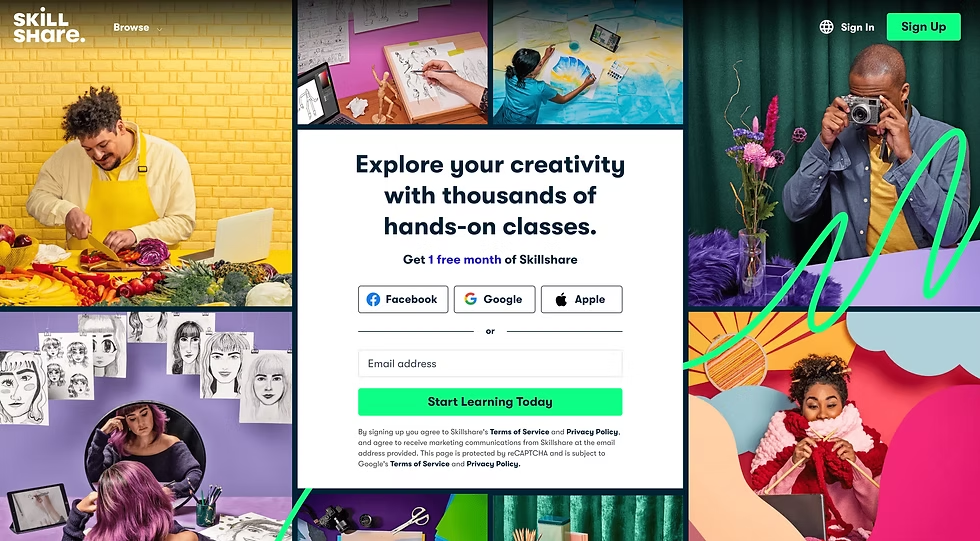
Skillshare is a subscription model where you pay once per year and unlock access to thousands of classes. Each class is deliberately short typically 20 to 60 minutes and centers on completing a creative project (a logo design, a watercolor piece, a short story, a beat in Ableton Live). You upload your project, classmates and the instructor provide feedback, and you refine based on that critique.
The instructor roster skews toward working creatives: illustrators, designers, photographers, and musicians with portfolios you can verify. The vetting isn’t as formal as Udemy’s, but the community itself is the filter if an instructor isn’t delivering, enrollment drops. This keeps quality relatively high within the creative niche.
The biggest strength is community engagement. Unlike Udemy, where learners typically work in isolation, Skillshare treats your learning as part of a cohort. That peer feedback and the obligation to give feedback in return creates accountability and accelerates skill-building in visual and creative fields.
Udemy: Built for Breadth and Depth
Udemy is a marketplace. You buy individual courses (often at a steep discount), and you own them forever even if you never log back in. Courses range from 2 to 50 hours, with video lectures, downloadable resources, quizzes, and coding exercises.
Udemy’s catalog is massive: programming, data science, business analytics, digital marketing, Excel, leadership, personal development, language learning, fitness, music production basically anything an instructor can package. That breadth is both a strength and a weakness. Instructors range from polished professionals with thousands of reviews to newcomers with five students.
The vetting process exists but is loose. Udemy requires instructors to submit courses for review and meet quality thresholds, but enforcement is uneven. That said, highly-rated courses (4.5+ stars with thousands of reviews) are generally solid; 3-star courses with 100 reviews are a gamble.
Lifetime access is the emotional draw. You buy a course, it’s yours. Skillshare’s subscription model means you lose access if you stop paying, which some learners find unsettling.
Head-to-Head Comparison
1. Course Quality & Instructor Expertise
Skillshare: Instructors are self-selected working creatives with visible portfolios. Classes are short and focused. The barrier to entry is lower, which means more variety but also more inconsistency. However, because Skillshare is smaller and design-focused, the median instructor quality is higher than Udemy’s overall catalog.
Udemy: Quality is all over the map. Some instructors web development and programming teachers in particular have built strong reputations on the platform, based on community reviews produce meticulous, well-structured courses. Beginner instructors often sound underprepared or deliver grainy video. You have to read reviews carefully: a 4.6-star course with 8,000 reviews is usually trustworthy; a 4.2-star course with 40 reviews might be hit-or-miss.
Win for creative learners: Skillshare. Win for tech/business learners: Udemy (because there’s enough high-quality supply to find genuine experts).
2. Course Pricing & Total Cost
Skillshare: Subscription model. Regular price runs around $180/year based on what’s typically displayed at signup, but Skillshare frequently runs promotions that bring the annual cost to roughly $30–$40. Once you’ve paid, you access the entire library. If you take 10 classes in a year, your per-course cost is $3–$4. If you take two classes, it’s $15–$20 per class.
Udemy: Pay-per-course. Full price is usually in the $180–$200 range per course, which is expensive. However, Udemy runs near-constant promotions most courses sell for approximately $10–$15. You own that course forever. If you take one course, you spend around $15. If you take 12 courses, you spend roughly $180.
Prices are approximate and based on publicly observed promotional patterns as of mid-2026; check each platform directly before purchasing.
The wrinkle: Skillshare’s upfront cost is lower if you’re a light learner (1–3 courses/year). Udemy’s is lower if you’re a heavy learner (8+ distinct courses/year) because you’re not paying for access to content you don’t use.
Win for budget-conscious learners taking few courses: Skillshare (cheaper upfront and no per-course commitment). Win for learners building a personal library: Udemy (no subscription, lower per-course cost at scale).
3. Certificates & Credential Weight
Both platforms offer completion certificates digital documents stating you finished the course. Neither carries institutional weight. Employers don’t treat them as credentials. They’re confidence markers, portfolio proof points, and résumé fillers, but they won’t help you pass an HR screening.
If you need a credential with external recognition (a degree, a bootcamp certificate, a professional certification like CompTIA or AWS), neither platform provides it. Coursera and some specialized platforms (like Google Career Certificates) offer credential-track programs with more standing, but that’s outside both Skillshare and Udemy’s scope.
Tie: Both offer the same certificate value minimal external weight, but useful for personal motivation and portfolio building.
4. Lifetime Access
Skillshare: Access is subscription-based. Stop paying, lose access. This is a critical difference for learners who want to revisit material years later.
Udemy: Lifetime access to purchased courses. You can log in years later and the content is still there (barring course removal by the instructor, which is rare).
Win for archive-minded learners: Udemy. Win for learners who prefer a clean recurring commitment with no backlog: Skillshare.
5. Community & Feedback Loop
Skillshare: Community is built in. Classes are small, projects are shared, and peer feedback is expected. If you’re learning design or writing, this is invaluable you get eyes on your work before you ship it to clients.
Udemy: Community is Q&A only. You can ask an instructor a question in the course forum; other students might answer. It’s helpful for technical questions but doesn’t replicate the creative feedback loop.
Win for creative learners: Skillshare. Win for self-directed learners who don’t need peers: Udemy.
6. Course Depth & Time Commitment
Skillshare: Classes are intentionally short (20–60 minutes each). This is great for learning a discrete skill quickly; it’s poor for mastery of complex topics like programming or data science.
Udemy: Courses range from 2 to 50 hours. You can find beginner-friendly overviews or deep dives. For technical skill-building, this range is essential.
Win for quick skill-grab: Skillshare. Win for career-track learning: Udemy.
Which Platform Should You Keep?
Keep Skillshare If…
- You’re learning a creative skill (design, illustration, photography, music production, writing, animation).
- You want community feedback on your work before launching it.
- You prefer short, focused classes over long lecture series.
- You’re a light-to-moderate learner (1–8 courses per year) and want lower upfront cost.
- You’re building a visual portfolio and want instructor guidance and peer critique.
Example profile: A freelance designer taking courses in Figma, Adobe XD, and typography to upgrade their toolkit, plus a photography lighting class they’ll engage with peers, get feedback on design work, and rotate through classes within a year. Total spend at promo pricing: roughly $35, versus $60–$120 buying equivalent courses individually on Udemy.
Keep Udemy If…
- You’re learning tech, business, or professional skills (programming, data analytics, digital marketing, leadership, language learning).
- You want to build a personal library of courses you can revisit indefinitely.
- You’re a heavy learner (8+ distinct courses per year); the per-course cost becomes economical.
- You need deep, 10–40 hour courses on complex technical topics.
- You prefer self-paced, structured learning without community pressure.
- You want the freedom to cherry-pick courses from the marketplace’s massive catalog.
Example profile: A career-changer learning Python, SQL, and data visualization to transition into analytics. They’ll work through each course independently, take notes, download resource files, and own the materials. Total spend at sale pricing: roughly $45–$60 for three courses and they keep access for job interview prep years later.
FAQ
Which is better, Skillshare or Udemy?
Skillshare is better for creative learners prioritizing community and portfolio-building. Udemy is better for tech and business learners prioritizing depth, catalog breadth, and lifetime access. Neither is objectively superior; the answer depends on your learning goal and learning style.
Can I use certificates from Skillshare or Udemy on my résumé?
Yes, but with caveats. Completion certificates show you finished a course, which can fill a résumé gap or demonstrate commitment to learning. Employers typically treat them as supplementary unless the course leads to a recognized industry credential (such as AWS or Google Career Certificates) or the instructor is a prominent name in the field. They won’t substitute for a degree or professional certification.
Is Skillshare worth it if I only want to take one or two classes?
Not necessarily. If you’re only taking one or two classes and don’t need community feedback, Udemy’s pay-per-course model (approximately $10–$15 per course on sale) is cheaper than Skillshare’s annual subscription ($30–$40 minimum at promo pricing). Skillshare makes sense if you’re committed to ongoing creative learning throughout the year.
Can I download courses on both platforms for offline viewing?
Yes, both Skillshare and Udemy allow you to download individual classes or courses to your device for offline viewing via their mobile apps. This is especially useful for travel or commuting.
Which platform has better video and audio quality?
Udemy’s top instructors produce polished, high-definition video with professional audio. Skillshare’s production quality is more variable many instructors shoot in home studios, which is fine but can sound tinny. For technical content, Udemy’s production standards are generally higher. For creative instruction, production quality matters less than the instructor’s teaching ability, where Skillshare often has the edge.
The Bottom Line
Stop comparing specs. Answer one question: Are you building a portfolio or earning a credential? If it’s a portfolio, go Skillshare. If it’s a credential or deep technical knowledge, go Udemy.
If you’re torn, try both: Skillshare’s promotional pricing often brings the annual cost to roughly $30–$40, which is low-risk for a one-year trial. Udemy’s pay-per-course model lets you test a single course for around $15. Pick the one that fits your first goal, then expand from there.