
Subwoofer Placement Matters More Than You Think
Where you put your subwoofer may matter as much as which subwoofer you buy. A $1,500 sub in the wrong corner will sound muddy and weak. That same sub in the right position sounds tight, controlled, and actually blends with your mains. This guide shows you how to find that position in your room.
The bad news: there’s no universal “best” spot. Every room has different modes, dimensions, and reflection patterns. The good news: you don’t need an acoustic engineer to figure it out. A methodical approach testing a few key positions and listening critically gets you 90% of the way there.
Why Subwoofer Position Affects Bass So Dramatically
Room Modes: The Physics Problem
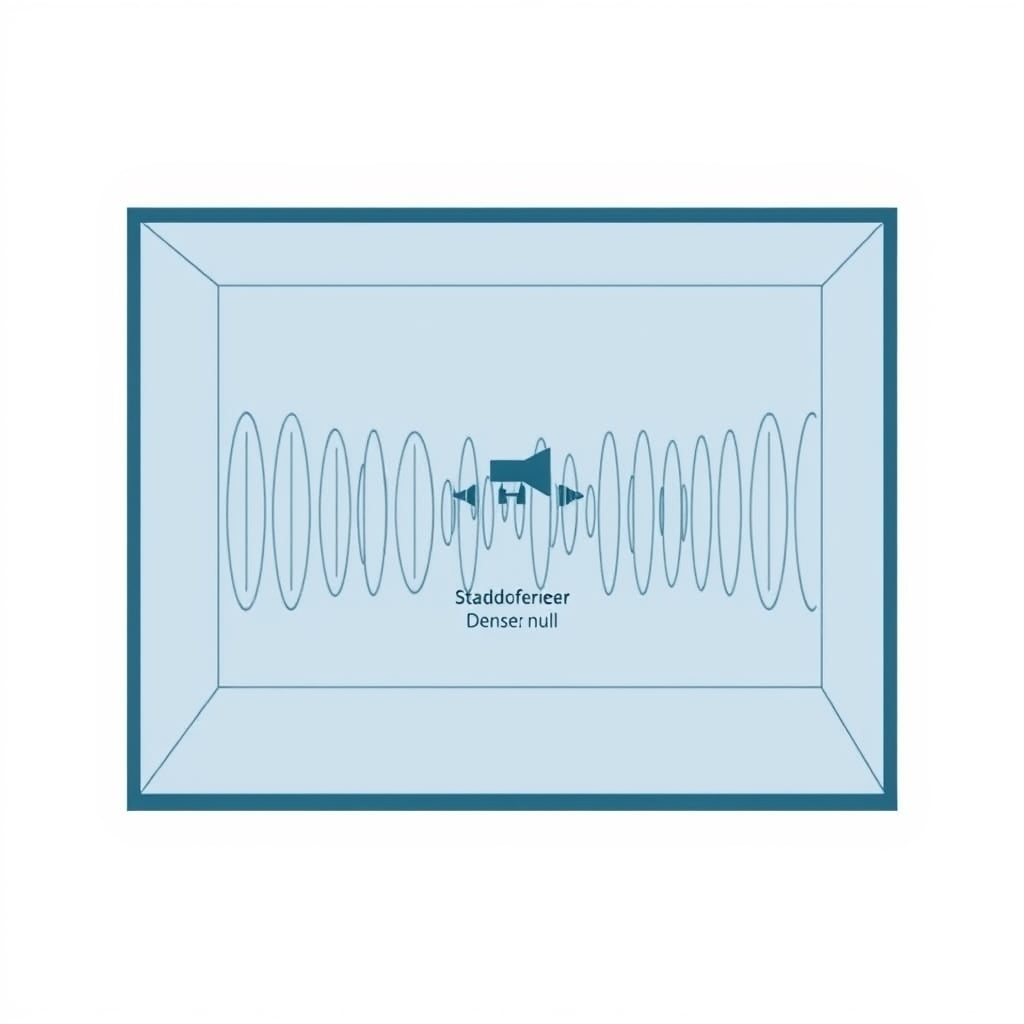
Bass frequencies create standing waves in rooms. These waves don’t behave like mid and high frequencies; they don’t “go” from the sub to your ear in a straight line. Instead, bass bounces around the room and interferes with itself sometimes reinforcing (louder), sometimes canceling (quieter).
Standing waves occur at specific frequencies determined by your room’s dimensions. A room that’s 15 feet long will have a room mode at roughly 38 Hz (speed of sound divided by twice the distance more on the math below). That mode will be louder in some spots and quieter in others. If your subwoofer sits at a pressure peak, you’ll hear a bloated, resonant bass response. If it sits at a pressure null (dead zone), bass disappears entirely.
This is why moving a sub even 2 feet can make a huge audible difference. You’re moving it relative to the room’s modal structure.
Why Corners Trap Bass
Corners are where three surfaces meet: two walls and the floor (or two walls and the ceiling). Bass energy bounces off all three surfaces and reinforces itself there. In acoustic practice, a corner is generally understood to provide around 6 dB of reinforcement roughly twice the acoustic pressure compared to placement against a single wall.
That’s powerful, but it’s also a trap. Corner placement will almost always color the bass response. Whether that’s good or bad depends entirely on whether the room’s dominant modes align with the corner position.
Boundary Effects and Boundary Loading
When a subwoofer sits near a wall or floor, that boundary reflects the sub’s rear-firing acoustic energy forward, reinforcing the front-firing output. This is called boundary loading or corner loading.
Boundary loading is why placement changes specs: a sub rated at 100 dB in free space might measure closer to 106 dB in a corner. That extra 6 dB sounds noticeably louder. But it also colors the response by emphasizing certain frequencies more than others.
If you place a sub in an open room center, you lose this boundary gain but you also eliminate the colorations that come with it.
The Placement Test Protocol
Don’t guess. Test. This takes an hour but saves months of living with bass you don’t like.
What You’ll Need
- Your subwoofer and amplifier, fully powered and run a calibration if your receiver supports it (like Audyssey, MCACC, or Dirac Live).
- A sound source: either a music track with strong, consistent bass (a favorite song with deep bass notes you know well) or a dedicated test tone generator (many phone apps produce test tones; web-based generator sites let you create specific frequencies).
- Your listening chair or couch the spot where you actually sit to watch movies or listen to music.
- A pen and paper to note what you hear at each position.
Optional but helpful: a smartphone decibel meter app (accuracy varies, but it gives relative measurements) or a real SPL meter if you already own one.
Step 1: Identify Three to Five Test Positions
Don’t test every corner and wall. Pick positions that represent different modal loading:
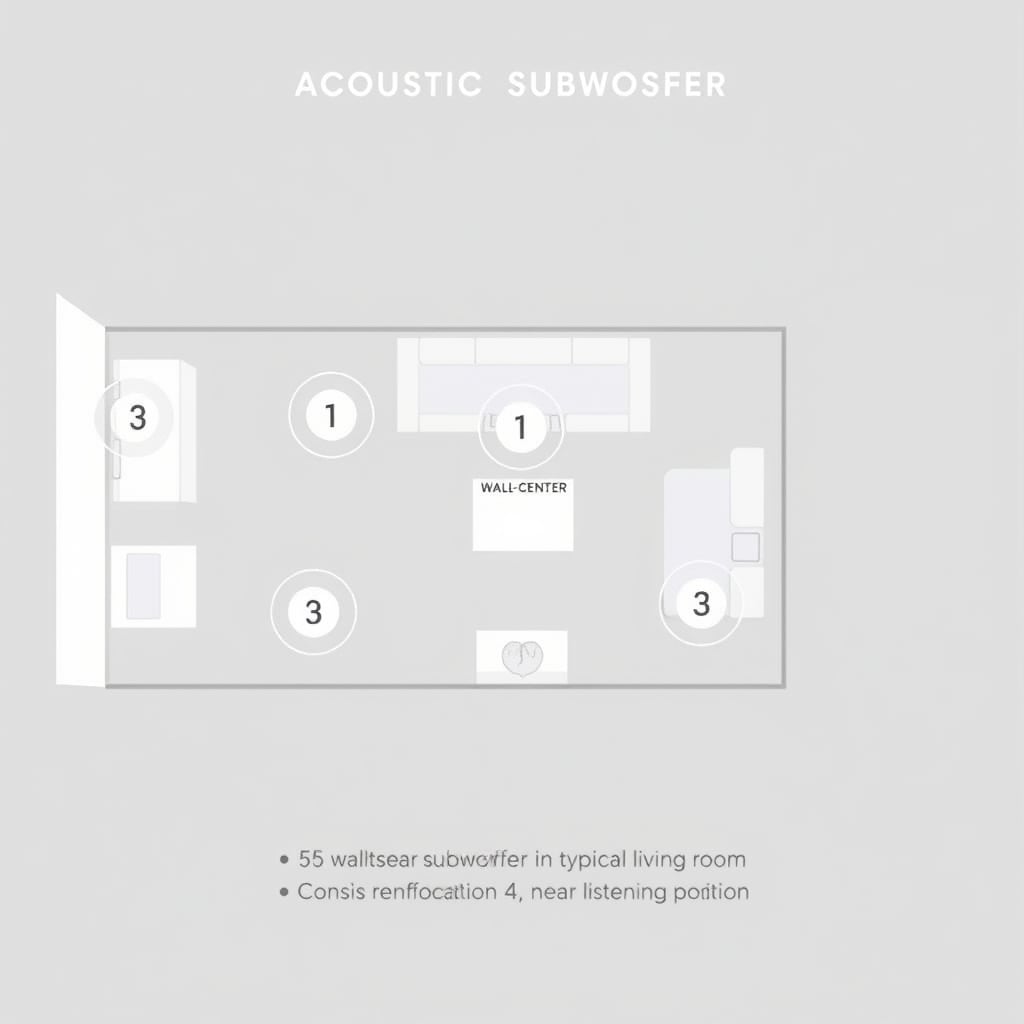
- Corner position (opposite your listening area if possible): maximum boundary loading, highest SPL.
- Wall-center position (mid-wall, a few feet from the corner): moderate loading, cleaner than corner.
- Room-center position: minimum loading, most neutral response but lowest SPL. Only test this if your room setup allows it.
- Along the front wall (where your TV or speakers are, left or right of center): practical for living rooms, moderate loading.
- Near your listening position (behind or beside the couch): unconventional but sometimes reveals modal null issues.
If you’re in a small room (under 150 sq. ft.), skip position 3 room-center placement is impractical and usually sounds thin anyway.
Step 2: Listen at Each Position
Place the subwoofer in position 1. Let it run for 5 minutes to stabilize. Then play a bass-heavy track or 50–60 Hz test tone for 30 seconds while sitting at your listening seat.
Note what you hear:
- Is the bass tight and articulate, or boomy and bloated?
- Does it sound even, or are some notes louder than others (uneven response)?
- Does it feel integrated with your speakers, or does it feel like a separate “thump” coming from a specific direction?
- Is there a ringing or resonant quality (sign of a mode peak)?
- Is the bass weak or hollow in the lower registers (sign of a mode null)?
Don’t overthink it. Write down one or two words: “muddy,” “tight,” “boomy,” “hollow,” “balanced.”
Move to position 2 and repeat. Then position 3, 4, and 5.
Step 3: Do a Follow-Up Comparison
Go back to the two or three positions that sounded best. Play the same track again, a few seconds at each location. This time, listen for which position sounds the most integrated with your main speakers. Which one doesn’t call attention to itself? Which one makes the sub sound like it’s part of the system, not an add-on?
That’s your winner.
Step 4: Measure (Optional, But Worth It)
If you have a decibel meter app, measure SPL at each position from your listening seat. Note the level at 50 Hz, 100 Hz, and 200 Hz if the app lets you.
You’re not looking for a specific number you’re looking for consistency. If position A measures 85 dB at 50 Hz and 83 dB at 100 Hz, that’s relatively flat. If it measures 85 dB at 50 Hz and 92 dB at 100 Hz, that’s a mode peak at 100 Hz, and it will sound boomy at that frequency.
Smartphone SPL apps vary in accuracy. A dedicated SPL meter (around $100) is more reliable, but the phone app is perfectly adequate for relative comparisons between positions.
Common Placement Scenarios and What Works
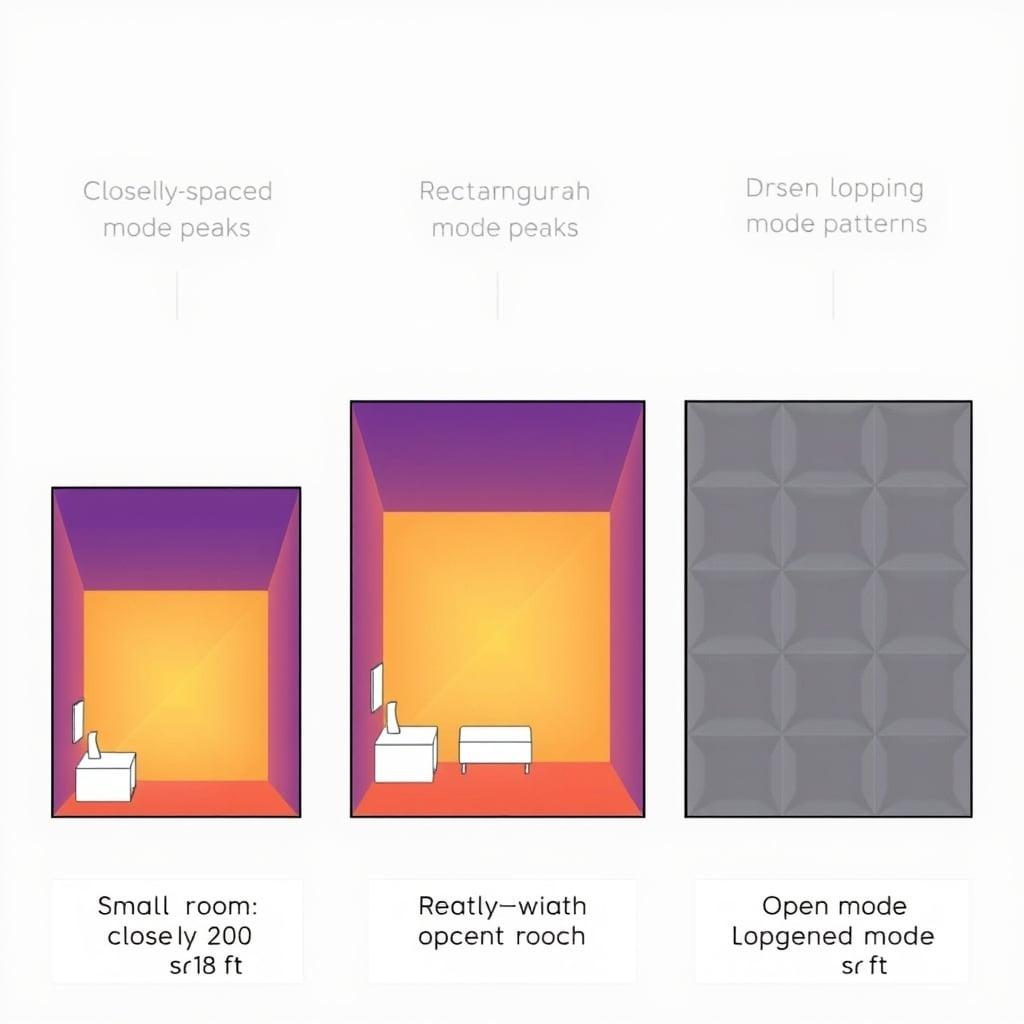
Scenario 1: Small Living Room (Under 200 sq. ft.)
Small rooms have fewer mode peaks and valleys, which is good news and bad news. Good news: placement is less critical. Bad news: when you hit a bad spot, it’s worse because the modes are narrower.
Start with the corner opposite your couch. If that sounds boomy (which it often does in small rooms), try moving the sub 3 feet into the room along the same wall, or place it next to the TV on the front wall.
Avoid placing the sub in the exact center of the room in a small space small-room centers often sit at room-mode nulls and sound thin.
Scenario 2: Rectangular Living Room (12 × 18 feet)
Rectangular rooms are predictable. The longest dimension creates the lowest mode (around 30 Hz in an 18-foot room). The shorter dimension creates a higher mode (around 45 Hz in a 12-foot room).
If you place the sub along the short wall, you’re adding energy to the 45 Hz mode. That can sound bloated in the lower midrange. If you place it along the long wall, you’re loading the 30 Hz mode, which sounds deeper but less controlled.
Try the front-left or front-right corner first (near where speakers sit). If that’s muddy, move it to the side wall, about 1/3 of the way into the room. This placement usually works well in rectangular rooms.
Scenario 3: Open-Plan / Great Room
Big, open rooms are harder because modes are complex and numerous. You can’t treat it like a simple rectangular box.
Start with a corner in the listening area (front-left or front-right). If that’s boomy, move it 2–3 feet away from the corner. Then test positions along the walls at different distances from corners.
If you have a choice, place the sub toward the rear of the listening area, away from the TV wall. This usually sits better acoustically and makes bass less directional you won’t hear the “thump” coming from a specific spot.
Scenario 4: Dedicated Home Theater or Listening Room
In controlled rooms where you can place the sub freely, use the “crawl test.”
Sit in your listening seat. Have someone place the subwoofer in different positions around the room and play a low bass note (around 40–50 Hz). Listen for where the bass sounds cleanest and most present. That’s usually the best position for your room.
Don’t rely on that alone your ears at the listening seat experience the room differently than a sub in an open position but it’s a strong starting point.
Bass Room Modes: Understanding What You’re Dealing With
Room modes occur at predictable frequencies based on room dimensions. If you know your room size, you can estimate where the modes will be.
The formula: Mode frequency = (speed of sound / 2) × (1 / room dimension)
The speed of sound in air is approximately 1,130 feet per second at typical room temperature (around 70°F / 21°C).
For a 15-foot room:
- Mode at roughly (1,130 / 2) × (1 / 15) = 38 Hz
For a 12-foot room:
- Mode at roughly (1,130 / 2) × (1 / 12) = 47 Hz
For a 20-foot room:
- Mode at roughly (1,130 / 2) × (1 / 20) = 28 Hz
These are first-order (axial) modes the dominant ones for rectangular rooms. A room that’s 15 × 12 × 9 feet will have mode peaks around 38 Hz, 47 Hz, and 63 Hz. These frequencies shift depending on where you sit, but they’re always present.
Why care? Because a subwoofer placed at a pressure peak for one of those frequencies will reinforce it excessively, sounding boomy at that note. If you move the sub 3 feet, you might move it to a null, and that frequency disappears entirely.
This is also why corner loading is inconsistent. Corners reinforce all modes that reach them, but they amplify modes that are already strong in your room which can make a problem worse rather than better.
Practical Placement Adjustments
If Bass Sounds Boomy or Bloated
You’re sitting at or near a pressure peak for a mode (usually 50–100 Hz). Options:
- Move the sub away from the corner: Try placing it 2–4 feet from the corner along the same wall. This reduces corner loading and often flattens the response.
- Move it to a different wall: Walls create different modal loading. If the left-front corner is boomy, try the right-front corner or the side wall.
- Move it back into the room: Away from all walls, if space allows. This is the most neutral option but loses boundary reinforcement.
- Lower the subwoofer volume or trim: Your receiver’s bass management (or the subwoofer’s level control) lets you reduce output by 3–6 dB. This can reduce boom without moving the sub.
- Use bass trapping: Acoustic absorbers (foam panels, bass traps) placed in room corners absorb some of the reinforced energy. This is effective but adds cost.
If Bass Sounds Thin or Weak
You’re sitting at or near a modal null (a dead zone). Options:
- Move the sub toward a corner: Corner loading adds roughly 6 dB of reinforcement. Moving from center to corner will almost always add perceived output.
- Move it to a different location: Try the opposite wall or a different corner.
- Increase the subwoofer volume: Use your receiver’s trim or the sub’s level control to boost output by 3–6 dB.
- Use bass shaping: Some subwoofers offer a “room gain” or “boundary compensation” switch. This EQ boost compensates for placement nulls. Check your manual.
- Consider placement between a corner and wall: This gives partial corner loading without full boom. About 1/3 of the way from the corner often works well.
If Bass Is Uneven (Bumpy, One-Note)
You’re hitting multiple modes unevenly. The sub reinforces some frequencies while missing others. This is harder to fix by placement alone.
- Test all five positions thoroughly: One might sound smoother than others.
- Use parametric EQ: If your receiver has a subwoofer EQ feature (like Audyssey, MCACC, or Dirac Live), run the calibration. These systems measure the room and automatically flatten uneven response.
- Add bass trapping: Absorbers in corners reduce mode peaks, smoothing the overall response.
- Accept the trade-off: Some rooms are just difficult. A slight bump at 80 Hz is better than missing all bass at 50 Hz. Choose the least-bad option.
Integration with Main Speakers
Optimal subwoofer placement isn’t just about bass smoothness it’s about blending the sub with your mains.
Crossover Frequency Matters
Your receiver’s subwoofer crossover (usually 80 Hz by default) determines where your mains hand off to the sub. If the crossover is set too high (e.g., 120 Hz), your ears can more easily pinpoint where the bass is coming from you’ll hear the “thump” coming from the sub location.
Lower crossovers (60–80 Hz) make the sub less directional because the frequencies it’s handling are harder for human ears to localize. Place the sub where the crossover frequencies (around 80 Hz) sound integrated with your mains.
Distance from Listening Position
Subwoofers and main speakers should be roughly equidistant from your listening seat, or the sub should be slightly closer. If your mains are 10 feet away and the sub is 25 feet away, there’s a timing and phase mismatch that makes them sound disconnected.
In most living rooms, this means placing the sub near the front of the room (near the TV) rather than at the rear, even if the rear position has smoother bass response on paper.
Phase and Timing
Most receivers let you adjust subwoofer phase (0 or 180 degrees). Try both settings during your placement test. One will sound tighter and more integrated; the other will sound loose or like there’s a “hole” in the bass.
Phase is position-dependent. If you change sub location, check the phase setting again.
Troubleshooting: Why Your Sub Still Sounds Bad
Issue: Bass Sounds Distant or Lacks Impact
- Placement is at a modal null: Test other positions.
- Crossover frequency is too low: Increase it to 100–120 Hz in your receiver’s menu (if you have larger mains, keep it at 80 Hz).
- Subwoofer volume is too low: Increase trim by 3 dB and listen again.
- Phase is inverted: Try flipping the phase switch to 180 degrees.
Issue: Bass Is Clearly Coming from a Specific Direction
- Crossover frequency is too high: Lower it to 60–80 Hz.
- Sub is too far from mains: Move it closer to the TV or main speaker location.
- Sub is isolated or disconnected: Check that it’s wired and powered on. Make sure your receiver is routing bass to the subwoofer (check the manual for audio setup).
Issue: Bass Blooms at Certain Notes and Dies at Others
- Multiple room modes are present: This is common in larger or oddly-shaped rooms. Use parametric EQ (Audyssey, MCACC, etc.) to flatten response, or accept that you’ll always have minor unevenness.
- Acoustic treatment is needed: Bass traps in corners reduce peaks. This is the most effective fix but also the most expensive.
Issue: Neighbors Complain About Vibration
- Sub is on the floor: Place it on isolation feet or a rubber mat to decouple vibration from the floor.
- Volume is too high: Lower the trim by 3–6 dB.
- Crossover is too low: Increase it to 100+ Hz to reduce output at very low frequencies that transmit through walls.
Advanced Techniques: Taking Placement Further
Multiple Subwoofers
Two subs placed at different locations even out room modes better than one. If you have two subs, place them at opposite corners or opposite walls.
Don’t place two subs next to each other this is corner loading on steroids and usually sounds worse than one sub alone.
With two subs, run the placement test with both active. You’re looking for the position pair that sounds smoothest across the frequency range.
The Subwoofer Crawl
For dedicated listening rooms, many acousticians recommend the “crawl” method: place the sub at your listening seat and crawl around the room listening to a sustained bass note. Wherever the bass sounds best (tightest and most present) is where the sub should go.
This works because your listening position reveals the room’s acoustic sweet spot. Moving the sub there often confirms it.
Caveat: this assumes your listening position is fixed and your sub can be placed freely. In most living rooms, that’s not realistic.
Nearfield Placement
Some rooms respond well to placing the sub very close to the listening position (2–4 feet away) rather than at the room perimeter. This reduces room-mode interaction because the sub’s output reaches your ears before it bounces significantly off walls.
Nearfield subs sound directional (you hear the “thump”), but they sound tight and controlled. Try this if corner and wall placements sound muddy.
Bass Trapping Strategy
If placement alone doesn’t cure boomy response, adding absorption to room corners addresses the root cause: room modes. Acoustic panels (1–2 feet per corner) absorb bass energy and reduce reinforcement.
This is expensive ($300–$1,000+) but permanent. Don’t do this before testing placement thoroughly placement is free and often solves the problem.
Conclusion: The Setup That Actually Works
Optimal subwoofer placement requires listening, not guessing. Spend an hour testing three to five positions. Take notes. Compare the best two or three. Pick the winner based on how the bass sounds tight or boomy, integrated or directional not on measurements or theory.
Once placed, use your receiver’s calibration system (Audyssey, MCACC, Dirac Live) if available. This optimizes crossover, phase, and trim for your room. Then leave it alone. A sub that sounds good in position A will sound worse if you move it to position B to impress a guest.
The hardest part of subwoofer ownership isn’t the sub itself it’s placement. Get that right, and a mid-range sub outperforms a flagship sub in the wrong spot.