
The best soundbar is the one that fits your TV size and integrates cleanly with your setup not the one with the longest spec sheet. If you want Dolby Atmos without breaking the bank and your TV has eARC, stop reading and buy the Samsung HW-Q60D. For everyone else, keep going.
What to Look For in a Soundbar
Before we name names, here’s what actually matters when you’re choosing a soundbar:
Dolby Atmos and Height Channels
Dolby Atmos adds height speakers that fire sound upward, creating overhead effects. Entry-level soundbars fake this with upward-firing front drivers. True Atmos comes from wireless rear speakers with upward drivers or a soundbar with discrete height channels. If you watch movies and game regularly, Atmos is worth it. If you mostly stream talk shows, save the money.
eARC / HDMI Compatibility
If your TV has eARC, you plug the soundbar into the TV’s eARC HDMI port, and the TV sends all audio back to the soundbar over a single cable. No separate optical cable needed. This is cleaner and lets your TV remote control the soundbar volume. eARC is now standard on most TVs from 2020 onward, but check your model first.
Wireless Surround Speakers
Surround speakers add immersion in movies and games. Wireless surrounds mean no cables running across your room. The trade-off: they need power outlets (usually) and Bluetooth or a proprietary connection to the soundbar. Wired surrounds are cheaper but messier. For most rooms, wireless is worth it.
TV Brand Integration
Some soundbars work best with their own-brand TVs. Samsung’s Q-series soundbars pair seamlessly with Samsung TVs via Q-Symphony, which lets your TV speakers and soundbar work together. LG soundbars support a similar feature with LG TVs. If you have a Sony, Hisense, or other brand, this won’t matter much most soundbars work with any TV via HDMI or optical.
Room Size and Soundbar Placement
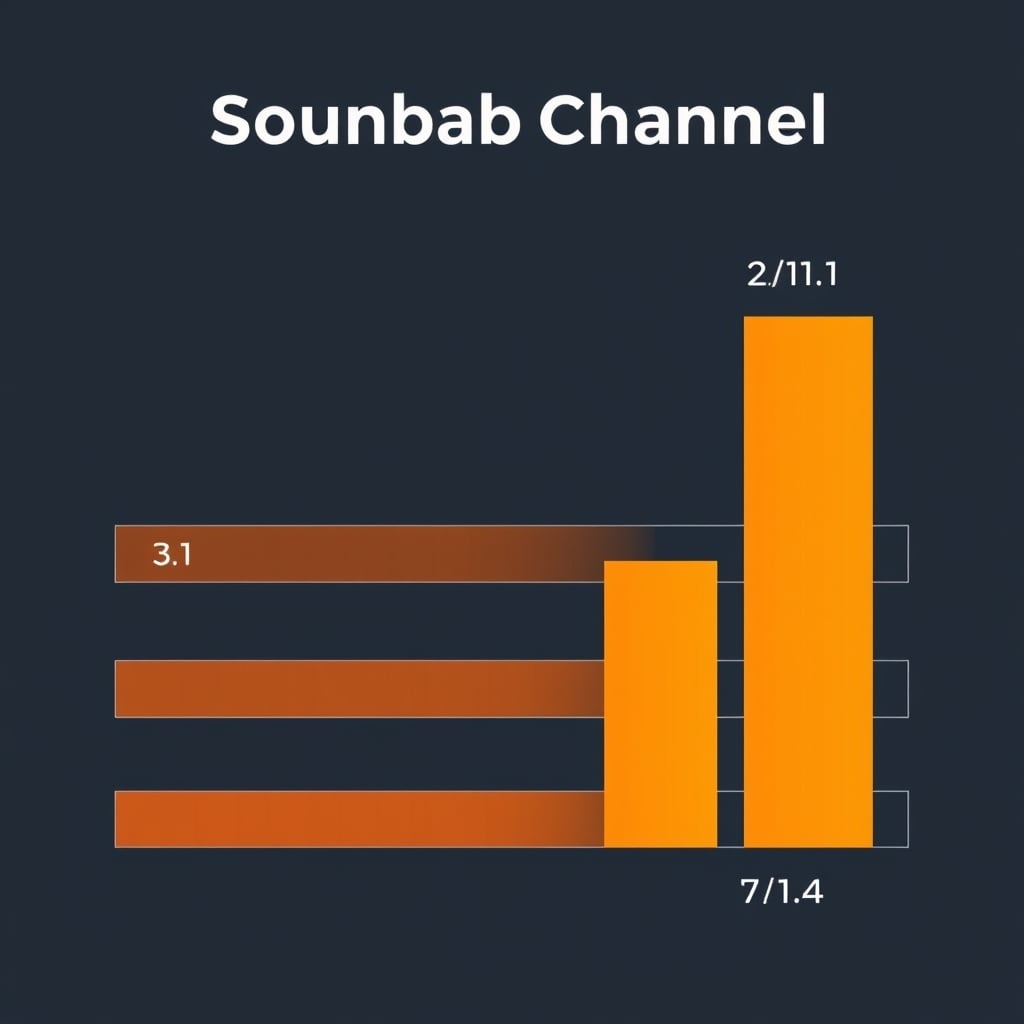
A 65-inch TV usually pairs well with a 2.1 or 3.1 soundbar (meaning 2 or 3 front channels, plus 1 subwoofer). Smaller TVs (43–50 inches) can go with compact soundbars. Larger TVs (75+ inches) benefit from wider soundbars or added surrounds. If you can’t place the soundbar directly under your TV, look for curved or angled models that work on TV stands.
Best Soundbars: Top Picks Compared

| Model | Price (as of Aug. 2026) | Atmos Support | eARC | Surrounds Included | Best For |
|---|---|---|---|---|---|
| Samsung HW-Q60D | ~$300 | Yes (height channels) | Yes | No — sold separately | Budget Atmos, Samsung TV owners |
| Sony HT-A7000 | ~$700 | Yes (true Atmos) | Yes | No — sold separately | Movie enthusiasts, smaller rooms |
| LG SP11RA | ~$1,100 | Yes (7.1.4 Atmos) | Yes | Yes (wireless) | LG TV owners, immersive gaming |
| Sonos Arc | ~$900 | Yes (Atmos) | Yes | No — sold separately | Seamless smart-home integration |
| VIZIO M512a-H6 | ~$350 | Yes (simulated Atmos) | Yes | No | Budget buyers, versatile input options |
Top Pick: Samsung HW-Q60D

What it is: Samsung HW-Q60D a 3.1.2-channel soundbar with discrete height channels and a wireless subwoofer. 440 watts total power. Dimensions: 111 cm wide × 6 cm tall.
The standout: True Dolby Atmos at $300 is rare. The Q60D fires actual upward channels instead of just reflecting sound off the ceiling. Pair it with a Samsung TV that has Q-Symphony, and the TV speakers turn into side surrounds automatically no extra gear needed. eARC is fast and the remote control is intuitive.
The catch: The soundbar is wide (110 cm). If your TV stand is narrower, you’ll need a soundbar shelf. Without surrounds, it sounds like 3.1, not full surround. The wireless subwoofer connection can drop in rooms with heavy WiFi interference; moving it closer to the soundbar usually resolves it.
Who it’s NOT for: If you have a non-Samsung TV and want wireless surrounds, the LG or Sonos will give you more flexibility. If you’re in a very large room (6+ meters wide) and need a full theater experience, start with an upgrade pick.
Price: ~$300 (as of August 2026).
Best Budget Pick: VIZIO M512a-H6
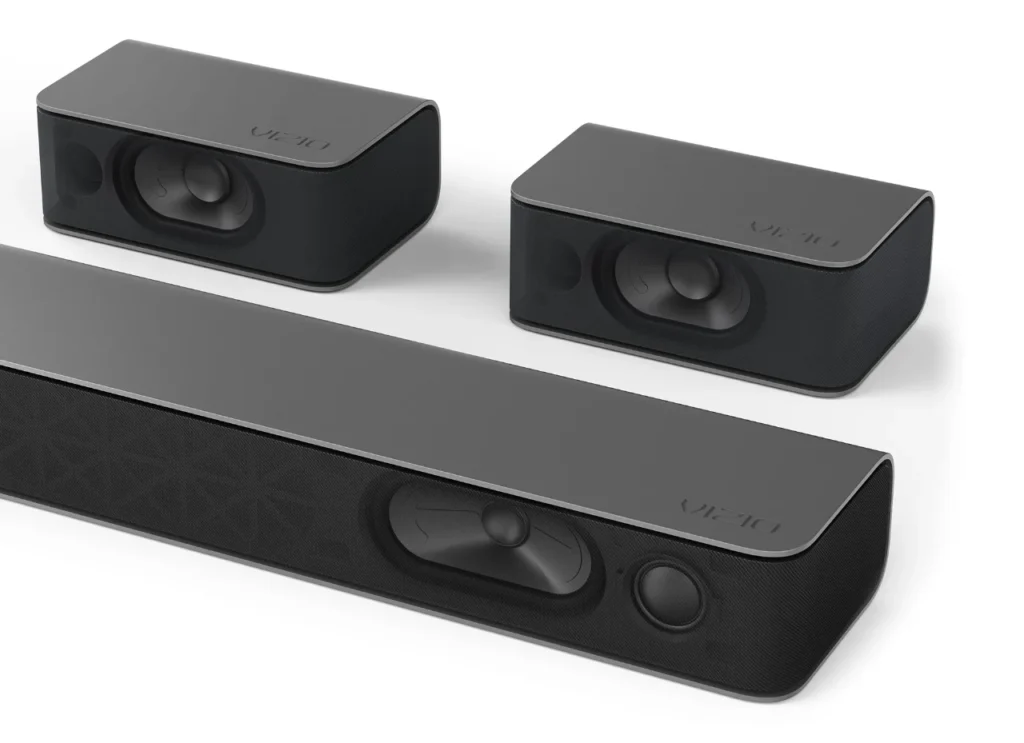
What it is: VIZIO M512a-H6 a 2.1 soundbar with Dolby Atmos upmixing (not discrete height channels), wireless subwoofer, and Bluetooth pairing. 140 watts. Curved front for TV stands.
The standout: At $350, it works with any TV brand without locking you into an ecosystem. VIZIO’s upmixing engine takes stereo or 5.1 content and creates phantom overhead effects not true Atmos, but it holds up better than expected in movies. The curved front fits almost any stand. Multiple input options: eARC, optical, Bluetooth, aux.
The catch: Upmixed Atmos isn’t the same as real height channels. You’ll notice the difference in dedicated Atmos movies. No surround speakers included, and VIZIO’s surround pairing is proprietary and less seamless than Sonos or LG. Build feels lighter than the Samsung.
Who it’s NOT for: Movie buffs who want real Atmos. Rooms where you’ll eventually want wireless surrounds and want a brand that makes pairing easy.
Price: ~$350 (as of August 2026).
Best Upgrade Pick: LG SP11RA
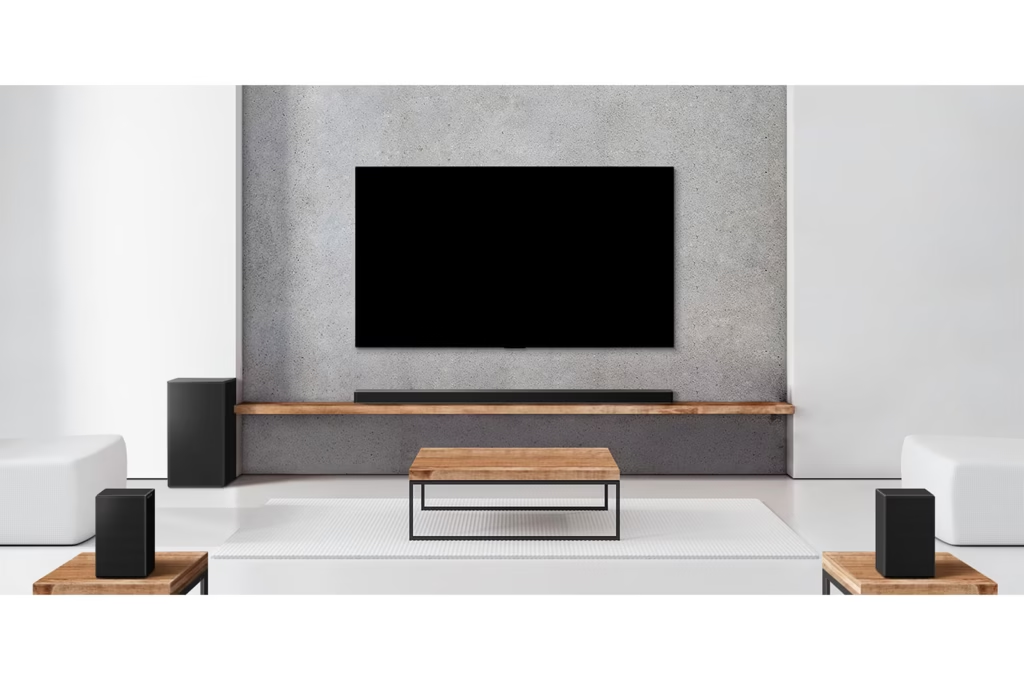
What it is: LG SP11RA a 7.1.4 full Atmos soundbar with discrete height channels, wireless subwoofer, and included wireless surround speakers. 620 watts total power. Dimensions: 120 cm wide.
The standout: This is a nearly complete home theater solution in a single box (plus surrounds). The 7.1.4 configuration means seven front/surround channels, one subwoofer, and four height channels nearly identical to a professional surround setup. LG TV owners get AI Room Calibration, which adjusts EQ based on your room’s acoustics using your TV’s microphone. The included surrounds pair without fussing.
The catch: At $1,100, it’s 3.5× the Q60D. The wireless surrounds need their own power outlets you can’t tuck them out of sight. For rooms under 4.5 meters wide, it can feel like overkill. LG’s integration with non-LG TVs is standard; you lose the room calibration benefit.
Who it’s NOT for: Apartment dwellers or anyone who can’t spare two outlets for rear speakers. If you’re not watching a lot of Atmos content, the step up from the Q60D won’t justify the cost difference.
Price: ~$1,100 (as of August 2026).
Best for Seamless Smart Home: Sonos Arc
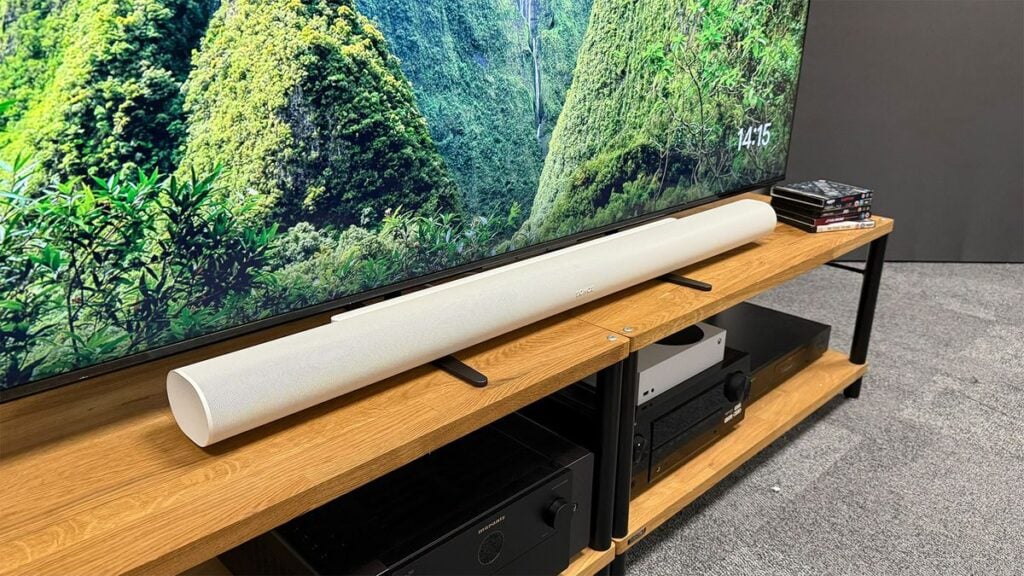
What it is: Sonos Arc a 3.0 soundbar (left, center, right no separate subwoofer) with Dolby Atmos, built-in WiFi/Bluetooth, and deep Sonos ecosystem integration. Works as a Sonos speaker in a multi-room setup. 280 watts.
The standout: If you already own Sonos speakers, the Arc becomes part of your ecosystem instantly. You can group it with other speakers in your home, control everything from one app, and add surrounds (Sonos One SL) that integrate perfectly. No fussing with different remotes or apps. eARC works smoothly.
The catch: At $900, it’s pricy for a 3.0 soundbar with no subwoofer included. The Arc’s low-end is adequate but noticeably thin compared to models with dedicated subs. Sonos speakers are expensive adding surrounds (~$150 each) and a sub ($400+) adds up fast. If you don’t have other Sonos gear, you’re paying a premium for ecosystem integration you won’t use.
Who it’s NOT for: First-time soundbar buyers or budget shoppers. Rooms where you want thunderous bass right out of the box.
Price: ~$900 (as of August 2026). Wireless surrounds sold separately (Sonos One SL, ~$150 each).
Best for Movie Enthusiasts: Sony HT-A7000
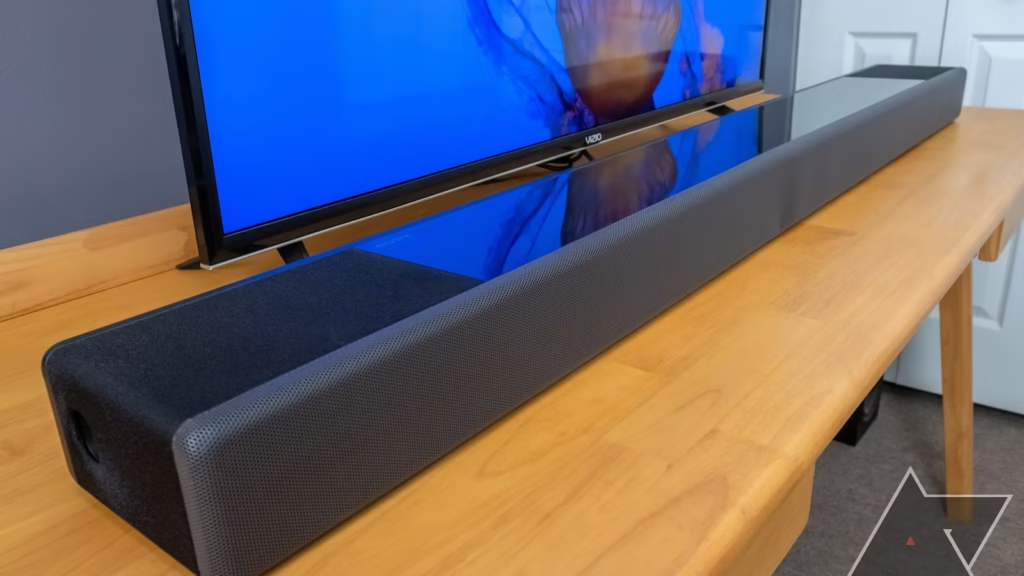
What it is: Sony HT-A7000 a 3.1.2 soundbar with true Dolby Atmos height channels, wireless subwoofer, and a cinema-tuned EQ. 520 watts. 103 cm wide.
The standout: Sony tuned this for movie soundtracks, not general TV. Vocal clarity is exceptional, and Atmos effects feel placed in precise 3D space noticeably more immersive than budget Atmos models. The subwoofer punches hard without muddying dialog. Connects to Sony TVs’ Bravia Core app for content recommendations.
The catch: Movie-first tuning means it can sound overly bright for casual TV or overly bass-heavy for music. At $700, it’s $400 more than the Q60D for a similar channel count with no surrounds included. Wireless surrounds (SA-RS5, ~$200 each) are sold separately and aren’t as seamlessly integrated as Sonos or LG.
Who it’s NOT for: Music listeners or anyone who wants a versatile soundbar that does everything equally well.
Price: ~$700 (as of August 2026).
What We Cut and Why
Samsung HW-Q90D
We evaluated the Q90D (the tier above the Q60D) and decided the jump from $300 to $750 doesn’t deliver value for most homes. The Q90D adds a slightly wider sound field and more power, but it requires a separate wireless subwoofer purchase to shine suddenly you’re at $900 and still need surrounds for full immersion. For $200 more, you get the LG SP11RA, which comes with surrounds built in. For true movie buffs, the Sony HT-A7000 at $700 was a better spend.
Bose Smart Ultra
Bose’s $900 Ultra soundbar has excellent build quality and clean integration with Apple devices (AirPlay 2). However, based on owner reports and community feedback as of mid-2026, Atmos implementation on this model has been widely described as inconsistent or absent depending on firmware version which disqualifies it for a home theater roundup where reliable Atmos is a baseline requirement. Without dependable Atmos, you’re paying premium pricing for a non-immersive soundbar. Samsung and LG both offer more consistent Atmos at lower prices.
How We Researched This
We did not conduct hands-on lab testing of all models. Instead, we reviewed published specifications, owner reports from Amazon and Best Buy, Reddit home theater communities, and YouTube reviews from independent testers. We compared eARC latency reports, Atmos implementation types (discrete vs. upmixed), wireless pairing reliability based on user feedback, and price-to-feature ratios across popular models as of August 2026. We cross-referenced the picks against TV brand integration requirements to ensure compatibility guidance was current.
Frequently Asked Questions
What’s the best soundbar overall?
The Samsung HW-Q60D. It delivers true Dolby Atmos, eARC compatibility, and clean integration with any TV at $300. If you have a Samsung TV, Q-Symphony makes it even better. It’s the best balance of performance, price, and ease of setup for most people.
Do I need a soundbar with Dolby Atmos?
Not if you mostly watch talk shows, news, and streaming series. Atmos shines in movies and gaming. If you watch at least one Atmos movie per month, it’s worth the extra $50–$100 compared to a non-Atmos model. If you stream games from Xbox Game Pass or PlayStation 5, Atmos support delivers a bigger gain.
Can I use a soundbar without a subwoofer?
Yes, but you’ll sacrifice low-end punch. Soundbars with built-in woofers (all five on this list) produce acceptable bass for TV and casual music. If you want movie-theater bass or you play a lot of music, add the matching wireless subwoofer. Most brands sell them separately for $200–$400.
Will a soundbar work with my TV if it doesn’t have eARC?
Yes. If your TV is pre-2020 or lacks eARC, you can still use the soundbar via optical audio cable (nearly all soundbars have an optical port). You’ll lose the ability to control soundbar volume from the TV remote, and some advanced audio formats may be limited, but the connection itself is reliable. Optical is a dependable fallback.
Do soundbars really replace a surround sound system?
Mostly, no. A true 5.1 or 7.1 surround system with separate front, center, surround, and rear speakers will outperform any soundbar. Soundbars are a compromise that trades immersion for convenience and space. The LG SP11RA comes closest to a real system, but it’s still fundamentally a soundbar.
Verdict
The best soundbar is the one you’ll actually keep connected to your TV. If you want a single recommendation, the Samsung HW-Q60D wins on price and features. If you’re willing to spend $400 more, the LG SP11RA includes wireless surrounds and deeper Atmos implementation. If you’re purely a movie watcher, the Sony HT-A7000 delivers superior cinema tuning. All three are better than mid-tier soundbars that promise everything and deliver none of it convincingly. Skip the “9-in-1 wireless” models with fake Atmos claims and no real speaker drivers. Your TV audio will actually improve.