
How to Choose the Perfect Cruise: Ship Size, Destinations & Duration Matched to Your Style
Choosing the right cruise means matching four core variables: ship size (which determines crowd level and onboard atmosphere), river type (Caribbean vs. Alaska vs. river), cruise duration (3 days vs. 10 days), and budget tier. For most first-time cruisers, starting with a mid-size ship (2,000–4,000 passengers) sailing a familiar region for 5–7 days strikes the best balance of value, atmosphere, and ease. Below is how to work through each decision point, plus a decision tree to match your preferences to the right experience.
How We Researched This Guide
This guide is based on comparative research across cruise-line booking materials, owner-reported satisfaction patterns from cruise communities, and publicly available pricing data from major cruise lines. Prices, seasonal patterns, and cost estimates reflect observed ranges across listings and owner reports they are not guarantees and will vary by sailing date, cabin class, and promotions. All figures are labeled as estimates or observations.
What Actually Matters When Choosing a Cruise
Ship Size Categories: The Decision That Changes Everything
Ship size is the single biggest factor shaping your cruise experience it determines crowd density, onboard atmosphere, port access, and entertainment style.
There are five ship categories, each with distinct tradeoffs:
Mega Ships (5,000+ passengers)
- Massive pools, multiple restaurants, Broadway-style theaters, casinos, rock-climbing walls
- Crowded buffets, bottlenecks at ports, slower embarkation
- Best for: Party-focused cruisers, families with teens, people who want constant activity options
- Price point: Budget to mid-range economies of scale bring costs down
- Lines: Royal Caribbean (Icon, Wonder of the Seas), Disney Cruise Line, Carnival
Large Ships (2,500–4,999 passengers)
- Good entertainment, cleaner dining, easier navigation than mega ships
- Still busy at ports and buffets, but quieter than mega ships
- Best for: First-time cruisers, families, balanced experience seekers
- Price point: Mid-range
- Lines: Norwegian Cruise Line, Princess Cruises, Holland America
Mid-Size Ships (1,000–2,499 passengers)
- Authentic port exploration, more intimate dining, single seating (not four seatings)
- Fewer on-deck activities, simpler entertainment, shorter pool queues
- Best for: Couples, repeat cruisers, people who want relaxation over constant entertainment
- Price point: Mid to premium
- Lines: Regent Seven Seas, Oceania Cruises, Cunard
Boutique Ships (500–999 passengers)
- Access to smaller ports (Galápagos, Iceland fjords, South Pacific atolls), gourmet dining, expedition-style travel
- Limited onboard nightlife, small pools, higher per-night costs
- Best for: Adventurers, luxury seekers, specialty interest travelers
- Price point: Premium
- Lines: Seabourn, Windstar Cruises, Lindblad Expeditions
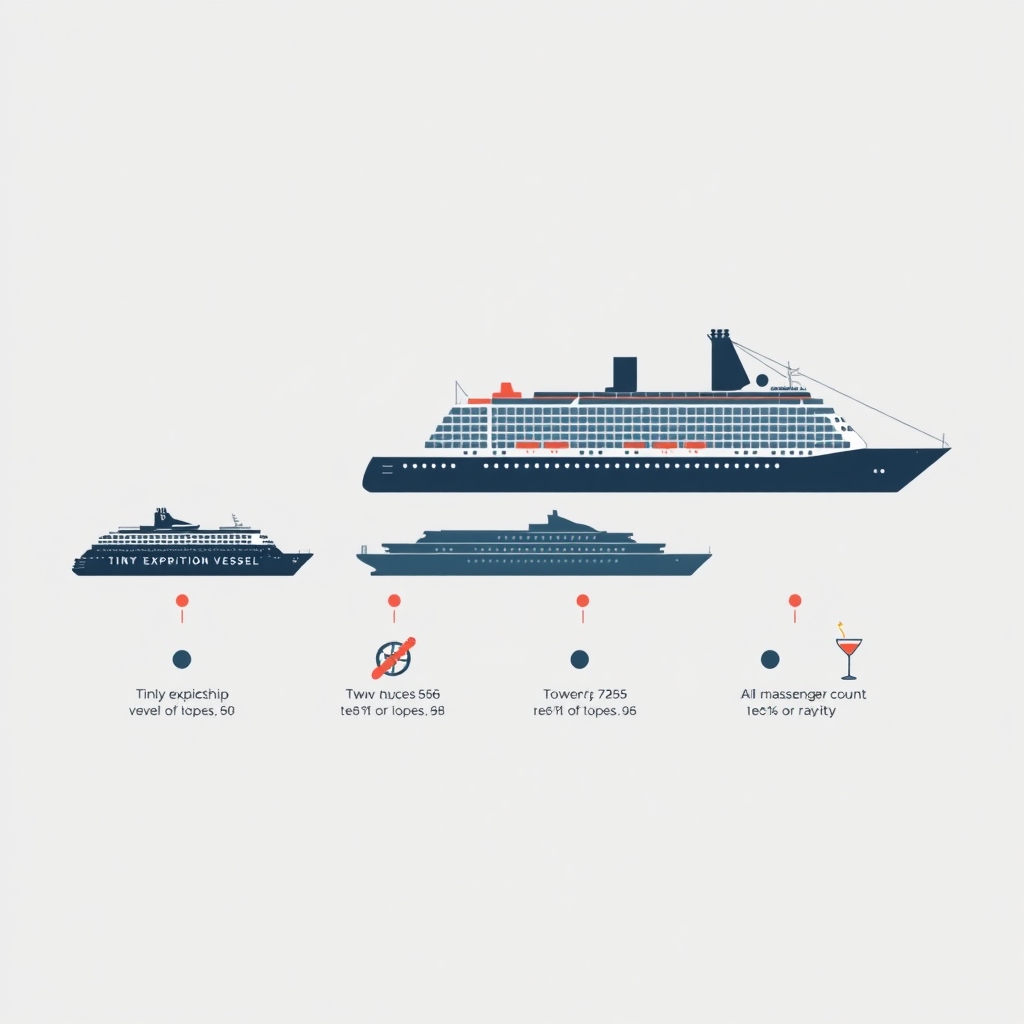
Small Ships (under 500 passengers)
- Expedition cruising (Antarctica, Central America), kayaking programs, naturalist guides
- Almost no formal entertainment, basic cabins on some lines, very high cost per night
- Best for: Active explorers, nature enthusiasts, couples seeking private travel
- Price point: Luxury
- Lines: Hurtigruten, UnCruise, Adventure Life
What to ignore: Marketing promises of “spacious” mega ships. A 5,000-passenger ship has more deck space per person than a 2,000-passenger ship in the pool area, but corridors, dining, and ports are always crowded. Deck-to-passenger ratio is marketing noise go by the raw passenger count instead.
Destination Type: Seasonal Reality Matters
Cruise price, crowd level, and weather vary wildly by destination and season. Matching the right destination to the right time of year is half the value game.
Caribbean (winter/spring dominant)
- Best months: December–April (warm, dry, calm seas)
- Worst months: August–September (hurricane season, discounted but risky)
- Crowd level: Highest in December–January, lower in May–June
- Port access: Large ships can visit major ports; smaller ships access Tobago, Nevis, Bequia
- Budget consideration: January is most expensive; June–July offers better value if you skip hurricane season
Alaska (summer only)
- Best months: June–August (longest daylight, warmest weather, peak whale watching)
- Worst months: September onward (ships redeploy, limited inventory)
- Crowd level: Peak in July, better value in June or September shoulder season
- Port access: Glaciers, Juneau, Ketchikan; smaller ships access Tracy Arm and remote bays
- Budget consideration: Based on observed listing patterns, July sailings typically run 20–40% higher than comparable June departures though exact spreads vary by line and cabin type
Mediterranean (spring/summer/fall)
- Best months: May–June, September–October (warm, fewer crowds than July–August)
- Worst months: July–August (peak crowds, peak prices, intense heat)
- Crowd level: Massively crowded in summer; peaceful in shoulder seasons
- Port access: Small and mid-size ships beat mega ships for island exploration
- Budget consideration: Based on owner-reported booking patterns, September Mediterranean sailings are commonly 30–50% cheaper than July with broadly similar weather though deals vary significantly by itinerary
River Cruises (spring/fall)
- Best months: April–May, September–October (moderate crowds, ideal water levels)
- Worst months: Winter (some rivers freeze), peak summer (crowded)
- Crowd level: Generally quieter than ocean cruises; repeat-traveler demographic
- Port access: Stop in city centers; land excursions are included
- Budget consideration: Shoulder seasons offer best value; all-inclusive pricing means fewer hidden costs
What to ignore: Cruise-line marketing saying “off-season is still great.” If you’re chasing specific wildlife (whale watching, bird migration) or weather, season is non-negotiable. Off-season discounts exist because conditions are worse.
Cruise Duration: The Surprise Factor
Duration affects value per night, onboard experience, and how “worn out” you feel by the end.
3-day cruises
- Best for: Trial cruises, quick escapes, people with limited vacation time
- Trade-off: Most expensive per night; you’re packing and unpacking constantly; sea days are minimal
- Observed price range (mid-size ship, based on listing research): approximately $150–$250/person per night, before drinks and excursions
- Best cabin choice: Inside cabin (you’re rarely in it)
5–7 day cruises
- Best for: First-timers, balanced leisure, most popular price point
- Trade-off: Sweet spot enough sea days to relax, enough ports to explore, reasonable value
- Observed price range: approximately $100–$180/person per night
- Best cabin choice: Balcony (you’ll use it, and the value gap is small)
10–14 day cruises
- Best for: Travelers seeking genuine relaxation, transatlantic repositioning, repeat cruisers
- Trade-off: Cheaper per night, but requires more vacation time; some cruisers report “cruise fatigue” by day 10
- Observed price range: approximately $80–$140/person per night
- Best cabin choice: Balcony; the longer stay justifies the upgrade
21+ day voyages
- Best for: Retirees, sabbatical-takers, people treating the cruise as a destination, not transit
- Trade-off: Excellent per-night value; usually smaller, more upscale ships; limited ports per day
- Observed price range: approximately $70–$120/person per night
- Best cabin choice: Verandah suite (amenities and concierge matter at this duration)
What to ignore: The myth that longer cruises are “always cheaper per night.” A 10-day transatlantic from Cunard is far more expensive per night than a 7-day Caribbean from Carnival. Duration alone doesn’t determine value destination, ship line, and time of year do.
Budget Reality: What You Actually Pay
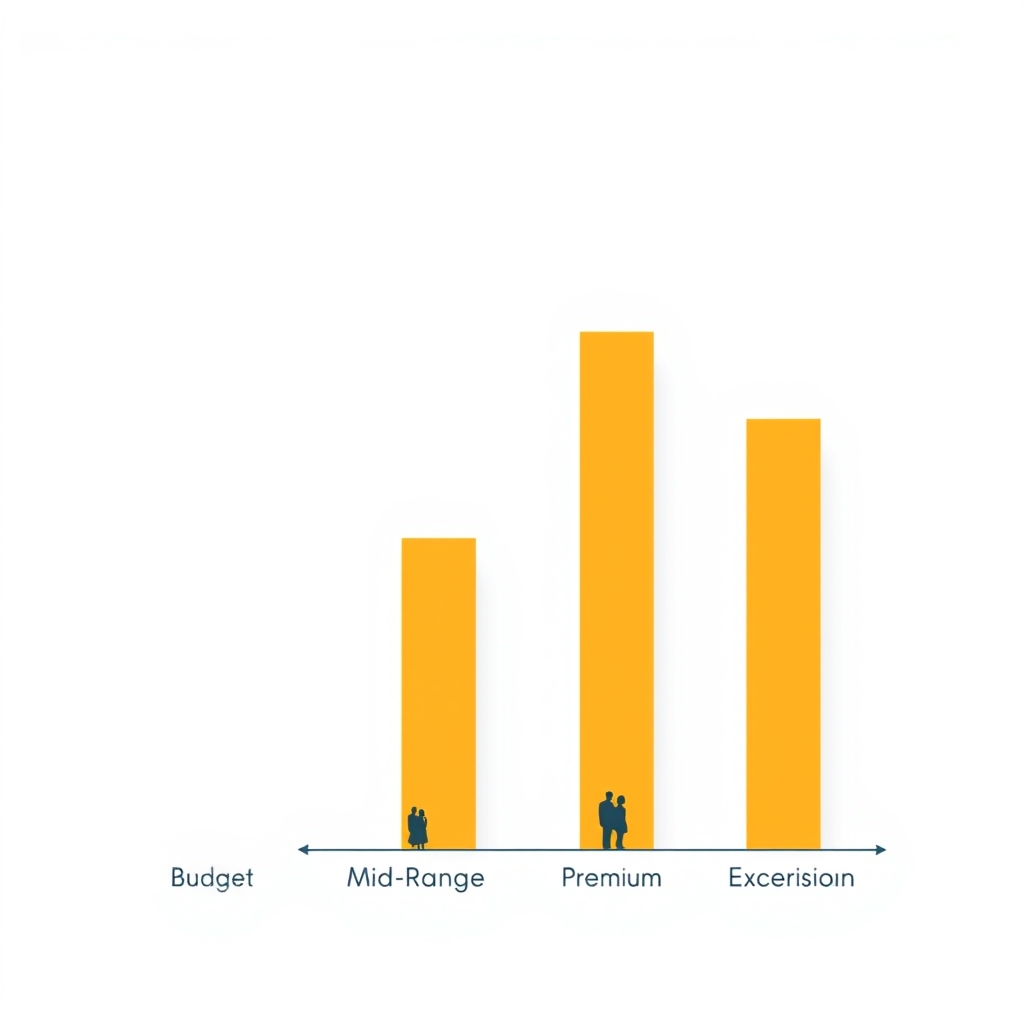
Cruise-line pricing is notoriously opaque. Understanding the tier structure prevents sticker shock.
Based on our research of current cruise-line listing patterns and owner-reported costs, here’s what cruisers typically observe across budget tiers. These are observed ranges, not guaranteed fares your actual cost will depend on sailing date, cabin category, and promotions active at the time of booking.
| Budget Tier | Per-Night Base Fare (Observed Est.) | Drinks Included? | Specialty Dining? | Excursion Avg. | Total Approx. Cost (7-Day Couple) |
|---|---|---|---|---|---|
| Budget (Carnival, Disney Value) | $60–$120 | No | Extra $15–$25/meal | $100–$200/port | $1,400–$2,200 |
| Mid-Range (Royal Caribbean, Norwegian, Princess) | $100–$180 | No | Extra $20–$35/meal | $120–$250/port | $1,800–$3,200 |
| Premium (Holland America, Regent, Oceania) | $150–$280 | Often Yes | Often Included | $150–$300/port | $2,500–$4,500 |
| Luxury (Seabourn, Windstar, Silversea) | $300–$600+ | Yes | Yes | $200–$400/port | $3,500–$6,000+ |
What gets added:
- Gratuities: approximately $13–$16/person/day (often auto-added)
- Drinks package: approximately $50–$80/person/day (or pay per drink, roughly $8–$12 each)
- Specialty dining: approximately $25–$45 per restaurant visit
- Excursions: approximately $80–$400 per port (heavily dependent on destination and activity)
- Onboard spending: Spa, casino, photos, laundry, internet (if not bundled)
Based on patterns we observe in owner-reported cruise budgets, most cruisers underestimate their final cost commonly by 25–40% above the advertised base fare. The advertised $89/night price can realistically become $180–$220/night once drinks, gratuities, and excursions are factored in.
What to ignore: The advertised base price in isolation. Always calculate: base fare + gratuities (mandatory) + drinks (if you drink) + 1–2 excursions per port + miscellaneous onboard spending. That’s your real number.
Onboard Atmosphere: The Personality Fit
Two ships of the same size can feel completely different based on passenger demographic, entertainment style, and ship design.
Party/Family Energy (Carnival, Royal Caribbean)
- Younger passengers, 24-hour activity, casino, club scene, loud pools
- Best for: Families with kids, party-focused groups, people who want constant entertainment
- Downside: Not relaxing if you’re seeking quiet
Sophisticated Leisure (Holland America, Cunard, Regent)
- Older, repeat-cruiser demographic, formal dress codes, classical entertainment, wine-focused
- Best for: Couples, quiet seekers, people interested in enrichment lectures
- Downside: Can feel slow if you’re looking for high-energy entertainment
All-Inclusive Luxury (Seabourn, Silversea)
- Ultra-small ships, butler service, gourmet dining, exclusive destinations
- Best for: Luxury travelers, people fleeing crowds, special occasions
- Downside: Extremely high cost; overkill for casual cruisers
Adventure-Focused (Lindblad, UnCruise, Hurtigruten)
- Naturalists, kayaks, zodiac excursions, expedition mood
- Best for: Active travelers, wildlife enthusiasts, explorers
- Downside: Spartan accommodations, high cost, limited comfort amenities
What to ignore: Ship reviews that fixate on one negative experience (“the buffet was slow once”). Read 20–30 reviews for patterns, not extremes. Also ignore “best cruise ship” lists that rank across all categories a mega ship and a boutique ship can’t be ranked on the same scale.
Common Mistakes First-Time Cruisers Make
Booking the cheapest cabin on a mega ship and expecting a relaxing vacation. If you’re introverted or seeking downtime, the cheapest inside cabin on a 5,000-person ship leaves you in hallways all day. Spending $40–$60 more per night for a balcony or upgrading to a smaller ship is typically worth it.
Ignoring the “free” excursions. Cruise lines don’t offer port talks unless it’s mandatory or they make money off it. Book excursions in advance through the cruise line (pricier but insured) or independently on sites like Viator if you’re confident in the operator. Never book from a shore vendor without verification.
Assuming all-inclusive packages actually save money. Beverage packages (often $13–$16/day added) are a bet you’ll drink enough to break even. If you drink one soda and one beer daily, you’ll spend roughly $9 on drinks, so the package is close to neutral. If you drink zero, you’ve lost $13/day. Do the math before committing.
Traveling in peak season and being shocked at crowds. July Caribbean and summer Alaska are the most crowded and expensive periods. Based on booking patterns we’ve observed, moving your cruise to May, September, or October can meaningfully cut both crowds and costs commonly 20–30% on fares, though this varies by line and itinerary.
Choosing a mega ship for a romantic anniversary cruise. Romance and 5,000 other passengers rarely coexist. If anniversary or intimacy matters, book a mid-size or boutique ship, request a late dining seating (fewer crowds), and skip the buffet.
How to Use the Decision Framework
Answer these five questions in order:
- How much vacation time do you have? 3-day, 5–7 day, 10+ day → Duration is set.
- What season can you travel? Winter = Caribbean; summer = Alaska/Europe; spring/fall = flexible → Destination narrows.
- What’s your budget per person for the whole trip? Budget $1,500, mid $3,000, luxury $5,000+ → Tier is set.
- Do you want constant activity or quiet relaxation? Party/mega ship vs. sophisticated/mid-size vs. luxury/adventure → Atmosphere follows.
- Are you a first-timer or repeat cruiser? First-timers: mid-size ship, 5–7 days, familiar destination. Repeat cruisers: boutique, longer, adventure destination.
Example:
- “I have a week in June, $2,500 budget, I want adventure, and I’ve never cruised.”
- Answer: 5–7 day Alaska sailing (June shoulder season), mid-size ship (better port access than mega), mid-range line like Holland America.
- “I have three weeks in September, $3,000 budget, I want pure relaxation, and I’ve cruised five times.”
- Answer: 10–14 day transatlantic or Mediterranean cruise, smaller luxury ship, premium line like Regent or Oceania.
What Ship Size Is Best for Different Traveler Types
Based on the feedback patterns we observe across cruise communities, here’s which size typically matches which traveler:
Families with kids: Large ship (2,500–4,999 passengers). Kids’ clubs are robust, nighttime entertainment is consistent, dining has options, and the ship feels designed around families.
Couples (relaxation focus): Mid-size ship (1,000–2,499 passengers). Quieter, better dining, sea days are peaceful, no four-person table-mates you don’t know.
First-time cruisers: Large or mid-size ship. Mega ships can feel overwhelming; small ships feel risky if you’re unsure. Large or mid-size is the confidence-builder.
Party/younger crowds: Mega ship. The ship IS the destination. If you don’t love crowds, this will feel claustrophobic.
Luxury/romance: Boutique or small ship. Crowded ships and romance are opposites. Pay more to escape crowds.
Adventure/wildlife: Small or boutique expedition ship. You need naturalists, zodiac access, and remote ports. Mega ships can’t deliver this.
Solo travelers: Large or mid-size ship. Mega ships have solo cabins and a critical mass of solo travelers; mid-size ships allow you to socialize if you want. Small ships can feel isolated if you don’t join the group dynamic.
Frequently Asked Questions
Q: Is a 3-day cruise worth it, or should I hold out for a 7-day? A: A 3-day cruise is best as a trial you’ll test whether you like cruising before committing serious time and money to a week. If you have only a long weekend and want to cruise, a 3-day is perfectly valid. However, cost per night is highest on 3-day itineraries (you’re paying for the ship to sail back). If you can swing 5–7 days, the per-night value is observably better commonly 25–40% lower based on listing comparisons and you’ll actually relax instead of rushing.
Q: Do I really need to buy drinks in advance, or can I just pay as I go? A: Most cruisers who don’t pre-buy drinks spend more on the ship. If you drink 2+ alcoholic beverages daily, pre-buying a package is generally worthwhile. If you drink 0–1 daily (coffee, tea, soda count), skip it and pay as you go. Premium spirits (top-shelf liquor) are almost always cheaper pre-packaged; standard mixed drinks are roughly equal. Do the math before you sail.
Q: What’s the difference between a balcony cabin and an inside cabin? A: Balcony cabins give you personal outdoor space and natural light they’re psychologically valuable on longer cruises (7+ days). Inside cabins are cheaper, darker, and feel smaller. For a 3–5 day cruise, an inside cabin is fine (you’ll be out exploring anyway). For 7+ days, the balcony upgrade typically $30–$60/night more based on observed fare differences is generally worth it.
Q: Can I get seasick, and will the ship rock a lot? A: Modern cruise ships are stabilized and rarely move enough to trigger seasickness unless you’re in rough open ocean during a storm. Atlantic crossings can be choppy; Caribbean sailing in calm season is nearly still. If you’re prone to motion sickness, book an inside cabin (you’ll feel less motion than on deck) and ask your doctor about medication. Most cruisers report zero seasickness on mainstream itineraries.
Q: What size ship did most cruise reviewers report loving most? A: In our review of owner-reported satisfaction patterns across cruise communities, mid-size ships (1,000–2,500 passengers) show the highest satisfaction among repeat cruisers and first-timers who want balance. Mega ships show high satisfaction among families with kids and party-focused groups. Luxury ships show high satisfaction among travelers who can afford them. There’s no universal “best” it tracks closely with what you value.
Q: Is travel insurance worth it for a cruise? A: If your cruise is more than $3,000 per person, or if you have an uncertain schedule, travel insurance is typically worth the $200–$400 cost to cover medical emergencies, trip cancellation, and missed embarkation. For a $1,500 cruise with a healthy traveler and flexible schedule, the math is tighter insurance costs roughly $150, so you’re weighing that against specific loss scenarios. Many cruisers skip insurance for short, inexpensive cruises. Read the policy carefully; some exclude pre-existing conditions.
Final Recommendation
For most first-time cruisers, a 5–7 day Caribbean cruise on a large or mid-size ship (2,000–4,000 passengers) in a shoulder season (May–June, September–October) is the sweet spot. You get enough sea days to relax, enough ports to explore, reasonable value, and an authentic sense of whether cruising is for you. Book it 3–6 months in advance (not last-minute prices rarely drop significantly below 8–10 weeks out), choose a balcony cabin if your budget allows (typically $40–$60 more per night and worth it), and skip the mega-ship unless you’re traveling with kids.
If you already cruise and want to upgrade the experience, move to a mid-size premium ship (Holland America, Regent, Oceania) or a boutique ship (Seabourn, Windstar) and extend to 7–10 days. Smaller ships access ports mega ships can’t reach, dining is dramatically better, and the passenger demographic tends to be quieter and more well-traveled.
If you’re seeking pure adventure and high value per experience, book a small expedition ship (Lindblad, UnCruise, Hurtigruten) to Alaska, Central America, or the Galápagos in shoulder season. You’ll pay more per night, but the experience kayaking, wildlife, naturalist guides is genuinely unique and impossible on a mega ship.
The phrase everyone uses is “find the cruise that matches YOUR style.” That’s true, but it’s also unhelpful without a framework. Use the decision tree above answer the five questions, match your answers to the category descriptions, and you’ll land on your ideal fit. Yes, it’s that systematic. No, the cruise line’s website won’t tell you this part they want to sell you what’s available, not what’s right for you. Do this instead takes thirty seconds.