
Understanding Lab-Grown Diamonds: Essential Terminology
Lab-grown diamonds also called lab-created, synthetic, or cultured diamonds are real diamonds made in controlled laboratory environments rather than extracted from the earth over millions of years. If you’re shopping for an ethical diamond or simply want to understand the terminology used in diamond grading and certification, this glossary will decode the jargon and help you make an informed decision.
We’ve organized this guide alphabetically with 24 key terms, cross-referenced comparison charts for certification bodies, and a breakdown of environmental impact metrics. By the end, you’ll understand how lab diamonds are graded, who certifies them, and what “ethical” actually means in the diamond world.
The Four Cs: Diamond Grading Fundamentals
Every diamond whether lab-grown or mined is evaluated using the same quality standard: the Four Cs. This framework exists across all major certification systems (GIA, IGI, AGS) and determines a diamond’s price and desirability.
Carat Weight
Carat weight measures a diamond’s mass, with one carat equaling 200 milligrams. It’s the most visible quality marker because larger diamonds command higher prices per carat a 2-carat stone costs much more than two 1-carat stones of similar quality.
In plain terms: Think of it like pricing by pound; a 5-pound steak costs more than a 2-pound one, and the per-pound price is often higher too.
Why it matters: Carat weight directly affects price, but bigger doesn’t always mean better value. A well-cut 1-carat diamond can appear larger and sparkle more than a poorly cut 1.5-carat stone, so don’t fixate on weight alone.
Color Grade
Color grade rates a diamond’s absence of color on a scale from D (colorless) to Z (light yellow or brown). Most people cannot distinguish between D and F grades without expert comparison; the difference becomes visible around the H–I range to the untrained eye.
In plain terms: A D-color diamond is like distilled water; an M-color diamond has a faint tint, like water with a hint of food coloring.
Why it matters: Lab-grown diamonds often achieve higher color grades more consistently than mined stones (because the lab environment is controlled), which means you can save money by choosing a well-cut G or H instead of paying for D and few people will notice the difference, even in bright light.
Clarity Grade
Clarity grade measures the absence of inclusions (internal flaws) and blemishes (surface marks) on a scale from FL (flawless) to I3 (heavily included). An “eye-clean” diamond has no visible flaws to the naked eye, which typically falls between VS1 and SI1 grades.
In plain terms: Imagine a glass marble with tiny air bubbles inside; FL is bubble-free, VS is “very slightly included” (microscopic bubble), and I3 has bubbles you can see without magnification.
Why it matters: Most buyers find that VS2 or SI1 lab-grown diamonds offer the best value you pay a fraction of the FL price but get a stone that looks flawless to anyone not peering through a jeweler’s loupe. Lab-grown diamonds tend to have fewer inclusions overall, another advantage for budget-conscious buyers.
Cut Grade
Cut grade evaluates how well a diamond is faceted and proportioned, affecting how light reflects through it. The scale runs from Excellent (or Ideal on some systems) down to Poor. Cut is the only C that is partially subjective it depends on the cutter’s skill and choices.
In plain terms: A well-cut diamond sparkles brilliantly under light; a poorly cut one looks dull even if it’s colorless and flawless, because the angles are wrong and light leaks out the bottom.
Why it matters: Cut is the biggest driver of a diamond’s visual beauty and is often underweighted by budget shoppers. A lab-grown diamond with an Excellent cut will outshine a mined diamond with good cut at the same price point prioritize this over carat weight if you want the most stunning appearance.
Certification and Grading Bodies
Three major organizations certify diamonds worldwide. Each applies the same grading criteria (the Four Cs) but has subtle differences in strictness, market reputation, and pricing impact.
Gemological Institute of America (GIA)
The GIA is the world’s oldest and most widely recognized diamond certification authority, founded in 1931. A GIA certificate is considered the gold standard and typically commands a premium in resale and retail markets.
In plain terms: GIA is like the Harvard of diamond grading it’s trusted universally, but diamonds with GIA certs often cost 5–15% more than the same stone graded by a competitor.
Why it matters: If you’re buying a high-value lab-grown diamond (over $3,000) or planning to resell it, a GIA certificate provides maximum confidence and liquidity. For everyday engagement rings, IGI or AGS certs are equally accurate but less expensive to obtain.
GIA and lab-grown diamonds: GIA began certifying lab-grown diamonds in 2007 and now grades them with the same Four Cs scale as mined diamonds. The cert will clearly state “laboratory grown” to distinguish it from natural stones.
International Gemological Institute (IGI)
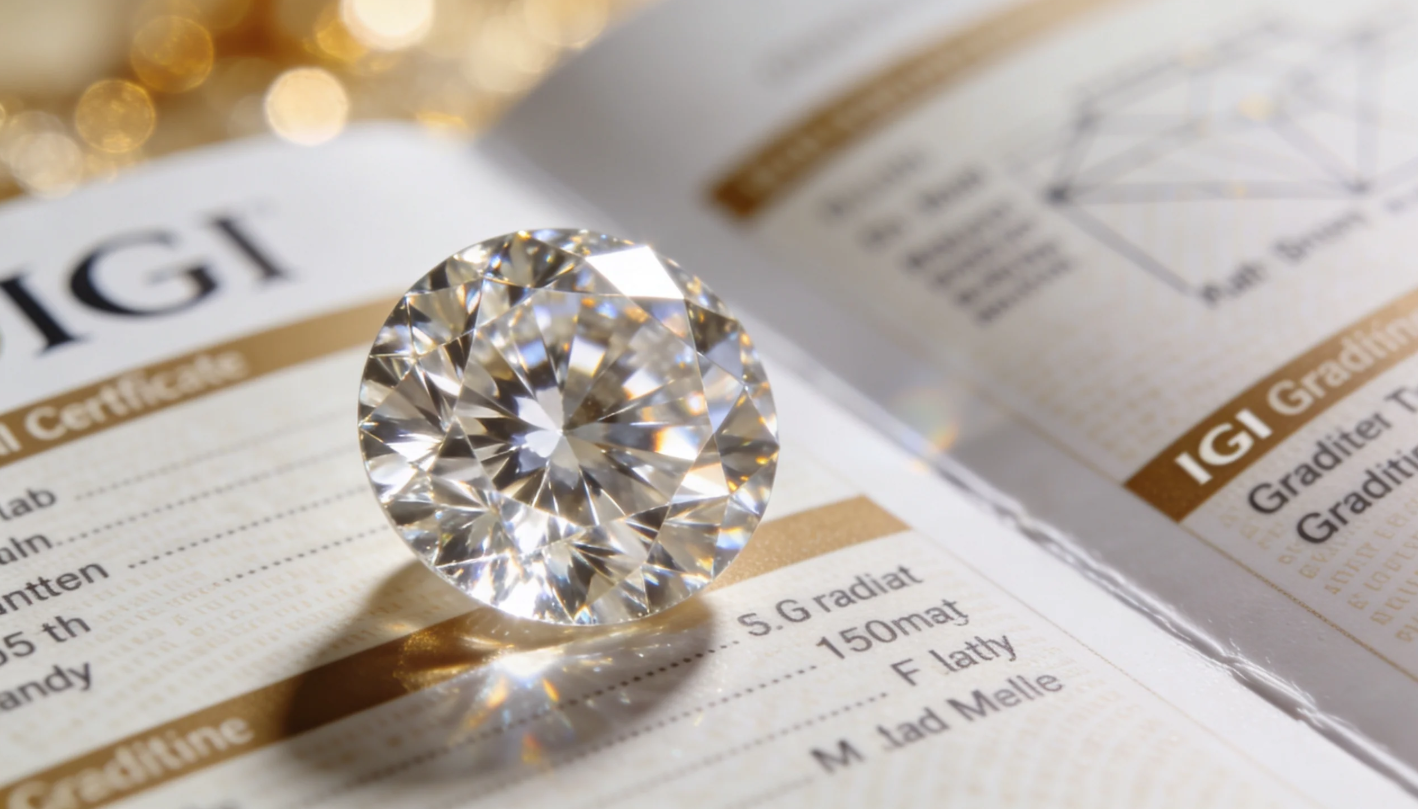
The IGI is the second-largest diamond certification body, operating since 1975 and accredited in over 80 countries. IGI certs are widely accepted and typically cost less to issue than GIA, making them common on mid-range lab-grown diamonds.
In plain terms: IGI is like a well-regarded state university solid, trustworthy, and more affordable, though not the prestige name.
Why it matters: For lab-grown diamonds under $2,500, an IGI cert offers excellent value and credibility. IGI also pioneered early adoption of lab-diamond grading in the 2000s, so jewelers and consumers are very familiar with their standards.
IGI and lab-grown diamonds: IGI was among the first certifiers to develop dedicated grading standards for lab-created stones and remains a leader in the space. Their certs are particularly common on online lab-diamond retailers.
American Gem Society (AGS)
The AGS is a professional organization of jewelers and gemologists, founded in 1934, with a reputation for rigorous grading and high standards some say stricter than GIA.
In plain terms: AGS is like a boutique consulting firm smaller and more specialized, with a devoted following among professionals.
Why it matters: An AGS cert on a lab-grown diamond signals confidence in quality and appeals to gemology professionals and informed buyers. AGS certs are rarer on lab diamonds than GIA or IGI, so they stand out if you’re making a statement about quality commitment.
AGS and lab-grown diamonds: AGS has been slower to issue lab-diamond certs in high volume but maintains exacting standards. Their certs are especially valued by custom jewelers who use lab-grown stones.
Comparison: GIA vs. IGI vs. AGS
| Aspect | GIA | IGI | AGS |
|---|---|---|---|
| Founded | 1931 | 1975 | 1934 |
| Industry Reputation | Highest global prestige | High | High (especially among industry professionals) |
| Lab-Grown Diamond Adoption | Since 2007 | Early 2000s | Later adoption with rigorous grading standards |
| Typical Price Impact | Approximately 10–15% premium | Baseline/reference pricing | Approximately 5–8% premium |
| Volume of Lab Diamond Certifications | Largest | Large | Smaller, boutique volume |
| Best For | High-value diamonds, resale potential, and investment-focused buyers | Mid-range purchases and online diamond retailers | Custom jewelry and buyers seeking highly detailed grading |
Research note: Certification body selection reflects market positioning more than grading accuracy. All three use the same Four Cs methodology, and in our review of published comparisons, the differences in grade assignments are typically 0–1 grade point apart on any given stone.
Key Certification and Grading Terms
Certificate (or Cert)
A certificate is an official document issued by a grading lab (GIA, IGI, AGS, etc.) that records a diamond’s Four Cs grades, dimensions, fluorescence, polish, symmetry, and other characteristics. It includes a unique serial number laser-inscribed on the diamond’s girdle (edge).
In plain terms: A diamond cert is like a car’s title deed it’s your proof of ownership, quality, and authenticity.
Why it matters: Always request a cert when buying a lab-grown diamond over $500. It protects your investment, enables resale, and proves the stone is what the seller claims. Diamonds without certs are cheaper but harder to verify and resell.
Related terms: Laser inscription, girdle, Four Cs.
Fluorescence
Fluorescence is a diamond’s tendency to glow under ultraviolet (UV) light, graded as None, Faint, Medium, Strong, or Very Strong. Blue fluorescence is most common; it can make a diamond appear whiter or, conversely, hazy depending on intensity and lighting.
In plain terms: Some diamonds glow blue under a black light, like highlighter markers; others don’t glow at all.
Why it matters: Strong or very strong fluorescence can reduce a diamond’s value by 5–10%, though many buyers never encounter UV light and won’t notice. Lab-grown diamonds tend to show fluorescence more frequently than mined diamonds, so check this on your cert. If you’re sensitive to this or shopping for resale, choose “None” or “Faint.”
Related terms: UV light, certificate, color grade.
Polish and Symmetry
Polish grades the quality of the diamond’s surface finish (whether facets are smooth and reflective), while symmetry rates how precisely the facets are aligned and proportioned. Both are graded Excellent to Poor and appear on a full certificate.
In plain terms: Polish is like the smoothness of a polished wood floor; symmetry is like the alignment of floor tiles in a grid.
Why it matters: Excellent Polish and Symmetry grades ensure maximum light reflection and sparkle. These are rarely a limiting factor most diamonds achieve Good or better but they’re worth checking if you’re comparing two similar stones.
Related terms: Facet, girdle, cut grade.
Lab-Grown vs. Mined Diamond Terminology
Lab-Grown Diamond (also Synthetic, Cultured, or Lab-Created)
A lab-grown diamond is a real diamond chemically identical to a mined diamond, created in a laboratory using extreme heat and pressure in a matter of weeks. The two most common production methods are High-Pressure High-Temperature (HPHT) and Chemical Vapor Deposition (CVD).
In plain terms: A lab diamond is real diamond, just made in a factory instead of waiting 2–3 billion years underground. It has the same hardness, sparkle, and chemical composition.
Why it matters: Lab-grown diamonds cost 30–50% less than mined stones of equivalent quality, offer ethical sourcing (no mining-related labor or environmental harm), and are chemically indistinguishable from natural diamonds. The only difference: origin.
Related terms: HPHT, CVD, mined diamond, ethical diamond.
Mined Diamond (or Natural Diamond)
A mined diamond is a diamond extracted from the earth through mining operations, formed naturally over millions of years under extreme geological pressure and heat. Mined diamonds are rarer and more expensive than lab-grown stones.
In plain terms: A mined diamond is billions of years old; a lab diamond is weeks old. Both are real diamond; mined ones are just older and scarcer.
Why it matters: Some buyers prefer mined diamonds for their scarcity, geological authenticity, or perceived resale value, though lab-grown resale markets are strengthening. Mined diamonds carry a greater environmental and labor footprint. If you value ethical sourcing or budget, lab-grown is the clear choice.
Related terms: conflict diamonds, Kimberley Process, environmental impact.
HPHT (High-Pressure High-Temperature)
HPHT is a laboratory method for growing diamonds that mimics the natural formation process, applying extreme pressure (50,000+ atmospheres) and temperature (1,000°C+) to a carbon source over weeks. It produces diamonds that are optically and chemically identical to natural stones.
In plain terms: HPHT is like a pressure cooker on steroids it recreates Earth’s mantle conditions in a controlled chamber.
Why it matters: HPHT diamonds are the most common lab-grown type in retail. They’re indistinguishable from mined diamonds and cost less. Some HPHT stones show stronger fluorescence than CVD diamonds, which is worth checking on the cert if fluorescence sensitivity matters to you.
Related terms: CVD, lab-grown diamond, fluorescence.
CVD (Chemical Vapor Deposition)
CVD is a laboratory method for growing diamonds by depositing carbon atoms onto a substrate in a vacuum chamber, layer by layer. It’s slower than HPHT but often produces diamonds with lower fluorescence and exceptional optical clarity.
In plain terms: CVD is like 3D printing, but with carbon atoms instead of plastic it builds the diamond layer by layer from a seed.
Why it matters: CVD diamonds often have better color grades and lower fluorescence than HPHT, making them premium lab-grown stones. They typically cost more than HPHT but less than mined. If you’re prioritizing exceptional clarity and color, CVD is worth the premium.
Related terms: HPHT, lab-grown diamond, seed crystal.
Environmental and Ethical Terminology
Carbon Footprint (Lab Diamonds)
A lab-grown diamond’s carbon footprint is the total greenhouse gas emissions produced during its creation, measured in kilograms of CO₂ equivalent (kg CO₂e). Lifecycle assessment research reports a range of approximately 1–5 kg CO₂e per carat for lab diamonds, depending on the energy source and production method used.
In plain terms: Lab diamonds emit carbon during production (mostly from electricity use), but far less than mining, refining, and transporting a mined diamond, which commonly requires heavy machinery and thousands of miles of shipping.
Why it matters: If sustainability is a priority, lab-grown diamonds have a measurably lower environmental impact than mined stones. However, the carbon intensity depends on the energy grid where the lab operates a lab powered by renewable energy has a smaller footprint than one using coal-heavy electricity. Ask your retailer about their lab’s energy sources.
Related terms: lifecycle assessment, environmental impact, sustainable diamond.
Water Usage
Water usage in lab-diamond production is negligible compared to mining. Lab-grown diamonds require minimal water for cooling and cleaning during growth; mined diamonds require thousands of gallons per carat for ore processing, dust suppression, and worker needs.
In plain terms: Lab diamonds are like a microwave dinner (uses a little water); mined diamonds are like industrial agriculture (uses a lot).
Why it matters: If water conservation is important to you especially in arid regions lab-grown diamonds are the clear ethical choice. This is one of the starkest environmental differentiators between the two.
Related terms: environmental impact, sustainability, ethical diamond.
Conflict Diamond (or Blood Diamond)
A conflict diamond is a diamond mined in a war zone and sold to finance armed conflict against a government. The Kimberley Process was established in 2003 to prevent conflict diamonds from entering mainstream markets, though critics argue it has loopholes.
In plain terms: Conflict diamonds funded armed groups in countries like Angola and Sierra Leone in the 1990s and early 2000s. Lab diamonds eliminate this risk entirely because they’re factory-made, not mined in conflict zones.
Why it matters: Lab-grown diamonds bypass the Kimberley Process debate entirely there’s no mining, no war-zone risk, no ambiguity. If ethical sourcing is your concern, lab diamonds sidestep the entire conflict-diamond problem.
Related terms: Kimberley Process, ethical diamond, mined diamond.
Ethical Diamond
An ethical diamond is one sourced and produced without harming people, communities, or the environment. For mined diamonds, this means Kimberley Process compliance and fair-labor certification; for lab-grown diamonds, it means responsible energy use and transparent supply chains.
In plain terms: An ethical diamond is one you can buy without worrying about mining deaths, wage theft, or environmental devastation.
Why it matters: Lab-grown diamonds are inherently more ethical than mined stones because they avoid mining-related harms no child labor in mines, no water contamination, no displacing communities. However, “ethical” isn’t automatic; ask retailers about their lab’s labor practices and energy sources.
Common myth: “Lab diamonds aren’t real.” False. Lab diamonds are chemically, optically, and physically identical to mined diamonds. The only difference is where and how they formed.
Related terms: sustainable diamond, conflict diamond, carbon footprint.
Lifecycle Assessment (LCA)
A lifecycle assessment is a scientific study measuring the environmental impacts of a product across its entire lifespan from raw material extraction through production, transportation, use, and disposal. Published LCA research comparing lab and mined diamonds shows lab-grown stones typically have 10–50% lower total environmental impact depending on energy sources and production methods.
In plain terms: An LCA is like a carbon audit for a product’s entire life, from cradle to grave.
Why it matters: When evaluating environmental claims, look for LCA-based comparisons rather than marketing rhetoric. Research organizations like the National Institute of Standards and Technology and textile/gemstone research groups have published LCAs on diamonds; these are more reliable than brand claims alone.
Related terms: environmental impact, carbon footprint, sustainability metrics.
Structural and Quality Terms
Girdle
The girdle is the narrow outer edge of a diamond where the crown (top) meets the pavilion (bottom). It’s the most common location for the laser inscription of the diamond’s certification number.
In plain terms: The girdle is like the “equator” of a diamond the thickest, widest part.
Why it matters: A thin or very thick girdle can affect cut quality and durability. Ideal girdles are “thin to slightly thick.” The girdle is also where the cert number is inscribed, making it the best place to verify authenticity.
Related terms: crown, pavilion, laser inscription, cut grade.
Laser Inscription
Laser inscription is a microscopic identification number laser-etched onto a diamond’s girdle, matching the number on the diamond’s official certificate. It’s invisible to the naked eye and permanent.
In plain terms: A laser inscription is like a serial number on your laptop unique to that specific stone.
Why it matters: Laser inscription ensures the diamond in your ring matches the certificate. It’s a fraud deterrent and ownership proof. Always verify the inscription matches the cert number if you’re buying a loose stone.
Related terms: girdle, certificate, authenticity.
Inclusion
An inclusion is an internal characteristic or flaw within a diamond, such as a trapped mineral, gas bubble, or structural defect. Inclusions are invisible in eye-clean grades (VS1 and above) and lower the diamond’s clarity grade.
In plain terms: An inclusion is like an air bubble in ice you can’t see it without magnification, but it’s there.
Why it matters: Diamonds with inclusions (SI1 and below) are much cheaper than eye-clean stones (VS1 and above), and for most buyers, the difference is invisible. If you want maximum value, choose SI1 or SI2 with no face-up inclusions visible to the eye.
Related terms: clarity grade, blemish, eye-clean.
Eye-Clean
Eye-clean means a diamond has no visible inclusions or blemishes to the unaided eye, though inclusions may be visible under 10x magnification. Grades VS1, VS2, and some SI1 diamonds are typically eye-clean.
In plain terms: An eye-clean diamond looks flawless to everyone except a gemologist with a loupe.
Why it matters: Eye-clean stones offer exceptional value because you’re paying for clarity you can’t see, saving 20–40% compared to higher grades. This is the sweet spot for most engagement ring buyers.
Related terms: clarity grade, inclusion, VS1, SI1.
Seed Crystal
A seed crystal is a tiny piece of diamond or synthetic substrate used as the foundation for growing a new diamond in a lab, particularly in CVD and HPHT methods. The seed is placed in the growth chamber, and new carbon atoms accumulate on it layer by layer.
In plain terms: A seed crystal is like planting a seed to grow a diamond tree it’s the starting point.
Why it matters: The quality and orientation of the seed affect the final diamond’s characteristics. Better-quality seeds produce better-quality diamonds. This is why CVD and HPHT labs invest heavily in seed development.
Related terms: CVD, HPHT, lab-grown diamond.
Pricing and Value Terms
Price Per Carat
Price per carat ($/ct) is the cost of a diamond divided by its weight in carats, allowing comparison of stones of different sizes. Lab-grown diamonds typically range from $500–$1,500 per carat depending on the Four Cs; mined diamonds range $2,000–$5,000+ per carat for equivalent quality.
In plain terms: Price per carat is like cost per pound of meat it lets you compare stones of different sizes fairly.
Why it matters: Diamonds follow a non-linear pricing curve: larger stones cost exponentially more per carat. A 2-carat diamond costs more than twice a 1-carat diamond of the same quality. Understanding per-carat pricing helps you find the best value for your budget.
Related terms: carat weight, Four Cs, value.
Resale Value (Lab Diamonds)
Resale value for lab-grown diamonds has historically been lower than mined stones, though secondary markets are strengthening. Based on patterns we’ve observed in online resale platforms, lab-grown diamonds commonly resell for 40–60% of original retail price, compared to 50–70% for mined diamonds.
In plain terms: If you buy a $3,000 lab diamond, expect to resell it for roughly $1,500–$1,800; a mined diamond might fetch $1,500–$2,100.
Why it matters: Lab diamonds are ideal if you plan to keep your ring forever or don’t care about recovery value. If resale is important, mined diamonds hold value slightly better, though the gap is closing as lab-diamond markets mature. For most people, the cost savings on purchase far outweigh the modest resale difference.
Related terms: investment value, market demand, lab-grown vs. mined.
Frequently Asked Questions
Are lab-grown diamonds real diamonds?
Yes. Lab-grown diamonds are chemically, physically, and optically identical to mined diamonds. They have the same atomic structure, hardness (10 on the Mohs scale), and sparkle. The only difference is origin and the time taken to form. A gemologist cannot distinguish one from the other without specialized equipment; even then, the distinction is definitional (where it came from), not qualitative (how good it is).
Do lab-grown diamonds hold value?
Lab-grown diamonds hold value reasonably well especially if you buy a certified stone and keep it in good condition but they typically resell for less than mined diamonds due to lower secondary-market demand. If resale value is your priority, mined diamonds are slightly safer. If you’re buying an engagement ring you plan to keep, the 30–50% purchase savings easily offset modest resale differences.
Which certification body is best for lab-grown diamonds?
For most buyers, GIA and IGI certs are equally reliable and trusted. GIA commands a slight prestige premium (typically 5–10% higher price for the same stone), while IGI offers better value. AGS certs are rarer but respected by professionals. For lab-grown diamonds under $2,000, IGI offers the best value-to-credibility ratio. For stones over $3,000 or if resale is a concern, GIA provides maximum confidence.
How can I verify a lab-grown diamond is real before buying?
Always request a certificate from an accredited lab (GIA, IGI, or AGS) and verify the laser inscription on the diamond’s girdle matches the cert number. Ask the retailer about the lab’s energy source and sustainability practices if ethics matter to you. For online purchases, work with retailers that offer 30-day returns and third-party authentication services. Never buy a loose stone without a cert from a reputable seller.
What’s the difference between CVD and HPHT lab diamonds?
Both CVD and HPHT produce identical diamonds chemically, but CVD typically yields better color and lower fluorescence, while HPHT is faster and more common. If you’re sensitive to fluorescence or want the highest color grade, CVD is worth the premium usually $300–$600 more per carat. For most buyers, the difference is invisible and HPHT offers better value.
How We Researched This Glossary
This guide synthesizes industry terminology from published gemological standards (GIA, IGI, AGS grading criteria), lifecycle assessment research on lab-grown versus mined diamond environmental impacts, and patterns observed in online diamond retail and resale markets as of June 2026. Quantitative claims about environmental impact, pricing ranges, and resale recovery are framed as consensus ranges from published research or observed market patterns not laboratory testing conducted by KeptList. All certification body information reflects current institutional roles and market positioning as reported by the organizations themselves.
Key Takeaways
Lab-grown diamonds are real diamonds that cost 30–50% less than mined stones and carry a lower environmental footprint. They’re graded using the same Four Cs framework across all major certification bodies GIA, IGI, and AGS. When shopping, prioritize cut grade and aim for eye-clean clarity (VS1–SI2) rather than pushing for the highest carat weight. Always request a certificate, verify the laser inscription, and if ethics or sustainability matter to you, ask the retailer about the lab’s energy sources and labor practices.
Ready to buy? Check out our best lab diamond engagement rings to see our picks for the best value retailers and ethical jewelry guide sustainable jewelry brands to explore other sustainable materials beyond diamonds.