
Subwoofer Crossover Settings & LFE Management: The Complete Tuning Guide
A subwoofer running at the wrong crossover frequency will either overwhelm your mains or leave a bass hole in the middle. Phase misalignment causes cancellation and dead spots. Wrong LFE management creates muddy dialogue in movies or boomy music playback. Most owners never touch these settings after unpacking and it shows.
This guide walks through the core tuning parameters that actually matter: how to set your bass crossover frequency correctly, align phase with your speakers, manage the LFE channel in both movies and music, and diagnose what’s gone wrong when your setup sounds disconnected.
Understanding Crossover Frequency: The Foundation
The crossover frequency is the point where bass duties hand off from your main speakers to the subwoofer. Set it too high, and your mains struggle with low-mid frequencies they can’t reproduce cleanly. Set it too low, and you create a gap the subwoofer sits idle while your speakers labor on frequencies they were never meant to handle.
Why Crossover Frequency Matters
Your main speakers have a lower frequency limit. This isn’t a suggestion; it’s a hard boundary set by driver size and cabinet volume. A typical bookshelf speaker might bottom out at 80–100 Hz. Tower speakers often reach lower, sometimes 40–50 Hz, but they rarely stay clean below 60 Hz.
The crossover frequency bridges this gap. It tells the subwoofer: “Start taking over here.” Everything below that point goes to the sub; everything above goes to the mains (or both, depending on your AV receiver’s configuration).
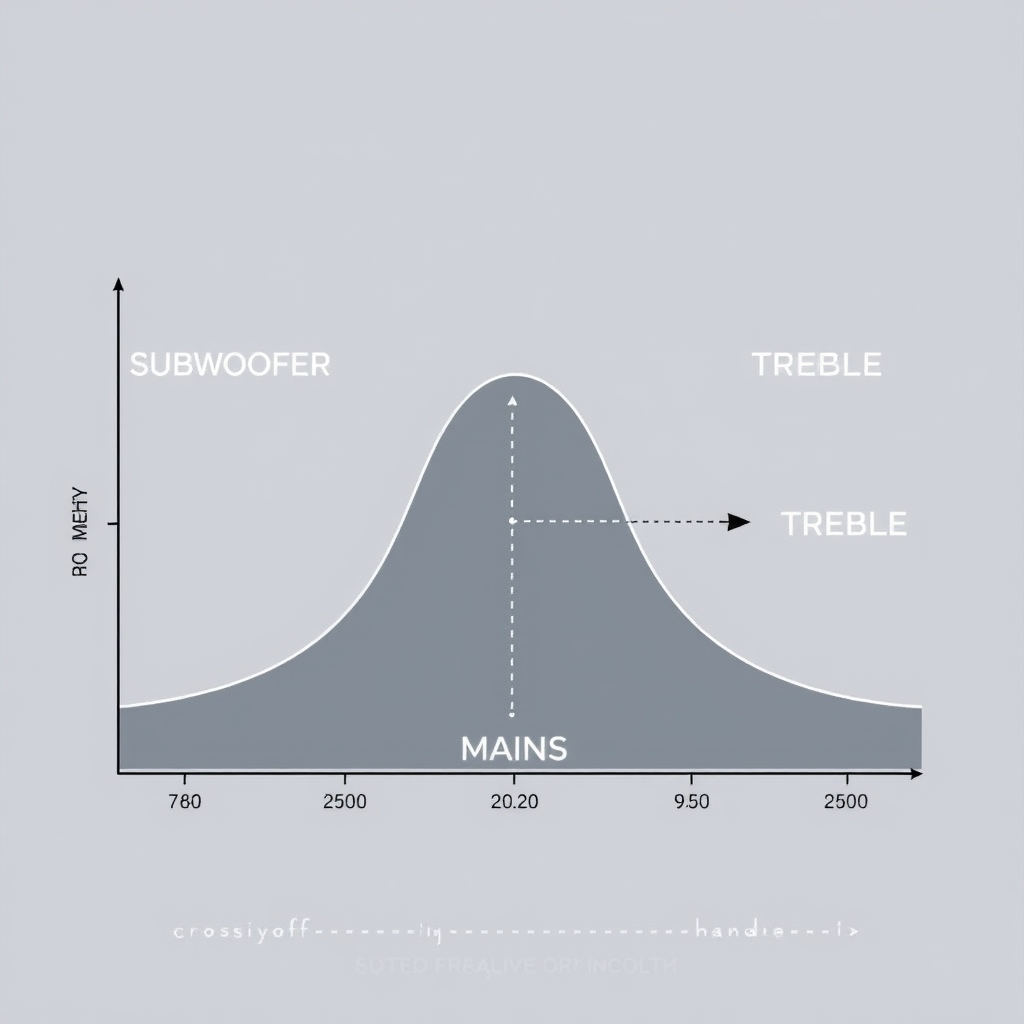
When the hand-off is clean, bass feels integrated one continuous spectrum. When it’s clumsy, you hear a bump or hole at that transition point. Bass seems to come from different places in the room.
How to Choose Your Crossover Frequency
Start with your main speakers’ rated lower limit. If the manual says 80 Hz, that’s your baseline crossover point. If it says 40 Hz, you have flexibility but “rated” often means audible, not clean. Rated specs typically describe the point where output drops 6 dB; in practice, most listeners notice the degradation starting 10–15 Hz above that figure.
In practice, most listening rooms work well with a crossover set 10–20 Hz above the main speaker’s stated limit. A speaker rated to 80 Hz might sound best with the sub taking over at 80–100 Hz. This gives your mains a small safety margin and lets the subwoofer shoulder frequencies your speakers can’t reproduce as cleanly.
For surround speakers (if you’re using them), set the crossover higher often 100–150 Hz. Surround speakers are smaller and usually placed at ear level, not on the floor. They struggle more with low-end duty than your mains do.
Measuring Your Room’s Bass Response
Theory and practice diverge in real rooms. Wall bounce, cabinet placement, and room modes all color the bass your speakers actually produce. A measurement app like REW (free, open-source) or an inexpensive calibration microphone can show you how your setup actually sounds before you spend hours chasing the “right” crossover.
Run a simple frequency sweep. Sit in your main listening position and note where peaks and dips occur. If your mains have a nasty peak at 60 Hz, pushing the crossover up to 80 Hz might reduce that boom. If there’s a null (dip) at 40 Hz, the subwoofer needs to fill that which means the crossover must sit above that dip.
Don’t obsess over exact numbers. A crossover moved from 80 Hz to 90 Hz won’t cause audible changes in most content. The important move is finding the zone where the hand-off feels seamless and your mains aren’t strained.
Phase Alignment: Timing and Coherence
Crossover frequency is only half the story. If your subwoofer’s sound arrives at your ears at a different time than your mains, they’ll partially cancel each other out. You’ll hear a loss of punch and clarity at the crossover point.
This is a phase problem not phase shift, but phase misalignment.
Why Phase Matters
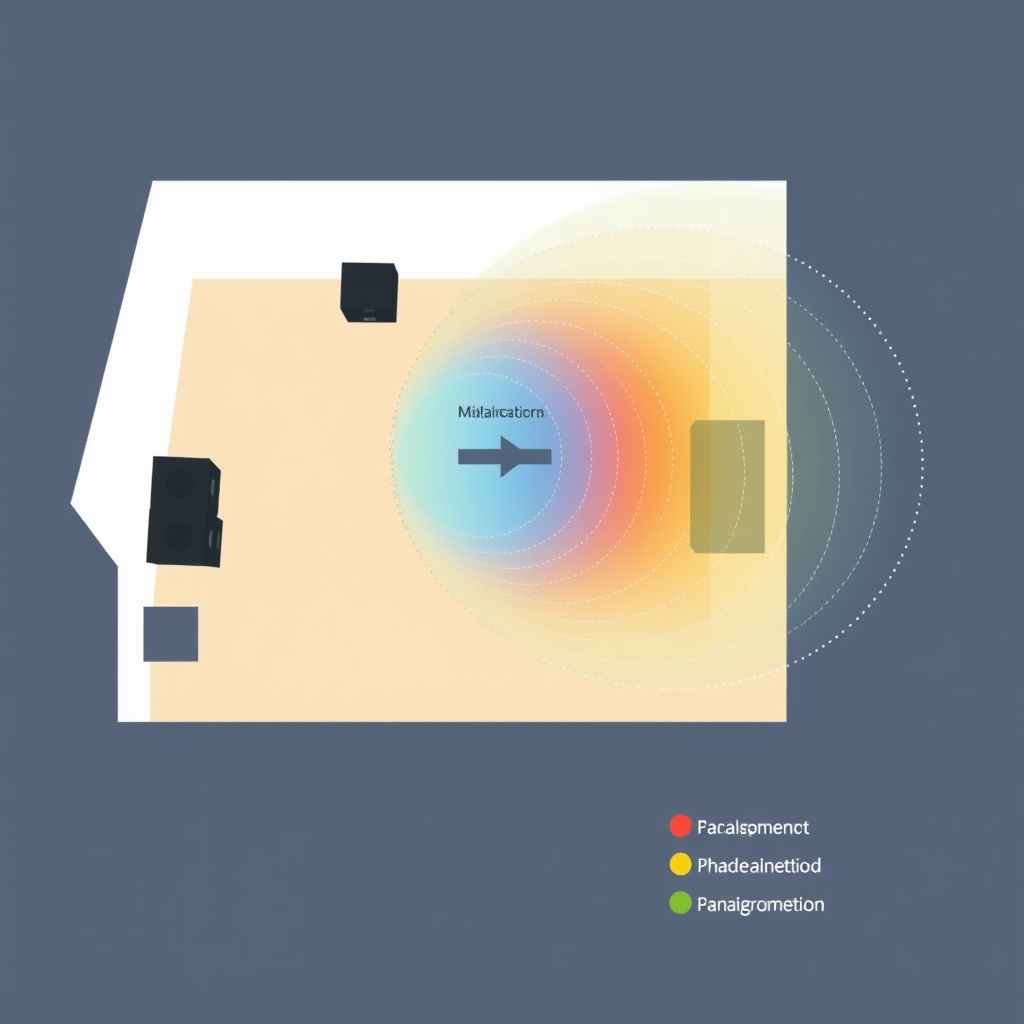
Sound travels at roughly 1,125 feet per second in air at typical room temperature fast enough that even a few feet of extra distance between your subwoofer and your main speakers adds measurable delay. A subwoofer placed 5 feet behind your main speakers will generate bass waves that arrive noticeably later. Those delayed waves interfere with the waves from your mains, creating a comb-filter effect: some frequencies reinforce, others cancel.
The closer your subwoofer is to your mains, and the faster its driver responds, the less this matters. But in real rooms, you’re almost never sitting equidistant from both. The bass usually needs correction.
The Phase Control
Most subwoofers include a phase adjustment usually a dial labeled 0–180 degrees, or sometimes 0–360 degrees in finer increments. This electrically delays or advances the subwoofer’s signal relative to the mains.
The goal is simple: find the setting where bass sounds fullest and most integrated. Your mains and sub should feel like a single source.
How to adjust phase in your listening space:
- Play a bass-heavy track or movie scene you know well. Use something with a clear low-end punch a kick drum, a car engine, explosions.
- Start at the 0-degree setting. Listen for clarity and impact.
- Switch to 180 degrees. Does it sound fuller or thinner?
- If 180 degrees sounds better, stop there. If 0 degrees is better, leave it there.
- On a receiver with finer increments (0–360 degrees), try increments of 45 degrees if the 0/180 choice feels marginal.
You’re not chasing perfection. You’re listening for the setting where bass integration feels natural and the kick or impact feels solid not hollow or overly boomy.
Avoid the temptation to measure phase with a microphone and calculator unless you’re already experienced. The room is not linear; your ears are the measuring instrument that matters.
LFE Channel Management: Movies vs. Music
LFE stands for Low-Frequency Effects. It’s the dedicated subwoofer channel in surround sound formats (5.1, 7.1, Atmos, etc.). In movies, LFE carries explosions, impacts, and other designed bass effects. In music, most sources have no LFE channel the bass lives in the main L/R channels.
How your system handles LFE has a huge impact on whether your subwoofer sounds right.
LFE Gain and Calibration
Your AV receiver has separate volume controls for the subwoofer and for the LFE channel. These are often conflated, but they’re different:
- Subwoofer master level controls the overall loudness of the sub in your system.
- LFE gain (or “LFE level”) controls how much the dedicated LFE track contributes relative to bass extracted from the main channels.
If your LFE gain is set too high, movies will have exaggerated bass effects that drown out dialogue. Too low, and impact scenes feel weak.
Most receivers ship with LFE gain at 0 dB, which is neutral. That’s usually correct. Only adjust it if movies consistently sound bass-heavy or bass-light compared to the main mix.
Subwoofer vs. Main Speaker Bass Contribution
Here’s where it gets practical. Your AV receiver can send bass two ways:
- To the subwoofer only (mains set to “small” or “off”, LFE routed to sub).
- To both the mains and the subwoofer (mains set to “large”, LFE routed to sub).
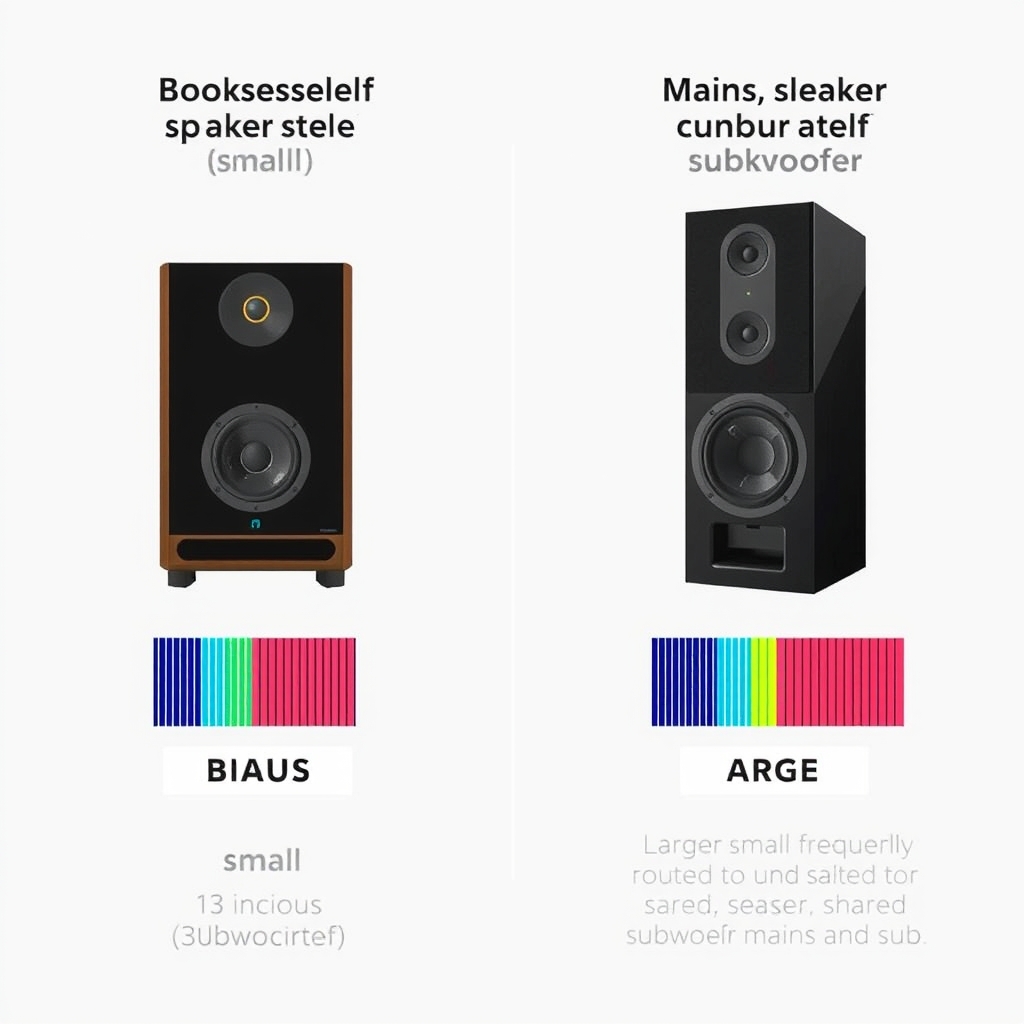
If your main speakers are small (bookshelf or satellite), set them to “small” and route all bass below the crossover to the subwoofer. Let your mains handle only midrange and treble. The subwoofer carries the entire bass load.
If your mains are large (full-range towers), you can set them to “large” and let them play bass and send the same region to the subwoofer as well. This is called “bass management with LFE summing.” It adds a layer of bass reinforcement but can also cause muddiness if the phase isn’t perfect.
For most setups, especially smaller mains, the “small” setting with the subwoofer handling all bass below the crossover is cleaner and easier to tune.
LFE in Stereo Music
Stereo music has no LFE channel. All bass lives in the L/R tracks. This means:
- The subwoofer pulls bass only from what the crossover extracts from your main channels.
- LFE gain controls nothing (because there’s no LFE to control).
- The subwoofer’s contribution to music is entirely set by the master subwoofer level.
This is why some owners find their subwoofer sounds different in movies versus music. In movies, the dedicated LFE channel is a separate, usually louder signal. In music, the subwoofer is just catching the low end of a stereo mix.
If your subwoofer is too quiet during music, don’t raise LFE gain that won’t help. Raise the subwoofer master level instead.
Speaker Integration: The Practical Tuning Process
Theory is one thing. Sitting in your listening chair and hearing a smooth, integrated bass response is another. Here’s how to get there.
Step 1: Set the Crossover Conservatively
Start with the crossover frequency 10–15 Hz above your main speaker’s rated lower limit. If you’re unsure, 80 Hz is a safe default for bookshelf speakers and 60 Hz for towers. You can refine this later.
Step 2: Calibrate Levels
Use your receiver’s built-in calibration tone (if it has one) or a calibration app. Set the subwoofer’s master level so that it sounds balanced with your mains not louder, not quieter.
A useful check: play a familiar movie or music track. The bass should feel like it’s part of the whole system, not a separate device. If you’re aware of the subwoofer as a distinct source, it’s either too loud or out of phase.
Step 3: Adjust Phase
Use the phase control to minimize the “hole” at the crossover point. Play a track with clear low-end impact. Listen for fullness.
If you have a measurement microphone, you can measure phase response; for most people, ear adjustment with familiar material is faster and works just as well.
Step 4: Experiment with Crossover Frequency
Once phase is set, try raising the crossover frequency by 5–10 Hz. Listen to how it affects kick drums, bass guitars, and explosive movie scenes. Does it sound cleaner? More integrated? Or does the subwoofer feel too active?
If moving the crossover up reveals a gap (bass suddenly gets thinner), move it back down. If it feels more seamless, stay higher.
The goal is the crossover frequency where you stop noticing the subwoofer as a separate device.
Step 5: Fine-Tune Distance and Placement
If integration still feels off, the subwoofer’s physical placement might be the issue. Bass in rooms interacts with walls and corners it’s not linear from the source.
Try moving the subwoofer 6–12 inches in any direction. Re-test. Some positions will have peaks or nulls that hurt integration; others will smooth things out.
In a small listening room, even a 1-foot move can produce audible swings in bass level at certain frequencies room modes can add or subtract a surprising amount of energy in a confined space. This is a real issue that crossover and phase settings can’t fully fix. Placement matters.
Common Tuning Mistakes to Avoid
Mistake 1: Crossover Frequency Set Too Low
If your mains are struggling with frequencies above the crossover, you’ve set it too low. Signs include muddy dialogue (the 500–1,000 Hz range is compromised), weak kick drums, or a sense that your mains sound strained.
Raise the crossover by 10–20 Hz and retest.
Mistake 2: Subwoofer Level Too High
If every bass note is exaggerated and overwhelming, the subwoofer is running too loud. Lower the master level by 2–3 dB and listen again. Bass should enhance, not dominate.
Mistake 3: Ignoring LFE vs. Main Channel Bass
If movies sound bass-heavy but music sounds right, check your LFE gain. It might be boosted above 0 dB. Reset it to 0 dB or lower until the balance feels right across both content types.
Mistake 4: Phase Never Tested
Many owners leave phase at 0 degrees because it’s the default. Spending 5 minutes comparing 0 and 180 degrees can reveal whether your subwoofer is working for or against your mains. It’s worth doing once.
Mistake 5: Crossover Frequency as a Volume Control
Some owners think raising the crossover makes the subwoofer louder. It doesn’t. It just shifts which frequencies the subwoofer handles. It’s a tonal tool, not a volume tool. Use the master level for volume.
Budget Considerations: Where Tuning Actually Matters
Subwoofer tuning pays dividends at every price point, but the return on effort is different. Note that price ranges reflect general market tiers as observed at time of writing and may shift.
Budget subwoofers (roughly $100–$300): Tuning is critical. A cheap subwoofer with wrong settings will sound terrible. Spend 30–45 minutes on crossover and phase adjustment. It can transform the outcome.
Midrange subwoofers (roughly $300–$800): Tuning helps but is less forgiving. The subwoofer’s inherent response starts to matter more than settings alone. Still worth 20–30 minutes of adjustment.
Premium subwoofers (roughly $800 and up): Tuning is important but the gains feel less dramatic. The subwoofer is designed to integrate well from the factory. Fine-tuning is still worthwhile you may hear meaningful improvement but the low-hanging fruit is smaller than at budget tiers.
Regardless of price, the crossover frequency and phase settings are free. Spend the time.
Key Factors to Consider When Tuning
1. Main Speaker Size and Type
Large tower speakers can handle lower crossover frequencies than small bookshelves. This changes everything downstream phase, level matching, and how much work the subwoofer has to do.
2. Room Size and Shape
Small rooms develop standing waves and modes more aggressively. A small bedroom will have more pronounced bass peaks and nulls than a large living room. This might require a lower crossover (to let the subwoofer fill nulls more precisely) or phase adjustments to combat cancellation.
3. Subwoofer Placement Flexibility
If you can move the subwoofer, you have more tuning tools. If it’s locked into a corner, you’re limited to crossover, level, and phase adjustment.
4. Content You Listen To Most
If you’re 80% music and 20% movies, tune for music. Set the LFE gain low and focus on crossover and phase for stereo bass integration. If it’s the reverse, prioritize LFE management and impact clarity.
5. AV Receiver Features
Some receivers let you adjust crossover per channel (80 Hz for mains, 100 Hz for surrounds). Others lock you to one global crossover. Know your receiver’s limits before you start.
6. Subwoofer Driver Quality
A faster-responding driver (tighter cone, better amplifier) will integrate more easily. A sluggish driver will show phase issues no matter what you do. This is why placement and phase matter more on budget subwoofers.
7. Your Listening Position
Bass response varies significantly across the room. If you listen in one chair 80% of the time, tune for that seat. If you use the whole space, aim for an average that works everywhere.
Top Picks for Easy Tuning
While tuning itself is free, some subwoofers are designed to be easier to integrate:
- Compact subwoofers (8–10 inch drivers) are easier to integrate than large ones because they mate well with smaller mains and are more forgiving of room placement.
- Subwoofers with onboard DSP (digital signal processing) let you adjust phase, frequency response, and level from one control panel instead of hunting through your receiver’s menus.
- Sealed enclosures integrate more cleanly than ported ones at higher crossover frequencies. Ported designs are louder but can boom more easily if mistuned.
FAQ: Subwoofer Tuning and Integration
What’s the difference between phase and polarity?
Phase is a timing difference in the signal. Polarity is a wiring difference (positive/negative swapped). Polarity flips the waveform 180 degrees permanently. Phase adjusts how much delay or advance the subwoofer’s signal has. Most modern subwoofers control phase electronically; polarity is a physical swap (usually a switch inside or on the back). Test phase first; only address polarity if phase adjustment maxes out and still sounds wrong.
Can I use the same crossover frequency for both mains and surrounds?
No. Surrounds are usually smaller and placed at ear level, not on the floor. An 80 Hz crossover for mains might make sense, but surrounds often need 100–150 Hz to avoid strain. Your receiver should let you set these independently.
Does subwoofer distance from the mains matter for tuning?
Yes. The farther the subwoofer is from your main speakers, the more likely phase misalignment becomes an issue. Ideally, keep the subwoofer within 6–8 feet of the mains, or accept that you’ll need to experiment more with phase settings.
Should I use bass management if my main speakers are full-range?
You can, but it’s usually unnecessary and adds complexity. If your towers genuinely reach 40 Hz cleanly, let them handle 40 Hz and above, and set the subwoofer to take only what falls below that. In practice, most people set the crossover 10–15 Hz above the speaker’s real limit and call it done.
What if my receiver doesn’t have a phase adjustment?
Some older receivers lack phase control. Your options: (1) Move the subwoofer closer to the mains to reduce distance delay naturally. (2) Upgrade to a subwoofer with onboard phase control the signal phase-shifts inside the subwoofer’s amp, not the receiver. (3) Buy a processor or external DSP box that adds phase control rarely worth the cost. Usually, upgrading the receiver is simpler.
Why does my subwoofer sound different in bass-heavy music versus movies?
Movies have a dedicated LFE channel that’s usually mastered louder than the bass in stereo music. If LFE gain is high, movies will dominate. Adjust LFE gain down to 0 dB and retest. If the subwoofer still sounds too quiet in music, raise the master level instead of the LFE gain.
How often should I re-tune if I move furniture?
If you move your main speakers or significantly change the room’s layout, re-test phase and crossover frequency. Small furniture moves (a couch shift) usually don’t require re-tuning. Big changes moving the listening position or subwoofer location do.
Can I measure phase with a smartphone app instead of manually adjusting?
Smartphone measurement apps are useful for trending bass response, but not reliable for phase alignment. They’re too influenced by room reflections and mic placement. Ear adjustment with familiar material is faster and usually more accurate. If you have a proper measurement mic and software like REW, that’s another story but the investment is only worth it if you’re already deep into speaker optimization.
What if my subwoofer has no phase control?
You’re limited to level and crossover adjustment, plus physical placement. Move the subwoofer closer to or farther from the mains (or left/right, or forward/back) to find a position where integration sounds best. Some placements will naturally have better phase alignment than others due to room reflections. This is slower but doable.
Final Recommendations
Subwoofer tuning is not complicated, but it requires patience and a willingness to listen critically. Here’s the path forward.
If you’re setting up a subwoofer for the first time:
- Set the crossover frequency 10–15 Hz above your main speaker’s rated lower limit (or use 80 Hz as a safe default).
- Set phase to 0 degrees and listen to a familiar bass-heavy track.
- Switch to 180 degrees and compare. Stick with whichever sounds fuller.
- Adjust the subwoofer’s master level so it feels balanced with your mains, not louder.
- Play movies and music. Note whether bass integration feels seamless or separate.
- If it feels separate, try moving the subwoofer 6–12 inches and re-testing, or raise the crossover by 10 Hz.
If your current setup sounds muddy or disconnected:
- Check that your receiver’s bass management is set correctly (mains to “small” if they’re small speakers).
- Test phase (0 vs. 180 degrees) again with a familiar track.
- Lower the subwoofer level by 2–3 dB and retest.
- If using an AV receiver, check LFE gain is at 0 dB, not boosted.
- Try raising the crossover frequency by 10–15 Hz to see if the hand-off gets cleaner.
If you have the tools and time:
- Run a simple frequency response measurement at your main listening position (a free app like REW plus a calibration mic is a good starting point).
- Look for peaks and nulls. Note where they sit.
- Adjust crossover and subwoofer placement to avoid the worst nulls.
- Use phase adjustment to smooth the crossover region.
None of this costs money. The equipment you already have your subwoofer, receiver, and ears is enough. What matters is taking the time to listen carefully and adjust methodically.
A well-tuned subwoofer disappears into your system. You don’t hear it as a separate device; you hear bass as a natural, integrated part of the soundstage. That’s the goal. It’s achievable, regardless of budget.