
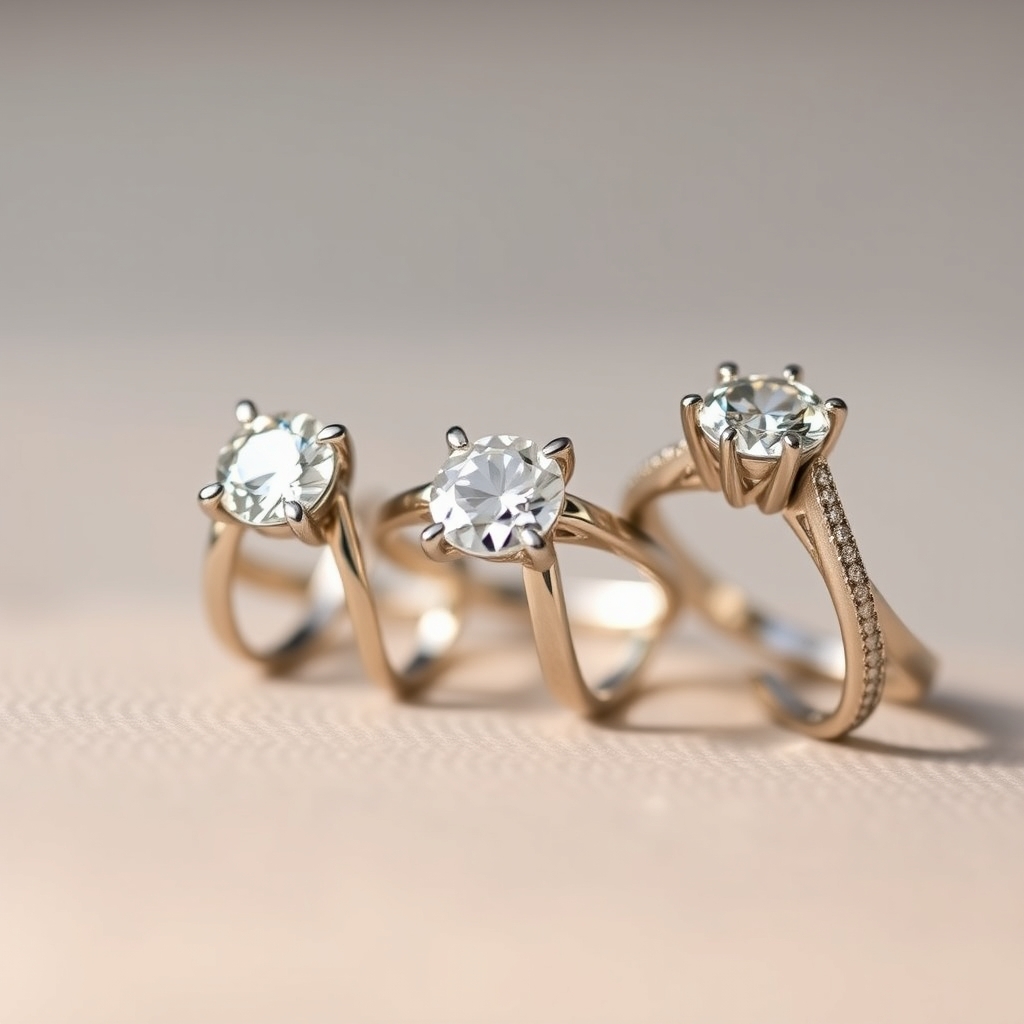
Lab-grown diamond rings and moissanite engagement rings offer the sparkle of traditional diamonds at a fraction of the cost without the ethical and environmental concerns that come with mining. If you’re shopping for an engagement ring in 2026, you have three legitimate paths: natural mined diamonds (with certified sourcing), lab-created diamonds (chemically identical to mined stones, made in weeks instead of billions of years), or moissanite (a durable silicon carbide stone that’s slightly different optically but holds its own). This guide breaks down each option, explains what ethical sourcing actually means, and shows you how to avoid overpaying for a stone that doesn’t match your values or budget.
The Three Main Materials Explained
Natural diamonds are mined from the earth. They’re rare, durable (10 on the Mohs hardness scale, per standard gemological grading), and carry the mystique of being “forever” stones but they’re also resource-intensive to extract and often carry murky sourcing histories, even with certification.
Lab-grown diamonds (also called lab-created, cultured, or synthetic diamonds) are chemically, optically, and physically identical to mined diamonds. They’re created in a lab over 6–12 weeks using one of two methods: high-pressure, high-temperature (HPHT) or chemical vapor deposition (CVD). A lab diamond typically costs 40–60% less than a comparable mined stone (observed retail as of July 2026; verify before purchasing), holds its durability, and has zero mining footprint. The catch: a lab diamond will never resell for anywhere near what you paid resale value is negligible but neither will most mined diamonds, so this isn’t the slam-dunk disadvantage it sounds like.
Moissanite is a lab-created stone made from silicon carbide. It’s nearly as hard as diamond (9.25 on the Mohs scale, per standard gemological grading), lasts effectively forever, and typically costs 80–90% less than a diamond of comparable size. The trade-off is optical: moissanite has more “fire” (rainbow sparkle) than diamond, which some people love and others find too glittery. Moissanite also has a subtle gray or yellowish tint under certain lights noticeable to a trained eye but not to most people in everyday wear.
Material Durability & Longevity: What Actually Lasts
The rule of thumb: diamond and lab-grown diamond will outlast moissanite under hard daily wear, but all three will survive a lifetime of normal use.
Diamond and lab-grown diamond both score 10 on the Mohs hardness scale the only difference is their origin. Both resist scratching and can take a knock without chipping. Lab diamonds are chemically identical to mined stones and won’t yellow, cloud, or degrade over time.
Moissanite scores 9.25 on the Mohs hardness scale, which is still extremely hard. It won’t scratch easily and won’t need replacement in your lifetime but under extreme conditions (like very hard impacts or extended exposure to abrasive surfaces), it can eventually show microscopic wear that a diamond wouldn’t. For most people wearing a ring daily, this difference is theoretical.
The real durability story is about the setting, not the stone. A diamond or lab diamond in a poorly constructed band can crack or become loose. Moissanite, being slightly less hard, can handle a less-perfect setting slightly better but a quality setting matters for all three.
Minimum spec to keep: Choose diamond, lab-grown, or moissanite based on your budget and values, not durability. All three will last 50+ years of normal wear. Invest instead in a well-made setting (solid gold, platinum, or high-quality alternatives) and plan for professional cleaning and inspection every 1–2 years.
FAQ: Durability
Will my lab-grown diamond get cloudy or yellow? No. Lab-grown diamonds are chemically identical to mined diamonds they won’t degrade or discolor any faster than a natural stone.
Does moissanite scratch easily? Not in everyday wear. Moissanite is hard enough for a lifetime of ring-wearing. Microscopic wear is possible under extreme pressure, but it’s rarely visible to the naked eye.
Optical Appearance: Color, Sparkle & What You’ll See
The rule of thumb: if you want the classic look of a diamond, lab-grown diamond is your best bet. If you’re okay with more sparkle and the possibility of a subtle tint, moissanite is lovely and will draw fewer “is that real?” questions than you might expect.
Diamonds and lab-grown diamonds display “brilliance” (white sparkle) and minimal “fire” (rainbow light). The sparkle is what most people picture when they think of an engagement ring. Both mined and lab-created diamonds look identical to the naked eye. Color grades (D = colorless, Z = light yellow) are barely noticeable below an H grade unless you’re comparing two stones side by side or looking through a jeweler’s loupe.
Moissanite has noticeably more fire than diamond you’ll see rainbows when the light hits it, especially in sunlight or under bright indoor lights. Some people find this gorgeous and prefer it to diamond’s subtler sparkle. Others find it looks “fake” or too glittery. The fire is less noticeable in premium moissanite (brands like Forever One by Charles & Colvard) and more obvious in budget moissanite from unknown sellers. Moissanite also tends to have a slight yellow or gray undertone, especially in larger sizes, which becomes visible when you compare it directly to a colorless diamond.
A critical detail: moissanite can look different under fluorescent light (offices, hospitals) versus natural sunlight. In natural light, the fire is apparent but often beautiful. Under fluorescent light, moissanite can read slightly gray or “off.” This isn’t a dealbreaker for most wearers, but it’s worth trying on moissanite in the light where you’ll wear it most.
Minimum spec to keep: If you want a stone that looks indistinguishable from a traditional diamond, buy lab-grown diamond or natural diamond in a D–H color grade. If you love the rainbow sparkle of moissanite or want the lowest price, go with moissanite but try it on in your typical lighting before committing.
FAQ: Appearance
Will people be able to tell my moissanite is fake? Most people, no. But a gemologist with a loupe can tell instantly. If you’re primarily concerned with other people’s perception, lab-grown diamond is the safer choice. If you’re happy with your decision, moissanite’s beauty is objectively real it just sparkles differently.
Does lab-grown diamond look different from mined diamond? No. They’re chemically identical. A trained gemologist can sometimes spot tiny lab-process markers under magnification, but to the naked eye, there’s zero visual difference.
Ethical Sourcing & Certifications: What Actually Matters
The rule of thumb: “ethical sourcing” is a spectrum, not a binary and the label on a box matters less than where the stone actually came from.
If you’re choosing an engagement ring partly for ethical reasons, here’s what you need to know.
Mined diamonds come with invisible history. The Kimberley Process claims to filter out conflict diamonds (stones used to finance war), but the system is widely considered toothless major retailers including De Beers have openly acknowledged its limitations. Even non-conflict diamonds carry a heavy environmental cost: mining requires heavy machinery, water depletion, and habitat disruption. Mined diamonds from Canada, Australia, or certain regulated regions are generally considered lower-impact than stones from areas with less oversight, but “lower-impact” is a relative term.
If you’re buying a mined diamond, look for:
- Kimberley Process certification (a baseline; better than nothing, but limited)
- Gemological Institute of America (GIA) certification (doesn’t guarantee sourcing, but confirms the stone’s specs)
- Jewelry retailers who commit to transparent sourcing and can tell you the mine or region of origin
- Canadian diamonds explicitly marked as such (Yellowknife, Northwest Territories diamonds are traceable and held to higher environmental standards)
Lab-grown diamonds sidestep the mining question entirely. No conflict, no habitat disruption, no water depletion at scale. The environmental cost is primarily energy: growing a lab diamond takes electricity, typically from the power grid. Some labs use renewable energy, which further reduces the footprint. The production method (HPHT vs. CVD) also affects energy use CVD is generally more efficient. Lab-grown diamonds made with renewable energy are sometimes marketed as “eco-friendly diamonds,” but even lab diamonds made with grid power have a meaningfully smaller carbon footprint than mining.
Moissanite has the cleanest ethical profile by default. It’s made in a controlled lab environment, no mining involved, and the energy footprint is smaller than lab diamond production. However, most moissanite is produced in China or India, and manufacturer transparency varies widely. Premium moissanite brands (Forever One, Charles & Colvard) publish energy and sourcing details; budget moissanite sellers often don’t.
Certifications worth knowing:
- GIA Lab-Grown Diamond Certification: Confirms the stone is lab-created and gives color/clarity/carat specs. Reputable labs include HPHT and CVD facilities in the US, Singapore, and elsewhere.
- IGI (International Gemological Institute): Another major certifier for lab diamonds; standards are comparable to GIA.
- Forever One certification (Charles & Colvard’s moissanite): Guarantees superior color and specifications; this brand is the industry benchmark for moissanite transparency.
- Fairmined certification (for precious metals, not stones): If you care about the metal in the band, look for Fairmined gold or platinum, which comes with supply-chain transparency.
Minimum spec to keep: If ethical sourcing is your priority, buy lab-grown diamond or moissanite from a reputable brand (see picks below). Avoid mined diamonds unless you can verify the specific mine and accept that even “certified” stones may have murky origins. If you choose a mined diamond, prioritize Canadian stones or retailers who publicly commit to transparent sourcing.
FAQ: Ethics & Sourcing
Is a lab-grown diamond still “real”? Yes, chemically and optically. It’s as real as a mined diamond the only difference is where it was made. “Real” means the stone is actual diamond (carbon in a cubic crystal structure), not a simulation like cubic zirconia.
Are lab-grown diamonds certified? Yes. Both GIA and IGI certify lab-grown diamonds and mark them as “lab-created” on the certificate. Some retailers also provide their own certifications, but third-party GIA or IGI certification is the gold standard.
Is moissanite ethical if it’s made in China? Generally, yes moissanite production doesn’t involve mining. However, transparency about energy sources and labor practices varies by manufacturer. Charles & Colvard (the original moissanite producer) publishes details; many off-brand sellers don’t. If ethics are your main concern, buy from a transparent manufacturer.
Setting & Design: Metal, Durability & Style
The rule of thumb: the metal in your setting matters as much as the stone itself. A beautiful diamond in a weak setting will fail; a modest stone in excellent platinum will last generations.
Your setting options are gold (10K, 14K, or 18K yellow, white, or rose), platinum, palladium, silver (not recommended for engagement rings too soft), or alternative metals (titanium, tungsten, stainless steel).
Gold in 14K or 18K is the classic choice: durable, beautiful, and reasonably priced. White gold is processed with a rhodium coating to look silver-bright; it will need re-coating every 5–10 years. Rose gold is perennially popular and doesn’t require re-coating but can read more orange than rose in some lighting. Platinum is the premium choice it’s denser, more durable than gold, and won’t require re-coating. It’s also typically 30–50% more expensive than gold.
Alternative metals like tungsten or titanium are scratch-resistant and affordable, but they can’t be resized as easily as gold or platinum, which matters if your ring size changes. They’re better suited to fashion rings than heirloom pieces.
Where people overpay: band thickness. A thinner band uses less metal and costs less without sacrificing durability but many jewelers upsell you into a thicker, “more solid” band that adds weight and expense without meaningful benefit. A 2mm band is plenty sturdy; a 4mm band is overkill for most people.
Minimum spec to keep: Choose 14K gold or platinum for a setting you plan to keep for life. If budget is tight, 10K gold is acceptable (it’s still 41.7% gold and very durable), but avoid anything below that. Stick with a 2–3mm band width unless you have large hands or want a statement look. Avoid silver and untested alternative metals for engagement rings they won’t hold up to daily wear.
FAQ: Settings
Will white gold turn yellow over time? Yes, gradually. The rhodium coating that makes it appear white will wear away over years of use, revealing the natural yellow gold underneath. A jeweler can re-coat it for roughly $50–$150. Rose gold and yellow gold don’t have this issue.
Is platinum worth the extra cost? If you plan to keep the ring for life and want the lowest maintenance, yes. If you might resize or modify the ring later, gold is more practical. Platinum is lovely but overkill for most people.
Price & Value: What You Should Actually Pay
The rule of thumb: lab-grown diamond and moissanite offer 50–90% savings versus a mined diamond of comparable size and appearance, with no performance loss.
Engagement ring pricing is notoriously opaque. Here’s how to think about value.
A mined 1-carat diamond can range from $3,000–$8,000+ depending on the 4 Cs (carat, color, clarity, cut). The most expensive diamonds are colorless (D–F) with perfect clarity (VS1 or higher) and excellent cut which is often unnecessary. A diamond graded H color and SI1 clarity (slightly included, visible only under magnification) will look identical to the naked eye and cost noticeably less.
A lab-grown 1-carat diamond typically runs $1,500–$3,000 from a reputable seller (observed retail as of July 2026; prices shift as the market matures). You get the same chemical properties and durability, plus the ethical advantage. The catch: resale value is minimal industry observers generally note that lab diamonds sell back at a small fraction of retail. Mined diamonds also don’t resell well; secondhand mined stones commonly fetch well below original retail price, so in practice you’re not losing dramatically more by choosing lab-grown. But neither option is an investment.
A 1-carat moissanite typically costs $400–$1,200, depending on the brand and quality (observed retail as of July 2026). Charles & Colvard (the premium option) runs roughly $900–$1,500 for a 1-carat stone. Budget moissanite from unknown sellers can be as cheap as $300–$500, but quality control is inconsistent. Moissanite’s optical difference means it’s not a perfect mined diamond substitute but you’re paying for a durable, beautiful stone with excellent ethics, not a fake diamond.
Metal costs: A 14K gold setting runs $500–$2,000 depending on design and band weight. Platinum settings run $1,500–$4,000+. A minimalist 2mm solitaire band is at the lower end; a three-stone setting with intricate work is at the higher end.
Total ballpark pricing (observed retail as of July 2026; verify before purchasing):
- Mined 1-carat diamond in 14K gold: $4,500–$10,000
- Lab-grown 1-carat diamond in 14K gold: $2,500–$5,500
- 1-carat moissanite in 14K gold: $1,500–$3,500
Where people overpay: clarity grades above SI1 (you can’t see the difference without magnification), color grades above H (same reason), and band designs that don’t add durability or beauty. A VS1 or SI1 clarity stone in H or higher color will look flawless to the naked eye and cost meaningfully less than a D/VVS1 equivalent.
Choosing a lab-grown diamond or moissanite is the single biggest money-saving move available. Choosing a sensible clarity and color grade rather than chasing top-tier specs saves another significant chunk on top of that.
Minimum spec to keep: Don’t overpay for invisible quality. Buy at least H color and SI1 clarity (or better) to avoid visible flaws. Below SI2, you risk inclusions visible to the naked eye that will bother you long-term. Resist the pull of D or VVS grades they’re vanishingly rare and mostly unnecessary for a ring you’re wearing, not auctioning.
Where to Buy: Retailers & What to Expect
Your options are traditional jewelry stores, online diamond retailers, custom jewelers, and direct-to-consumer brands. Each has trade-offs.
Traditional jewelry stores (local or chains like Zales, Jared) offer the advantage of trying rings on in person and working with a salesperson. The downside: they mark up significantly, often 100–200% above wholesale cost. Their staff are sometimes less knowledgeable about lab diamonds and moissanite they push mined diamonds because the margin is higher. Use them for sizing and comfort, but expect to overpay for the stone.
Online diamond retailers (James Allen, Blue Nile, Brilliant Earth, Ritani) offer meaningfully lower prices than brick-and-mortar stores, with 360-degree video of most stones and easy comparison tools. Brilliant Earth specializes in ethically sourced diamonds and lab-grown options. You can’t try on the stone before buying, which is a real drawback. Most reputable online retailers offer 30-day returns and will resize for free or low cost. Shipping and insurance are usually covered.
Custom jewelers and independent craftspeople offer the most personalized experience and often competitive pricing if you’re designing a one-of-a-kind ring. This path takes longer (6–12 weeks typical) and requires more upfront decision-making, but you get exactly what you want. Verify their experience with lab-grown diamonds and moissanite some are still reluctant to work with them.
Direct moissanite brands (Charles & Colvard, Moissanite.com, Forever One) sell their own stones and settings. You get the advantage of knowing exactly where the stone came from and the peace of mind of buying directly from the manufacturer. Prices are competitive with online retailers, but selection may be more limited than generalist platforms.
Red flags when buying online:
- No return policy or a very short window (less than 30 days)
- Prices significantly lower than all competitors (often a sign of lab-grown being misrepresented as mined, or very poor quality control)
- No certification or conflicting certifications
- Vague or missing specifications (“pretty 1-carat diamond” instead of actual grades)
- No customer reviews or reviews that look fabricated
Common Mistakes to Avoid
Buying a larger stone than you need. A 1.5-carat diamond looks only marginally larger than a 1-carat diamond to most people, but costs substantially more. If budget is a concern, a 0.9-carat or 1.2-carat lab diamond gives you more value than stretching to a mined 1.5-carat. Size is the least important of the 4 Cs clarity, color, and cut matter far more to how the ring actually looks.
Overpaying for clarity or color. A VVS1 or D-color diamond looks identical to the naked eye compared to VS1 or H-color. These grades matter for resale (mined diamonds) and for the satisfaction of knowing it’s technically perfect even if you can’t see the difference. For an engagement ring you’re keeping, SI1 clarity and H color is the sweet spot: you avoid visible flaws but don’t pay for invisible perfection.
Ignoring the setting. The most common failure point in an engagement ring isn’t the stone it’s a setting that’s too delicate or has prongs that aren’t holding the stone properly. Invest in a well-made setting. If you’re cutting costs, cut them on the stone, not on the band.
Buying moissanite and expecting it to look identical to diamond. Moissanite is beautiful, but it has more fire. If you buy moissanite and then resent the extra sparkle, you’ll be unhappy. Choose moissanite because you like it, not only because it’s cheaper.
Avoiding lab-grown or moissanite because of stigma. Lab-grown diamonds are chemically identical to mined diamonds. Moissanite is a legitimate stone, not a “fake diamond.” Both have real advantages. The stigma is almost entirely marketing from the traditional diamond industry ignore it.
Not getting insurance or a certificate. A GIA or IGI certificate is your receipt and your proof of specs if you ever need to replace or insure the ring. Don’t skip it, even for moissanite (some moissanite comes with manufacturer certificates, which are fine). Insure the ring itself, not just the stone settings fail.
Lab-Grown vs. Moissanite: Which Should You Choose?
| Factor | Lab-Grown Diamond | Moissanite |
|---|---|---|
| Typical Cost | ~40–60% less than a comparable mined diamond | ~80–90% less than a comparable mined diamond |
| Appearance | Chemically and optically a diamond; virtually indistinguishable from a mined diamond without specialized equipment | Diamond-like but with stronger rainbow sparkle (higher dispersion); may show a slight warm tint in some lighting depending on quality |
| Durability | 10/10 (Mohs hardness) – Excellent for lifetime daily wear | 9.25/10 (Mohs hardness) – Extremely durable and well-suited for everyday jewelry |
| Resale Value | Generally low; resale prices are often well below the original purchase price | Generally low; primarily valued for personal wear rather than resale |
| Ethical & Environmental Considerations | No mining required; typically considered a more ethical and environmentally conscious alternative to mined diamonds | No mining required for the gemstone itself; also widely considered an ethical choice |
| Best For | Buyers who want the look and properties of a diamond at a lower cost while avoiding mined stones | Buyers seeking maximum sparkle, outstanding value, and a budget-friendly alternative to diamonds |
Cost estimates reflect observed retail as of July 2026; verify before purchasing.
The verdict: If appearance is your priority and you want a stone that’s optically identical to a mined diamond, choose lab-grown diamond. If you want the best value and are okay with or actively prefer the extra sparkle, choose moissanite. Both are ethically superior to mined diamonds and will last a lifetime.
Our Picks
Best Overall Lab-Grown Engagement Ring: Brilliant Earth Lab-Grown Diamond Solitaire
Brilliant Earth specializes in ethical and sustainable jewelry. Their lab-grown diamonds come with GIA certification, transparent sourcing (they specify HPHT or CVD), and a 30-day return policy. You can customize the setting and see 360-degree video of the actual stone before buying. Prices are competitive with other online retailers, and their customer service is responsive.
Best Value Moissanite: Charles & Colvard Forever One Moissanite
Charles & Colvard is the original moissanite manufacturer, and the quality gap between their stones and budget alternatives is real. Their Forever One line is colorless and has less fire than earlier moissanite generations if you want moissanite that looks closer to diamond, this is it. Prices run roughly $900–$1,500 for a 1-carat stone (observed retail as of July 2026), and you can buy through authorized retailers or their own site. They offer certificates and lifetime warranties.
Best Budget-Friendly Option: James Allen Lab-Grown Diamond
James Allen’s platform makes it easy to compare lab-grown diamonds side-by-side with 360-degree video. Their lab-grown selection is extensive, pricing is transparent, and they offer free resizing and returns within 30 days. A 1-carat lab-grown diamond here runs roughly $2,000–$3,500 depending on specs (observed retail as of July 2026).
Best Moissanite for Daily Wear: Moissanite.com
Moissanite.com is one of the largest moissanite retailers and specializes in Charles & Colvard stones, which are the industry standard. Their website has useful filters for comparing by specs, and their customer reviews are transparent. A 1-carat stone runs roughly $800–$1,300, and they offer a 60-day return policy (observed retail as of July 2026; verify before purchasing).
Best Custom Option: Etsy or Independent Jewelers (with due diligence)
If you want a one-of-a-kind design, Etsy hosts thousands of independent jewelers who work with lab-grown diamonds and moissanite. Look for sellers with hundreds of reviews, clear pictures of previous work, and willingness to discuss lab-grown specs. Expect 6–12 weeks for creation, and plan to pay a deposit upfront. Verify reputation thoroughly before committing look for sellers with 1,000+ reviews and ratings of 4.9 stars or above.
FAQ: Engagement Rings
Do I have to disclose that my diamond is lab-grown? No legal requirement exists in most places, but GIA-certified lab diamonds are marked as such on the certificate. If someone asks directly, honesty is the best policy and you can explain the environmental and financial advantages. The stigma around lab diamonds is fading rapidly.
Will a lab-grown diamond hold its value? No. Lab diamonds have virtually no resale market as of 2026. Mined diamonds also don’t hold value well typical secondhand prices are well below original retail so you’re not dramatically worse off with lab-grown. But if resale value matters to you, neither option is an investment.
Can I resize a moissanite ring? Yes. Moissanite is hard enough that resizing is no different than resizing any other stone. Any experienced jeweler can do it, though some may charge slightly more because they’re less familiar with the material.
Is it weird to propose with a lab-grown or moissanite ring? No. Most people, when told the story, are impressed by the ethical choice and the money saved. The ring is beautiful regardless. If your partner cares deeply about a mined diamond, have the conversation before proposing but that’s rare among people under 40.
What if I want a mined diamond? That’s a legitimate choice. If you do, prioritize transparency: buy from a retailer who can tell you the mine or region of origin, look for Canadian diamonds if possible, and get a GIA certificate. Be aware that you’re paying a significant premium for origin transparency, and that even “certified” mined diamonds may have unclear sourcing.
Should I buy the setting and stone separately? Usually, yes. You’ll often save 10–20% by buying a loose stone from one retailer and having a jeweler set it. Make sure the jeweler is experienced with the stone type (lab-grown or moissanite) and won’t try to dissuade you or overcharge for the service.
Final Recommendation
Choose lab-grown diamond if you want the look of a traditional diamond at 40–60% of the cost, with the bonus of ethical sourcing. It’s the best value for most people and the easiest to explain to anyone who might ask.
Choose moissanite if you love sparkle, have a tighter budget, or want to make the strongest possible ethical statement. The extra fire is a feature, not a flaw and moissanite is tough enough to last forever.
Avoid mined diamonds unless you’ve done serious research into ethical sourcing and are willing to pay a premium for transparency. The marketing around diamonds is powerful, but it’s just that marketing. A lab-grown diamond or moissanite ring is just as beautiful, more ethical, and won’t leave you wondering where your stone came from.
If you’re buying an engagement ring, the most important thing isn’t the stone it’s choosing something you love and that feels right for your relationship. Both lab-grown and moissanite let you do that without compromising on ethics or emptying your bank account. That’s the real win.