
Shoe width is measured from the ball of your foot (the widest point across your toes) and sized in letters (AA, A, B, C, D, E, EE, EEE) or numerical increments. You can measure yours accurately at home in about five minutes with just paper and a ruler, then compare it to brand-specific width guides because sizing is not standardized across manufacturers. This guide walks you through the DIY method, explains what each width letter means, and shows you where to find shoes that actually come in your size.
What You’ll Need
- A blank piece of paper (8.5″ × 11″ or larger)
- A ruler or measuring tape
- A pen or pencil
- Socks you normally wear (the same thickness you’d wear with shoes)
- A hard, flat surface (not carpet)
- Access to a brand’s size chart (available on their website)
If you have access to a Brannock device (the old metal foot-measuring tool at shoe stores), that’s a bonus but the paper trace method is just as reliable if you’re careful.
How to Measure Shoe Width at Home: Step by Step
Step 1: Wear your normal socks and stand on the paper.
Put on the same weight of socks you’d wear with your everyday shoes. Stand on the paper with your weight distributed evenly not leaning forward or back. This simulates the pressure your foot exerts inside a shoe.
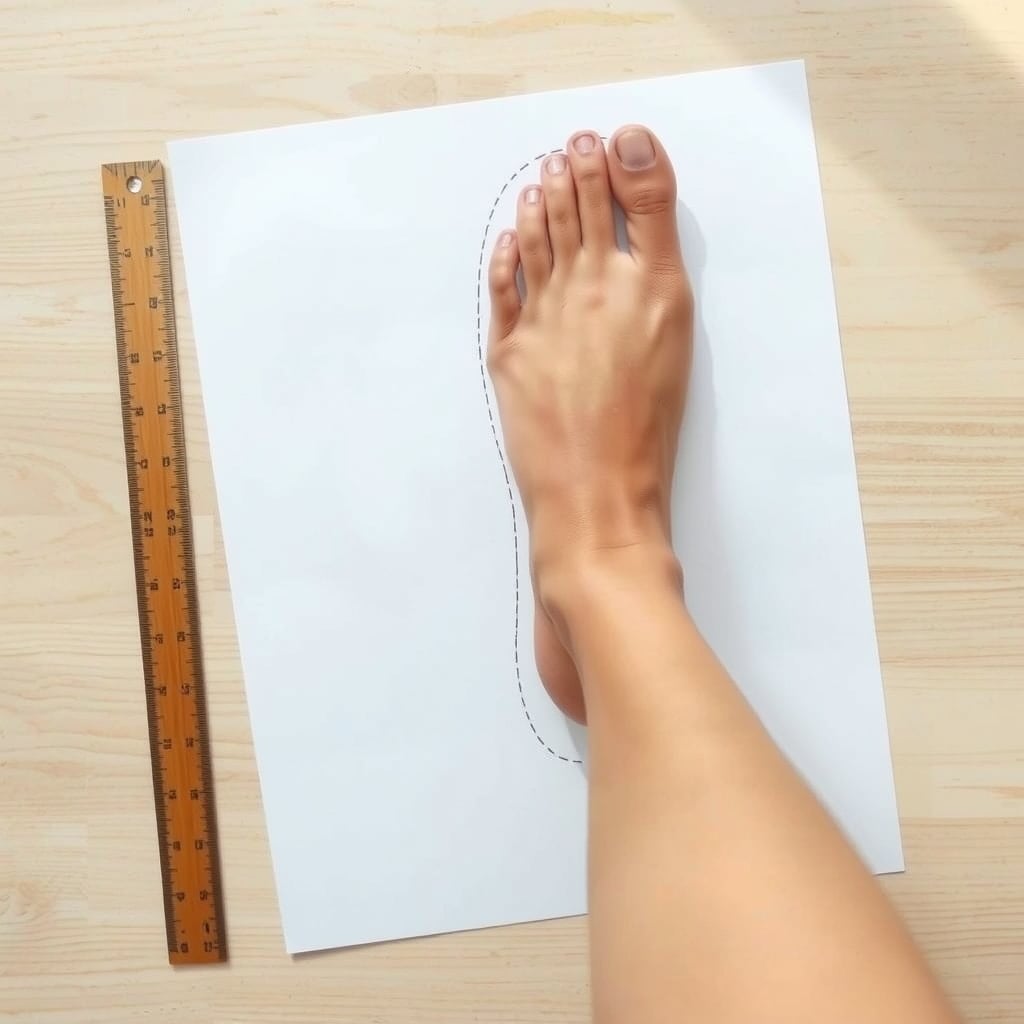
Step 2: Trace around your foot with a pen.
Have someone else trace the outline of your foot, or carefully trace it yourself by moving the pen around your heel, toes, and sides. Keep the pen perpendicular to the paper and as close to your foot as possible. Don’t press the pen into your foot or lift your foot during tracing an uneven outline will throw off your width measurement.
Step 3: Identify the widest point across your toes.
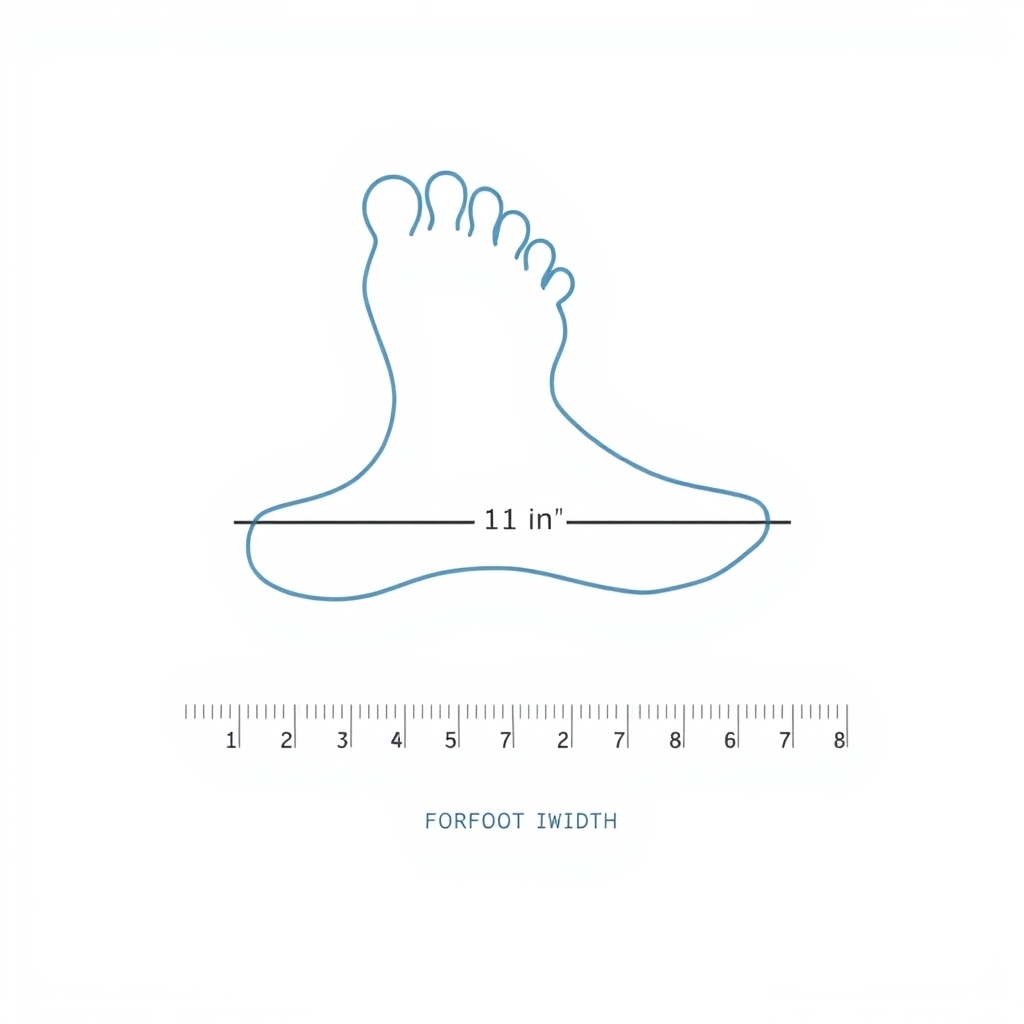
Once you’ve traced your foot, look at where your foot is widest. This is almost always across the ball of your foot the area just behind your five toes, where your foot naturally bulges outward. You’re not measuring the toes themselves; you’re measuring the forefoot width.
Step 4: Draw a straight line across the widest point.
Using your ruler, draw a horizontal line across the traced foot at its widest point. Make sure the line is straight and perpendicular to the length of your foot (which should be roughly vertical on your paper).
Step 5: Measure the distance in inches from side to side.
Using your ruler, measure the distance from the left edge of your trace to the right edge, crossing at the line you just drew. Write this number down (for example, 3.5 inches or 3.75 inches). This is your foot width in inches.
Step 6: Repeat on the other foot and use the larger measurement.
Most people have one foot slightly wider than the other. Repeat steps 1–5 on your other foot. If the two measurements differ, use the larger one when checking brand size charts. This ensures you don’t accidentally buy shoes that are too tight on your wider foot.
Step 7: Compare your width measurement to brand-specific charts.
Now go to the website of the shoe brand you want to buy from and find their size chart or width guide. Look for a row labeled “width at ball of foot” or “forefoot width” and find where your measurement falls. Each brand uses slightly different cutoffs a 3.5-inch width might be a “B” (standard) at one brand and a “C” (narrow) at another. That’s the whole reason you measured: to bypass the guesswork.
Understanding Shoe Width Letters and What They Mean
Shoe width is typically labeled with letters, though the exact standard varies by brand and country. Here’s what the main letters represent in most U.S. brands treat these ranges as typical starting points, not universal constants:
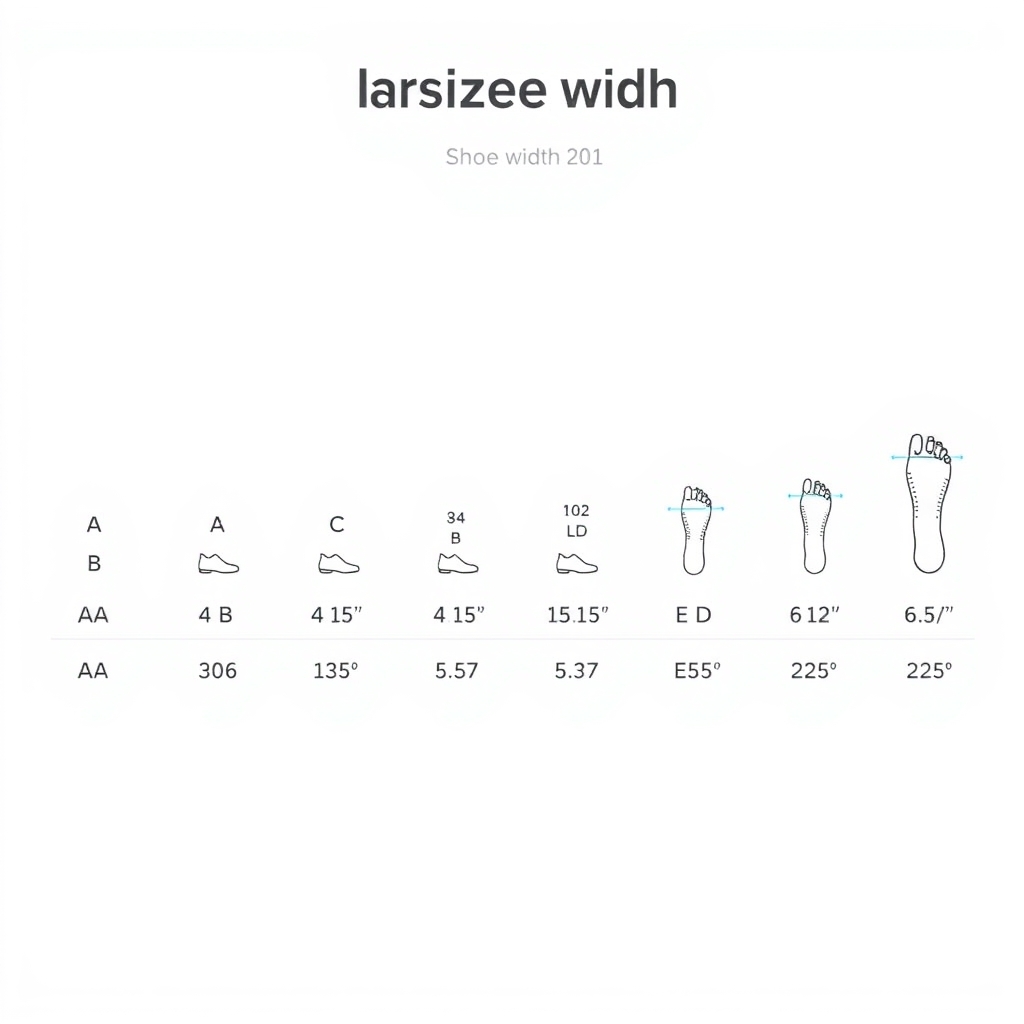
| Width Label | Meaning | Typical Forefoot Width* | Common in Stores? |
|---|---|---|---|
| AA / 2A | Extra-narrow | ~2.9–3.1 in | Rarely |
| A / 3A | Narrow | ~3.1–3.3 in | Occasionally |
| B | Standard / regular | ~3.3–3.5 in | Yes, widely |
| C / D | Medium / wide | ~3.5–3.7 in | Varies by brand |
| E / 2E | Wide | ~3.7–3.9 in | Sometimes |
| EE / 3E | Extra-wide | ~3.9–4.1 in | Rarely |
| EEE | Triple-extra-wide | ~4.1+ in | Very rarely |
*Ranges are approximate and vary by brand and shoe size. Always cross-reference against the specific brand’s published chart.
**The only reliable number is the one you measure and the one the brand you’re buying from publishes. Do not assume that a size D at Brand A is the same as a D at Brand B check their chart.
Common Mistake: Confusing Shoe Length with Width
The biggest error people make is measuring from heel to toe instead of side to side. Shoe length (heel to toe) and shoe width (side to side at the ball) are separate measurements** and both affect fit. A shoe can be the correct length but too narrow, or the correct width but a half-size too long. The width measurement is what determines whether your toes feel compressed or if there’s painful pressure on the sides of your foot. Length determines whether you have room in front of your toes or feel jammed against the toe box.
When you’re shopping, match both numbers to the brand’s chart. If the length and width don’t align (e.g., your length says size 9, but your width says wide), check the brand’s guide to see which size in that width best matches both.
The Non-Obvious Caveat: Width Varies by Shoe Type and Material
Even within one brand, width can feel different depending on the shoe style and material. A leather hiking boot stretches and softens over time, so it may feel tighter when new than a rigid synthetic running shoe of the same width label. Canvas shoes don’t stretch; leather shoes do. Slip-ons tend to feel more constrictive than lace-up shoes (because you can’t adjust lacing for a custom fit). Always check the product reviews for a specific shoe, not just the brand’s generic width chart. If 50 customers say a style runs narrow, it probably does regardless of what the width label says.
Also, your foot width can change slightly throughout the day. Your feet swell when you’ve been standing or walking, so measure in the afternoon or evening when your feet are at their largest, not first thing in the morning.
How to Find Shoes in Your Width: Where to Shop
Specialty Width-Focused Retailers
Some online and brick-and-mortar stores specialize in width options:
- New Balance (newbalance.com) consistently stocks widths from narrow to extra-wide across many styles; their site has a prominent width filter.
- Zappos (zappos.com) carries hundreds of brands and has a width filter in the search; free shipping both ways makes returns low-risk.
- ShoeBuy (shoebuy.com) wide selection of width options; filters by width are clear.
- Nordstrom (nordstrom.com) and Nordstrom Rack (nordstromrack.com) physical stores in many cities let you try on; online width filtering; knowledgeable fitting staff.
- Specialty athletic stores (Road Runner Sports, Fleet Feet, etc.) staff trained in gait analysis and width fitting; physical location for in-person fitting.
Brand-Specific Options
Most major shoe brands now offer at least one or two width options online, even if your local store doesn’t carry them:
- Nike (nike.com) widths available on select styles; check the product detail page.
- Adidas (adidas.com) some models available in narrow and wide.
- Clarks (clarks.com) one of the few traditional shoe brands with extensive width options; D (standard) and E/EE (wide) widely available.
- ASICS (asics.com) and Brooks (brooksrunning.com) athletic brands with solid width selection, especially in running shoes.
- Allen Edmonds (allenedmonds.com) men’s dress and casual shoes in B, D, and E widths; known for quality and custom fitting.
International and Direct-to-Consumer Brands
If you have a very wide or very narrow foot:
- Naturalizer (naturalizer.com) wide range of widths in casual and professional styles.
- Propét (propetusa.com) therapeutic and comfort shoes; strong in extra-wide options.
- SAS (San Antonio Shoemakers) (sasshoes.com) comfort shoes in multiple widths.
- Etonic (etonicshoes.com) focus on comfort and width accuracy.
Department Stores with Online Width Filters
- DSW (dsw.com) large inventory, clear width filter.
- Macy’s (macys.com) search by width; physical locations for trying on.
- Target (target.com) growing athletic and casual selection with width options.
How to Read Brand Width Charts Without Confusion
Brand width charts can look different, but they all contain the same core information. Here’s how to use one:
- Find the row for your shoe size length. Locate your size (e.g., size 9 or 9.5).
- Look at the width columns. Each column should be labeled with a width letter (B, C, D, E, etc.) or a width descriptor (narrow, standard, wide).
- Find the cell that matches your foot width measurement. If your foot is 3.6 inches wide and the chart says B width goes up to 3.5 inches and C width starts at 3.5 inches, choose C.
- Cross-reference with customer reviews. Once you’ve identified a size and width, read reviews of that specific shoe to see if other customers with similar feet found it comfortable or if they reported it running narrow or wide.
Many brands also publish a simple chart that just says “width at ball of foot: B = 3.1–3.4”, “C = 3.4–3.7”, etc. Use that to find your width letter, then look for that width in the specific shoe’s size chart.
Width and Fit: The Margin of Comfort
Once you’ve bought shoes in your measured width, here’s how to assess fit:
- At the ball of the foot: You should be able to wiggle your toes side to side slightly, but your foot shouldn’t slide inward or outward when you walk. If you feel pressure on the outside of your foot or if there’s obvious gap between your foot and the shoe’s sides, the width is wrong.
- At the heel: A shoe should grip your heel snugly without rubbing. If the shoe is too wide, your heel will slip; if it’s too narrow, it will pinch.
- In the arch: There should be light contact but no pressure that causes pain or cramping after an hour of wear.
Brand new shoes are often stiff and uncomfortable for the first few wears that’s different from being the wrong width. Give a shoe 3–5 wears before deciding it’s a poor fit, unless there’s acute pain (sharp, localized discomfort) rather than just tightness. Acute pain usually means the width is wrong; general stiffness usually softens with break-in.
Pro Tips for Online Shopping in Your Width
- Measure both feet and use the larger measurement. As noted above, asymmetry is normal.
- Check return policies before buying. Many online retailers offer free returns; use that to your advantage. Order in multiple widths if you’re unsure, then return what doesn’t fit.
- Buy from retailers with physical locations if possible. Zappos, Nordstrom, and DSW all have stores where you can try things on first.
- Read reviews filtered by width. Some review platforms (like Zappos) let you filter customer reviews by shoe width purchased; this is useful for figuring out if a style runs true to size or narrow/wide.
- Factor in material. Leather stretches; synthetics don’t. A tight leather shoe might loosen with wear; a tight synthetic shoe probably won’t.
- Don’t rely on “half-size up for wide” advice. Sizing up makes a shoe longer, not wider. If you need a wider width, order the correct width in your length don’t just upsize.
- Save your measurement. Once you’ve measured, keep the number somewhere (a notes app, a spreadsheet). The next time you shop, you won’t have to measure again.
FAQ: Shoe Width Questions Answered
Q: Is a D width the same at every brand? No. A D at New Balance might be roomier than a D at Nike. Always check the specific brand’s width chart and read reviews for the exact shoe model. Brands publish slightly different width cutoffs, and some shoes within a brand run narrow or wide depending on materials and construction.
Q: Can I size down if a shoe is too wide? Generally no sizing down makes a shoe shorter, which can make your toes feel cramped without actually solving the width problem. If a shoe is too wide, return it and order the correct width in your original length instead.
Q: My feet swell during the day. What width should I buy? Measure in the afternoon or evening when your feet are swollen, then buy based on that measurement. This ensures shoes that fit comfortably even at the end of a long day. If you only measured in the morning, you might buy shoes that become uncomfortably tight by evening.
Q: How do I know if a shoe’s width is wrong vs. just a bad break-in? A shoe with the wrong width will feel tight across the sides of your foot or at the ball, even after several wears. True break-in discomfort (stiffness in the heel or toe box) usually softens by wear 3–5. If pressure on the sides of your foot hasn’t eased by then, the width is wrong return it.
Q: Are shoes that come in multiple widths more expensive? Not necessarily. Brands like New Balance and Clarks offer wide and narrow options at the same price as standard widths. Some specialty retailers (like Allen Edmonds) charge more for custom fitting services, but basic width options usually cost the same.
Q: What’s the difference between “wide” (D/E) and “extra-wide” (EE/EEE)? In practice, a D or E width covers most people who describe themselves as having “wide feet.” Extra-wide (EE or EEE) is genuinely rare and usually only necessary if your forefoot measures 3.8 inches or more. Many online reviews conflate these; check the actual measurement in the brand’s chart, not just the review’s description.
Wrapping Up: The Measurement Is Your Shortcut to Fit
Measuring your foot width once takes five minutes and costs nothing but it’s the difference between ordering blind and ordering with actual data. Once you know your width in one brand, cross-check it against other brands you want to try. The measurement is consistent even when the letter labeling isn’t.
The thing shoe retailers don’t advertise loudly is that most people are wearing the wrong width because they’ve never measured. A well-fitting shoe in the right width feels effortless; a shoe in the wrong width pinches regardless of how good the brand or the reviews are. Measure, check the brand chart, read width-specific reviews, and buy with confidence.