
Who We Talked To, and the One Thing That Changed Our Approach
Sarah Chen is a residential interior designer based in the U.S. with over a decade of practice across renovation, new builds, and small-space problem-solving. She’s [work from home](https://keptlist.com/?p=1198)ed on projects ranging from 400-square-foot urban apartments to suburban family homes and she doesn’t separate “design” from “whether you can actually live in the space.” That distinction shapes everything in this interview.
The single most useful thing she said: **”Most people buy a lighting fixture and hope it solves a room. Instead, ask what you actually do in that space at 7 p.m. when it’s dark. Then light for that activity, not the fixture.” That one reframe activity before aesthetics appears in nearly every answer below.
Why Start With How You Actually Live
Casey: Before you touch paint or furniture, what’s the first question you ask a client?
Sarah: I ask them to walk me through a normal day. Morning coffee where are you standing? Evening wind-down where do you sit? Do you cook with your kids or alone? Do you work from home? Do you host dinner parties twice a year or twice a month? Most designers jump to “What’s your style?” I jump to “How do you live?” because that dictates everything that comes next. If you hate your morning because the kitchen is dim and cramped, no amount of beautiful tile fixes that.
Casey: So you’re saying function shapes the aesthetic, not the other way around?
Sarah:** Exactly. The aesthetic is the function, if it’s done right. A beautiful room is one where light hits your face the right way while you’re cooking, where you can have a conversation without yelling, where your kid can do homework without squinting. That’s beautiful design. It just happens to also be beautiful to look at.
The Cascading Question: Activity → Layout → Lighting
Once you understand how you live, the spatial questions follow logically. If you’re a solo cook, your layout is different from a family kitchen where three people might be moving around at once. If you work from home, your living room might double as an office which means lighting, noise, and sightlines matter differently.
Space Planning: The Invisible Architecture Most People Skip
Casey: Walk me through how you approach layout. A lot of readers have fixed walls and furniture they can’t move. Where do you start?
Sarah: Traffic patterns first. Stand in the doorway and imagine walking into the room on a normal evening. Where do your eyes naturally go? Where do your feet naturally want to walk? Now, don’t fight that design with it. If people naturally walk along the left wall to get to the couch, don’t put a console table there. That’s friction, and friction makes a room feel smaller and more annoying to live in.
Then zones. Even in an open plan, people need to feel distinct areas. A living room and a work zone aren’t separated by a wall they’re separated by a rug, a lighting shift, maybe a change in flooring. Your eye reads those boundaries, and your body relaxes because it knows, “Here I sit; there I work.”
Casey: So a rug is a spatial boundary, not decoration?
Sarah: It’s both, but the boundary is doing the real work. I’ve walked into living rooms where the furniture is scattered randomly, and it feels chaotic even though it’s minimalist. I’ve walked into cluttered rooms where a single large rug and thoughtful furniture arrangement made everything feel intentional and calm. The rug anchors the conversation area. It says, “This zone is for sitting together.” That’s spatial planning.
The Three Zones Everyone Needs (Even in Small Spaces)
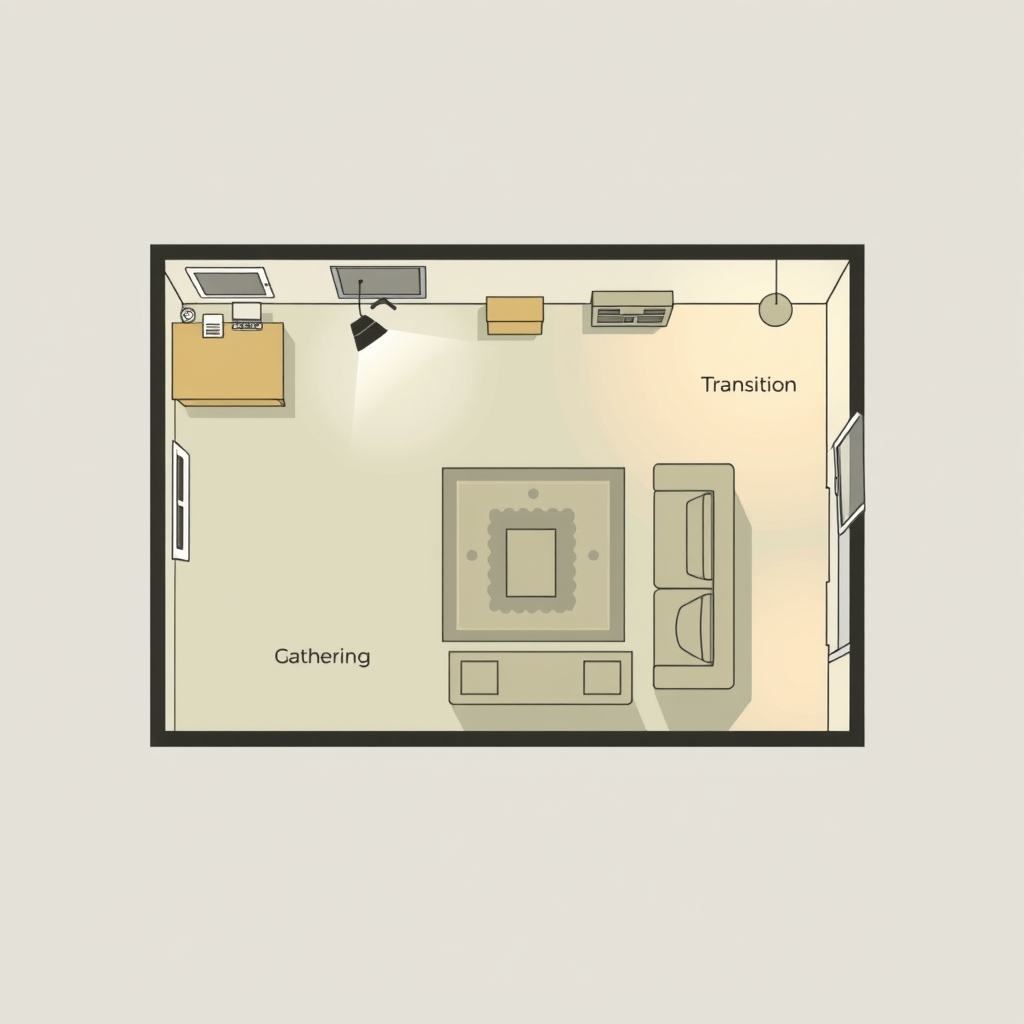
Based on patterns Sarah sees across residential projects, most homes benefit from three functional zones:
- The Activity Zone: Where you work, cook, or create (highest task lighting, often highest traffic)
- The Gathering Zone: Where you sit together (softer light, sightlines matter, acoustics matter)
- The Transition Zone: Entryways, hallways, the paths between (adequate light so you don’t stub your toe, but not so bright it feels institutional)
Each zone can be in the same room or separated; the principle is the same. Once you’ve named your zones, lighting and furniture placement follow naturally.
Lighting Design: The Underrated Workhorse
Casey: Let’s talk about lighting, because I think most people get this catastrophically wrong. Walk me through your process.
Sarah: Three layers: ambient, task, and accent. Most people choose a ceiling fixture and stop. That’s like choosing a single tool for a toolbox.
Ambient is your baseline the light in the room when nothing else is on. Task is specific to what you’re doing: reading, cooking, applying makeup. Accent is mood and focus a wall sconce that highlights art, or a table lamp that makes a corner inviting.
Casey: So a living room needs all three?
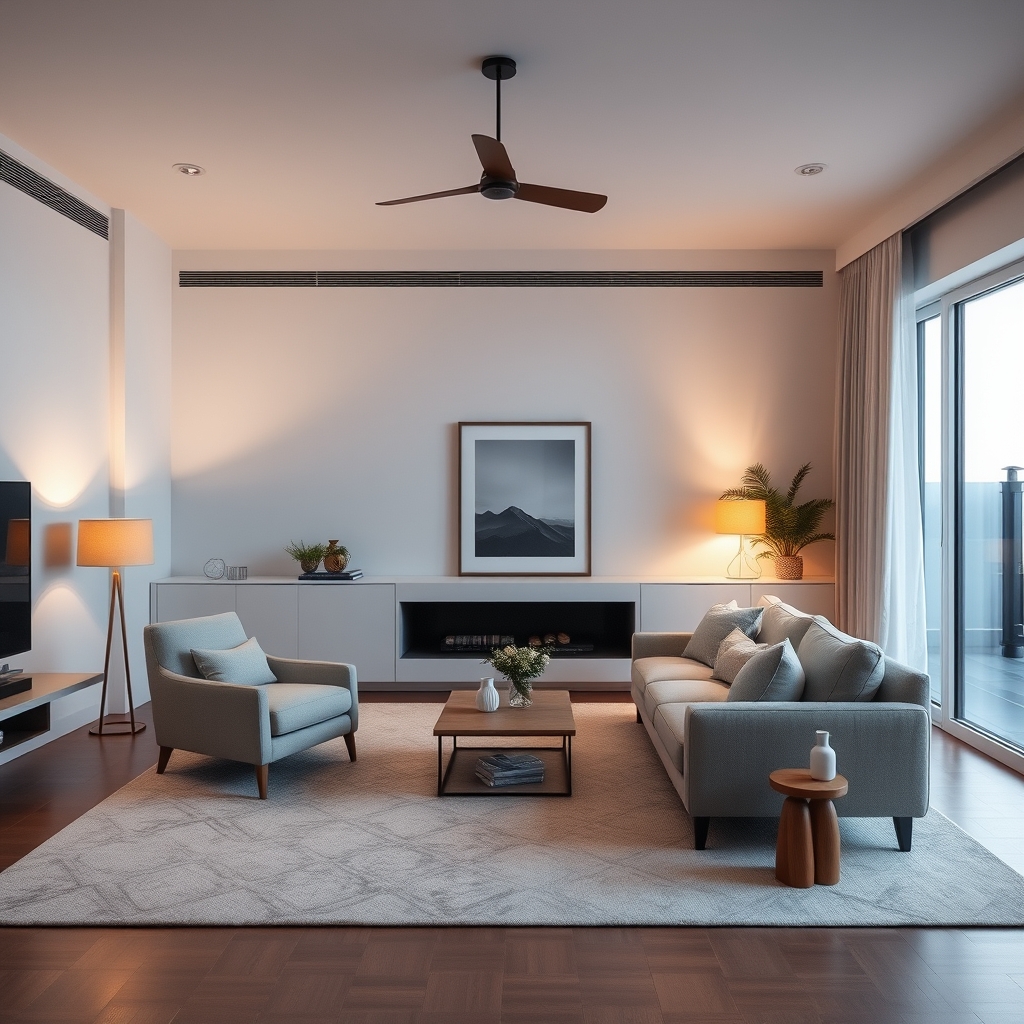
Sarah: Yes. Ambient might be a dimmable ceiling fixture or recessed lights. Task is a reading lamp by the chair, maybe a table lamp on a console. Accent could be uplighting behind a painting or a pendant that’s more sculptural than bright. When you layer them, you’re not choosing one light color or one brightness you’re building flexibility. On a Tuesday evening when you’re exhausted, you dim the ambient and turn on one reading lamp. On Saturday when friends are over, everything is on, and the room feels alive. Same room, three different moods.
Room-by-Room Lighting Strategy
Kitchen Lighting (where visibility is non-negotiable):
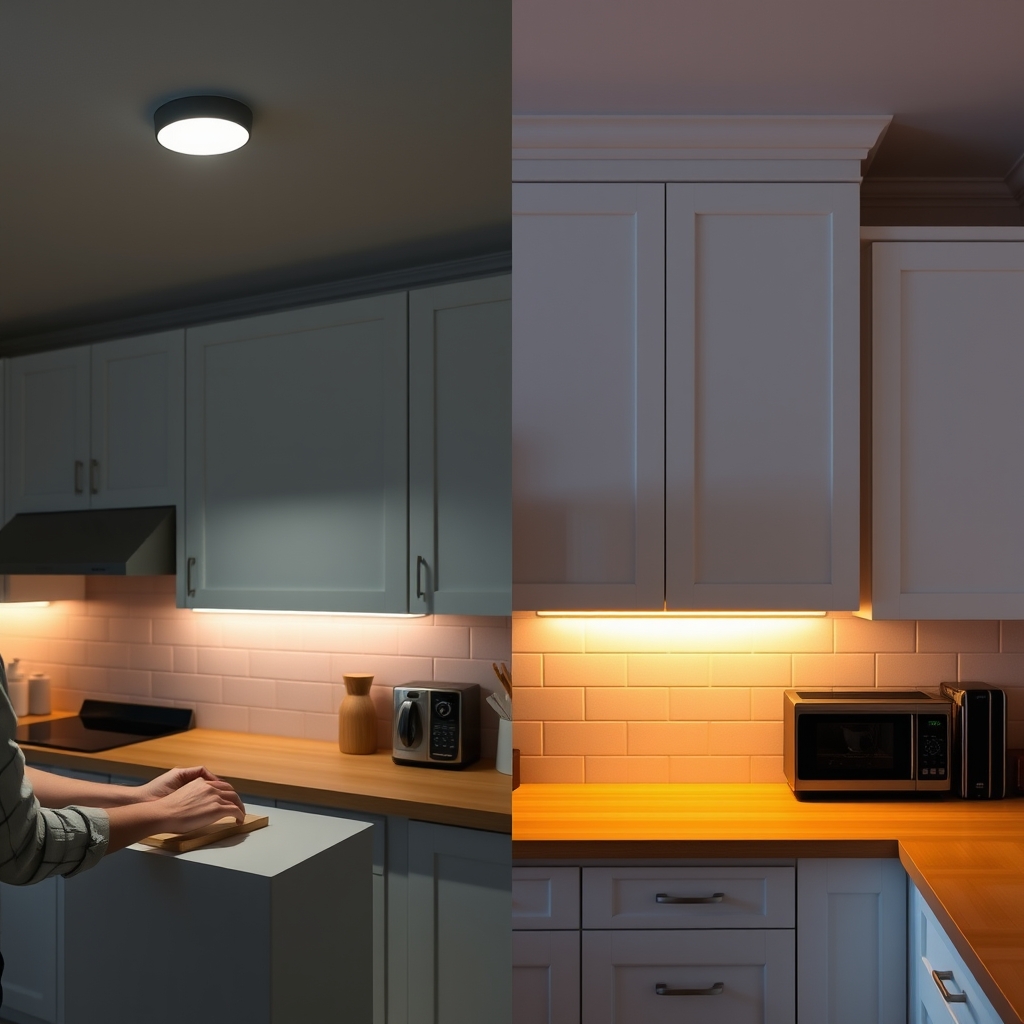
- Ambient: Recessed lights or a bright ceiling fixture (or both), positioned to avoid casting shadows on the counter where you prep food
- Task: Under-cabinet lights aimed at the counter (this single addition fixes more kitchens than any other change Sarah makes)
- Accent: Optional pendant lights over an island, more for aesthetics and defining the space than for function
Common mistake: a single center ceiling light. You stand at the counter and your own shadow blocks your work. Under-cabinet lights fix it instantly.
Bedroom Lighting (where dimmers are your friend):
- Ambient: Soft ceiling light or bedside lamps (dimmable if possible; you’re winding down)
- Task: A strong reading light on each side of the bed, on a dedicated switch or controllable separately from ambient
- Accent: Optional wall sconces or a small accent light that’s more for mood than visibility
The mistake: a single bright overhead. You’re trying to sleep, not do surgery.
Living Room Lighting (where flexibility matters most):
- Ambient: Dimmable central light or layered recessed lights
- Task: Reading lamps, table lamps, even a floor lamp in a corner (these give you the ability to create a reading nook without building a new zone)
- Accent: Whatever draws you in a framed print with a picture light, a sculptural lamp you love, uplighting on a dark wall
Bathroom Lighting (where shadow-free vanity light is critical):
- Ambient: Bright, even light from the ceiling
- Task: Vanity lighting on both sides of the mirror (this is non-negotiable; a single overhead casts shadows on your face)
- Accent: Rarely needed; functionality dominates
Casey: What’s the cheapest way to improve bad lighting without rewiring?
Sarah: Plug-in task lights. A $30 reading lamp by a dark corner transforms it. Under-cabinet battery-operated lights are $20–$40 and look built-in. If you rent or can’t hardwire, these are your cheat codes. And dimmers a $15 smart bulb that dims means you’re not buying three separate lamps.
Balancing Beauty and Function: The False Trade-Off
Casey: I think a lot of readers feel like they have to choose between a room that looks good and a room that works. How do you avoid that trap?
Sarah: It’s a false choice. Function is part of beauty. A room that works where you can cook without squinting, sit without craning your neck, move without tripping feels beautiful because your body is comfortable. A room that looks beautiful but doesn’t work? You resent it. You resent the designer, you resent the choices you made.
The way I avoid it: I ask “Does this choice make the room more pleasant to live in or less?” If you love a white marble coffee table but you have two toddlers, that’s not beautiful that’s stress. A durable, easy-to-clean alternative that lets you relax? That’s beautiful.
Casey: Give me a concrete example.
Sarah: Area rugs. A beautiful, expensive rug that shows every footprint and requires constant vacuuming creates tension every time someone walks on it. A rug in a durable, forgiving color grays, warm taupes, patterns with texture that you can actually use? It’s more beautiful because it’s more livable. Same square footage, same color family, completely different emotional experience.
Or lighting again: You can choose a stunning but dim pendant light, and then you’re eating dinner in a dark room. Or you choose a pendant plus supplemental lighting that’s subtle. The room looks just as beautiful, and you can actually see your food.
The Budget-Conscious Approach
Casey: How do you balance functional design with a tight budget?
Sarah: Prioritize ruthlessly. You need good light, comfortable seating, and a clear layout. Everything else is secondary. If your budget is limited, spend on lighting (labor and fixtures), invest in a good sofa (you sit there 4+ hours a day), and pick paint or flooring that’s durable and forgiving. Accessorize slowly with things you actually love, not things that fill space.
I’d rather see a room with four pieces of furniture and excellent lighting than a room stuffed with cheap furniture and bad light. The first one feels calm and livable. The second feels chaotic.
Casey: Specific dollar ranges?
Sarah: Based on projects I’ve worked on, retrofitting functional ambient lighting recessed lights or a quality ceiling fixture has typically run clients $300–$800 including labor, though that varies a lot by region and contractor. Task lighting (reading lamps, under-cabinet) tends to fall in the $50–$300 range depending on whether you’re hardwiring or going battery-operated. For a sofa that’s genuinely durable and comfortable, I’ve seen people find what they need in the $600–$1,500 range. Paint and primer runs roughly $100–$400 for a bedroom or living room. Flooring or a large area rug, somewhere in the $500–$2,000 range. If you’re starting a room from scratch on a modest budget, my observation from working with clients is that $2,000–$3,500 can get you a functional, attractive room lighting, a rug or flooring, a sofa, and one accent piece. Add from there over time.
Small Spaces: Spatial Planning’s Hardest Test
Casey: You mentioned you’ve done a lot of small apartments. What’s the biggest mistake people make?
Sarah: They treat it like a tiny version of a big room. A 300-square-foot studio needs different thinking. You can’t have a separate living room, bedroom, and office so you need zones that shift based on time of day. A sofa that faces a bed. A desk that doubles as a dining surface. Lighting that changes the perceived purpose of the space.
In a small space, your furniture is your wall. A tall bookshelf creates a visual boundary between a sleeping area and a sitting area just like a wall does. A console table signals, “This is the entry.” Lighting that shifts from bright (office mode) to warm (living mode) makes a 300-square-foot space feel like two rooms.
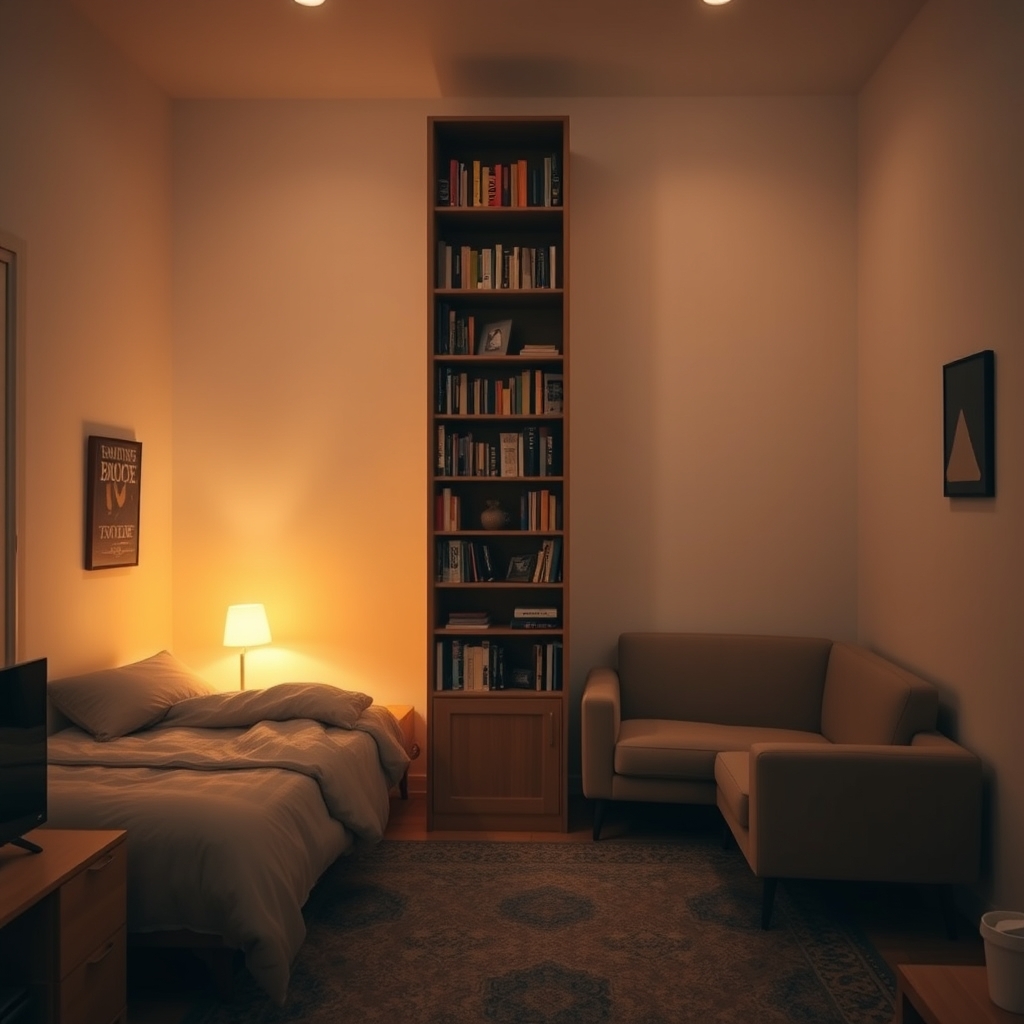
Casey: Specific layout tactics?
Sarah: Float your furniture. Don’t push everything against the wall it makes the room feel smaller and less inviting. Put your sofa 18 inches from the wall, define it with a rug, and suddenly the room feels intentional. Use vertical space: tall, narrow bookshelves, hanging storage, wall-mounted desk. In a small space, height makes it feel bigger because your eye travels up.
Light colors and mirrors help, but they’re overrated. What actually works is ruthless decluttering and clear zones. A small room with four pieces of well-chosen furniture and excellent lighting feels spacious. A small room crammed with furniture and bad light feels claustrophobic no matter how light the paint is.
What This Means If You’re Buying Lights, Furniture, or Planning a Room
If you take nothing else from this interview, take these three moves:
- Walk through your space at the time of day you use it most. If you hate your kitchen at 7 a.m., that’s the problem to solve, not the color of the cabinets. Light the activity, not the room.
- Layer your lighting. Ambient, task, accent. This one change adding a single reading lamp or under-cabinet lights fixes more rooms than any other single intervention Sarah makes.
- Choose furniture that fits how you live, not how magazines say you should live. If you have pets, light fabrics are a trap. If you work from home, your sofa needs to support your back. If you entertain rarely, don’t design for parties.
Disclosure: This site earns a commission on purchases made through some links on this page. That doesn’t change what we recommend but you should always comparison-shop. On lamps in particular: two $40 task lamps from different brands can produce completely different light quality. Buy one, try it for a week, return it if it’s not right. That’s cheaper than guessing.
FAQ: The Questions Readers Actually Ask
Q: Should I hire an interior designer, or can I do this myself? A: If you’re confident in layout and lighting, DIY is absolutely viable these are learnable skills. If you’re paralyzed by choice or your space feels off but you can’t name why, a single consultation (Sarah estimates $200–$400 for a one-session review based on her own practice, though rates vary by designer and market) can pay for itself in mistakes avoided. You don’t need a full design engagement; you need a second set of eyes on traffic flow and light.
Q: Is modern or traditional interior design more livable? A: Livability isn’t about style; it’s about whether the space functions for your life. A traditional room with bad lighting and awkward furniture is just as frustrating as a modern one. Pick the aesthetic you love, then apply functional principles to it.
Q: What’s the quickest, cheapest way to make a room feel bigger? A: Good lighting and one large rug. These two things create definition and draw the eye around the room. A third option: remove three pieces of furniture you don’t absolutely love. Emptiness reads as spaciousness more reliably than any design trick.
Q: Can I have a beautiful room on a student or single-income budget? A: Yes. Invest in light, one really good sofa, and let everything else come slowly. A dim room with expensive art is worse than a bright room with $20 prints. A lumpy sofa is worse than a floor cushion. Function first, beauty second and you’ll spend less overall because you won’t buy things twice.
Q: How do I know if a lighting choice is actually good or just trendy? A: Live with it for a month. If you’re still reaching for it and it makes you happy when you use it, it’s good. If you’re constantly wishing it were brighter, dimmer, or somewhere else, it’s trendy. Trust your actual experience, not the photo on Instagram.
Interior Design Tips: The Takeaway
The most livable rooms aren’t the ones that photograph best they’re the ones that fit your actual life. Space planning, lighting design, and functional aesthetics aren’t constraints on beauty; they’re the foundation for it. Ask how you live, light for the activities you do, and choose pieces that work for your body and your schedule. The beauty follows.
Sarah’s closing thought: “A room that works is always beautiful. A room that doesn’t work is never beautiful, no matter what it looks like.”